Basque Cheesecake
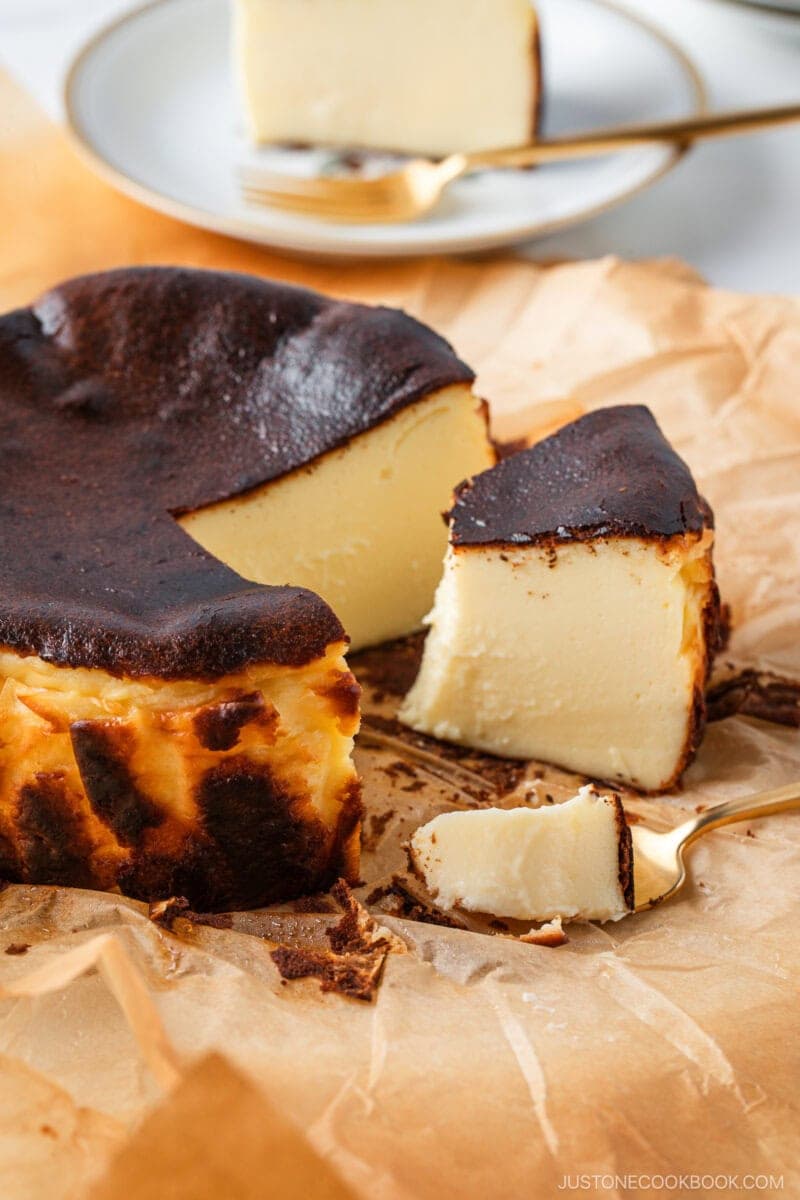
Basque Cheesecake recipe made easy at home! Master the caramelized top and creamy center with simple tips for a foolproof showstopper everyone will love.
- Total time
- 1 hr
- Active time
- 25 min
- Yield
- 1, 1 6-inch cake
- Difficulty
- Medium
Ingredients and Constraints
Ingredients
Ingredient watchpoints2 watchpoints
Short requirements and tradeoffs to check while gathering ingredients; detailed source notes stay expandable.
Eggs
3 large eggs (50 g each w/o shell) ((at room temperature))
The source row includes a form, size, temperature, preparation, or handling detail.
Details and source
Source: Basque Cheesecake バスクチーズケーキ
Heavy Cream
1 cup heavy (whipping) cream ((at room temperature))
The source row includes a form, size, temperature, preparation, or handling detail.
Details and source
Source: Basque Cheesecake バスクチーズケーキ
Additional ingredient notes
Ingredients for Basque Cheesecake
You’ll need a 3-inch deep 6-inch round cake pan with removable bottom, which is perfect for 6 people.
How to Make Basque Cheesecake
Preheat the oven for at least 30 minutes so it’s fully hot.
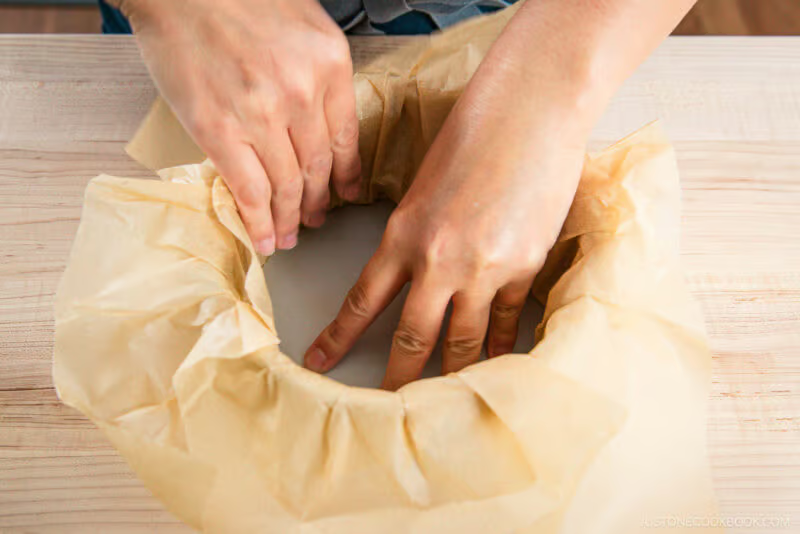
Bring the cream cheese, eggs, and heavy cream to room temperature for easy mixing. Line a deep 6-inch round cake pan or springform pan completely with sheets of parchment paper, folding the excess down over rim.
Show 4 more media items
For Prepping:
It’s important to heat the oven for at least 30 minutes.
A very hot oven is essential to properly caramelize the top. Use convection bake (oven with fan) to achieve a glossy brown top.
For Batter & Mixing:
Smooth the batter early.
Press and rub the cream cheese with a silicone spatula while the batter is still thick. Scrape down the bowl and spatula often—lumps are much harder to fix once the batter becomes liquid.
For Cooling & Serving:
Let the cake cool on a wire rack.
As it cools, it will sink slightly and continues to set from the residual heat. Once it reaches room temperature, refrigerate it.
Ingredients US CUSTOMARY METRIC 1X 2X 3X
1 lb cream cheese (226 g x 2 blocks for 1 6-inch cake; I used Philadelphia brand; at room temperature) 3 large eggs (50 g each w/o shell) (at room temperature) 1 cup heavy (whipping) cream (at room temperature) 2 Tbsp cake flour (or use all
Before You Cook
Constraints, controls, and warnings to review before starting.
Decisions before cookingDetails1
Reviewed comparisons and tradeoffs that affect the path before the first active step.
Can I use a larger cake pan?
Yes, but please scale the recipe as a wider pan spreads the batter thinner, which can affect how the top browns.
Multiply the recipe by 1.5 for a 7-inch pan or by 2 for an 8-inch pan, both at least 3 inches deep. Baking time will increase depending on your oven.
Method Overview
Structured method notes that are separate from the step timeline.
Recipe Highlights
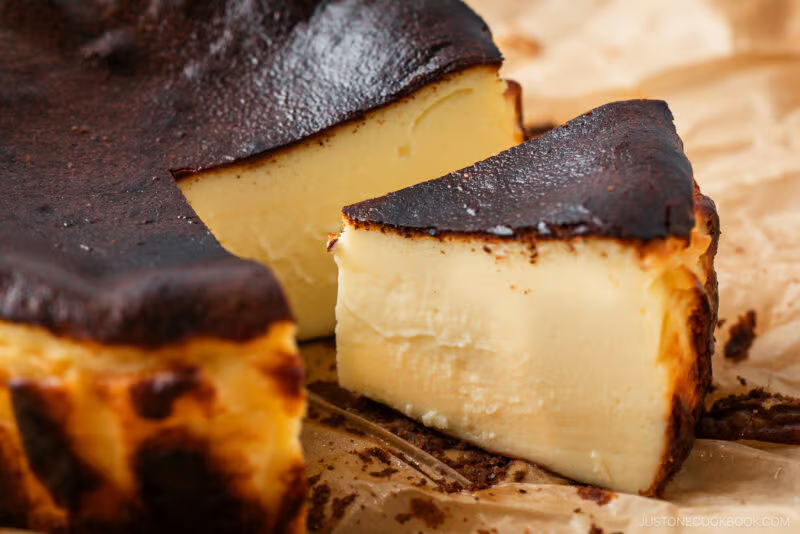
This Basque Cheesecake may look bold and dramatic, but it’s one of the easiest cheesecakes you can bake at home.
With no crust and simple ingredients, it relies on high heat to create its signature dark top while keeping the center creamy and custardy. After testing many versions, I found the balance that delivers a deeply caramelized exterior with a dreamy, smooth center. fuss-free – no crust, no water bath creamy center with a rich, caramelized exterior beginner-friendly recipe with simple ingredients If you love cheesecakes, try my Japanese Cheesecake, Matcha Basque Cheesecake, and Baked Cheese Tarts recipes next!
For Baking:
It’s a fact: Every oven is different.
Even if you follow my recipe to a T, you may not get the exact same texture. Use your judgment and watch closely as you bake.
Why isn’t my Basque cheesecake browning on top?
This usually means the oven was not hot enough.
Preheat for 30 minutes (or longer) and use the convection setting if you have one. Baking on a higher rack can also help, but avoid opening the oven door since heat loss affects browning.
My Basque cheesecake is browning too fast.
Every oven is different, so you may need to adjust the oven temperature.
Even if you follow the recipe exactly, the color and texture can vary. Watch the cake closely as it bakes.
Method Timeline
Prep
ActivePrep
25 min
Prep time from the source recipe card.
Cook
ActiveCook
35 min
Cook time from the source recipe card.
Total
PassiveTotal
1 hr
Total time from the source recipe card.
Step 1
Please note that this cake requires 2–3 hours of cooling time. You can serve it either at room temperature or chilled in the refrigerator for an additional 4 hours.
Step 2
Gather all the ingredients.
Step 3
Preheat a convection oven (with fan) to 450ºF (230ºC) for at least 30 minutes. If you don’t have convection, preheat a conventional oven to 475ºF (245ºC). If your oven doesn’t heat up very well, preheat it at the hottest temperature (mine is 550ºF/290ºC) for 30–60 minutes, then turn it down to 475ºF (245ºC) when it's time to bake. Oven rack: I used my convection oven's middle rack, as it's ideal position for the fan to circulate the air. If you use a conventional oven, move the rack slightly higher as the temperature toward the top is hotter. Keep in mind that a 3-inch deep cake pan needs extra space for rising.
Step 4
Gather one 6-inch (15-cm) round cake pan with removable bottom. Prepare two rectangular sheets of parchment paper long enough to hang over the sides of the pan by 2 inches (5 cm). Place them crisscross to make sure they cover all inside surfaces of the pan. (Or use one sheet if your paper is extra wide.) Fold each sheet in half, then again into quarters, like a paper napkin.
Step 5
Unfold the sheets and place them crisscross as before. Find the center point where the creases intersect. Center the parchment sheets over the cake pan ring, then center the removable bottom on top.
Step 6
Press them down into the cake pan, using the removable bottom to crease the paper into the pan and against the insides for a snug fit. Press and crease the paper edges down around the outside of the cake pan, too.
Step 7
Gently take out the removable bottom and parchment sheets, now molded to the shape of the pan. Place the removable bottom back into the cake pan (as it should be). Then, fit the molded paper into the pan and press it down to fit snugly. (If you‘re doubling the recipe, repeat with a second cake pan.)
Step 8
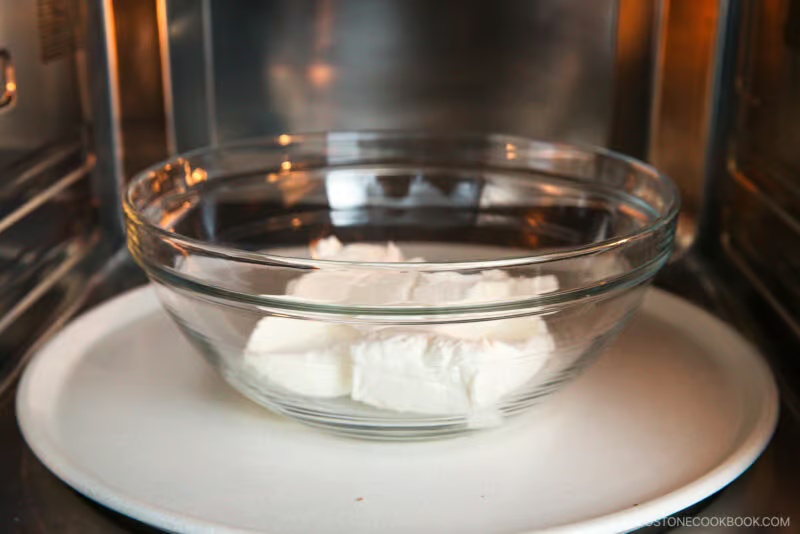
Place 1 lb cream cheese in a large bowl. Make sure the cream cheese is at room temperature. Nami's Tip: If the cream cheese is cold and firm, microwave it at half power (50%) in 15-second increments until it‘s room temperature (about for 45 seconds).
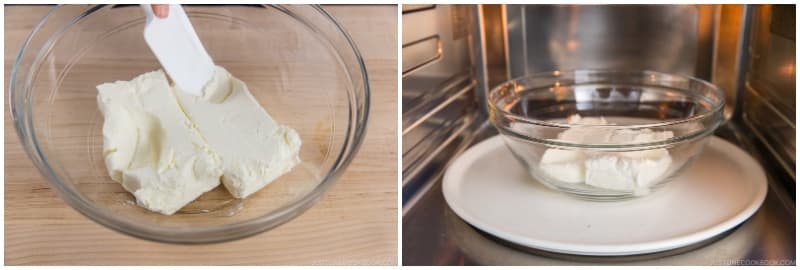
Image detailsPlace 1 lb cream cheese in a large bowl. Make sure the cream cheese is at room temperature.Nami's Tip: If the cream cheese is cold and firm, microwave it at half power (50%) in 15-second increments until it‘s room temperature (about for 45 seconds).Just One Cookbook · Basque Cheesecake バスクチーズケーキDev reference Visual cue
until it‘s room temperature (about for 45 seconds).
Checks2
Visual cueInfoVisualuntil it‘s room temperature (about for 45 seconds).
Expected state: until it‘s room temperature (about for 45 seconds).
TimingInfoTimingfor 45 seconds
Target: 1 minute
Expected state: Nami's Tip: If the cream cheese is cold and firm, microwave it at half power (50%) in 15-second increments until it‘s room temperature (about for 45 seconds).
Inputs and tools2
Uses
- 1 lb cream cheese
- 1 cup heavy (whipping) cream ((at room temperature))
Why and source
This step has reviewed source-backed guidance.
- Source: Basque Cheesecake バスクチーズケーキ
Step 9
Press down on the cream cheese with a silicone spatula to soften it. Then, add ½ cup sugar. (For the blender method, scroll down to the next section.) Nami's Tip: A silicone spatula makes the batter is super smooth with fewer air bubbles.
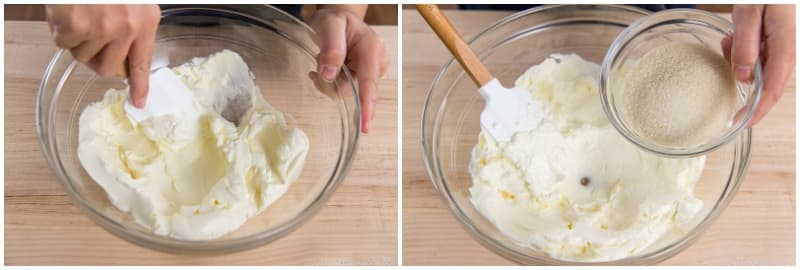
Image detailsPress down on the cream cheese with a silicone spatula to soften it. Then, add ½ cup sugar. (For the blender method, scroll down to the next section.)Nami's Tip: A silicone spatula makes the batter is super smooth with fewer air bubbles.Just One Cookbook · Basque Cheesecake バスクチーズケーキDev reference Inputs and tools1
Uses
- ½ cup sugar
Step 10
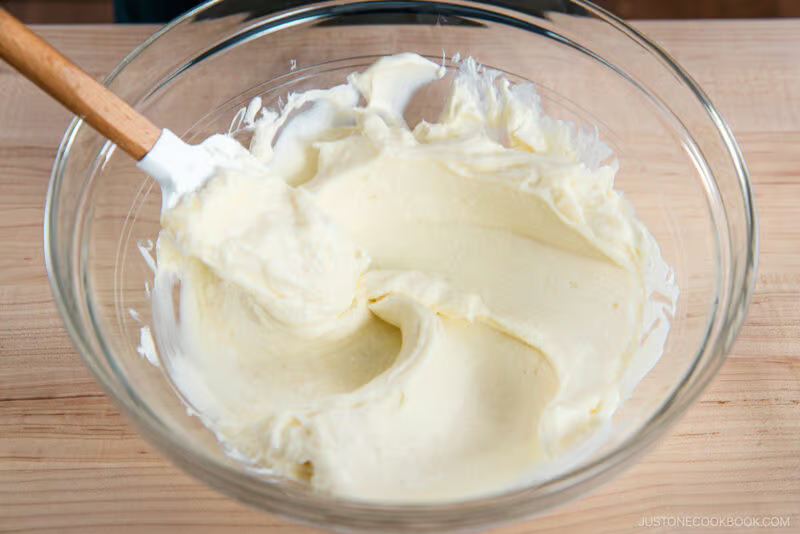
Rub the mixture with the silicone spatula against the sides of the bowl to combine. The cream cheese will become fluffy and smooth as the sugar granules dissolve.
Step 11
Frequently scrape the bowl and spatula to incorporate the ingredients well and prevent lumps. Nami's Tip: Get rid of lumps early, as it's harder to do when the batter is more liquid.
Step 12
Crack 3 large eggs (50 g each w/o shell) in another bowl and whisk well. Nami's Tip: Whisking in a separate bowl is extremely helpful for blending, instead of cracking eggs one at a time into the cream cheese.
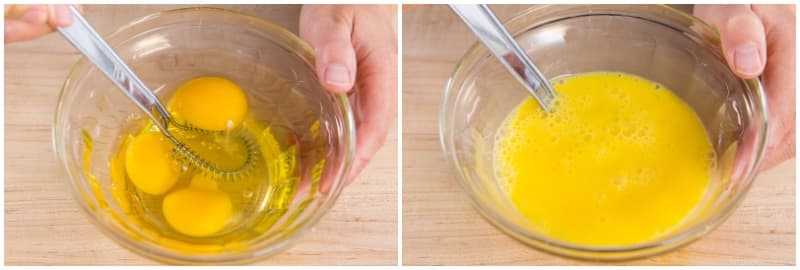
Image detailsCrack 3 large eggs (50 g each w/o shell) in another bowl and whisk well.Nami's Tip: Whisking in a separate bowl is extremely helpful for blending, instead of cracking eggs one at a time into the cream cheese.Just One Cookbook · Basque Cheesecake バスクチーズケーキDev reference Inputs and tools1
Uses
- 3 large eggs (50 g each w/o shell) ((at room temperature))
Step 13
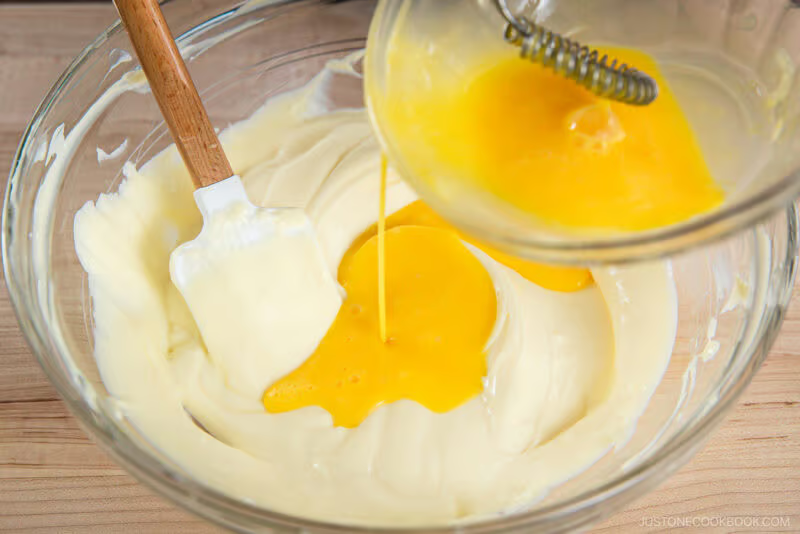
Slowly and gradually add the beaten eggs to the cream cheese mixture, one-third at a time. Make sure the batter is smooth and with no lumps before adding more egg.
Step 14
After each addition, blend the eggs with the cream cheese THOROUGHLY and COMPLETELY.
Step 15
Add the rest of the egg and blend well.
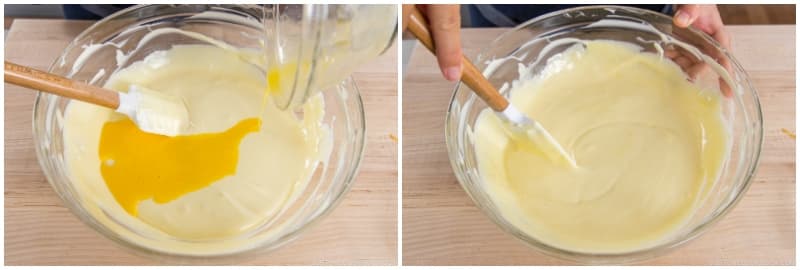
Image detailsAdd the rest of the egg and blend well.Just One Cookbook · Basque Cheesecake バスクチーズケーキDev reference Checks1
HoldingMain recipeSource holding instruction
Add the rest of the egg and blend well.
Why and source
This step has reviewed source-backed guidance.
- Source: Basque Cheesecake バスクチーズケーキ
Step 16
Occasionally scrape off the batter from the bowl and the spatula. This will help prevent lumps in the batter. Then, add 1 Tbsp lemon juice and mix thoroughly.
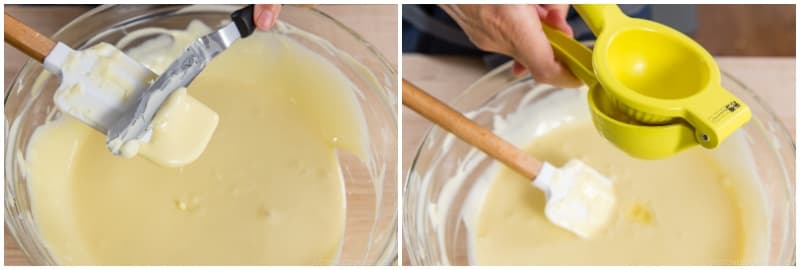
Image detailsOccasionally scrape off the batter from the bowl and the spatula. This will help prevent lumps in the batter. Then, add 1 Tbsp lemon juice and mix thoroughly.Just One Cookbook · Basque Cheesecake バスクチーズケーキDev reference Inputs and tools1
Uses
- 1 Tbsp lemon juice
Step 17
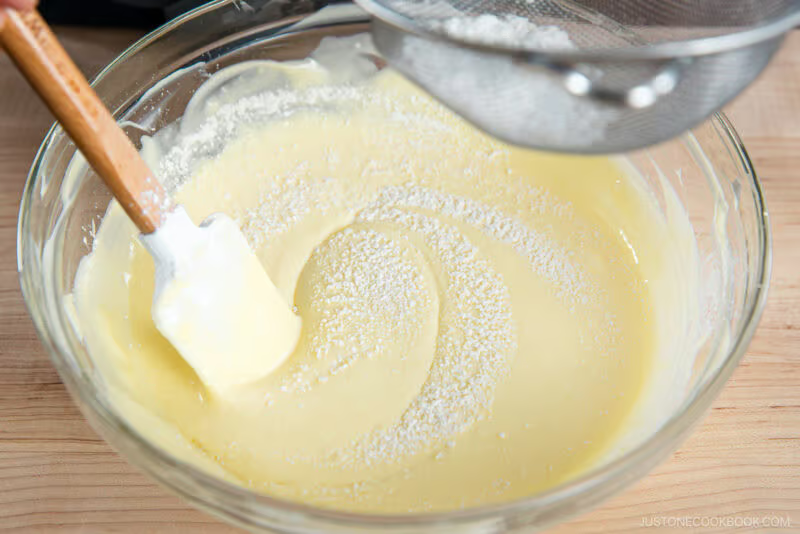
Next, add 2 Tbsp cake flour and 2 tsp cornstarch to a sieve. Sift a little bit of the flour and cornstarch into the cream cheese mixture while you stir with a spatula. Incorporate the ingredients well before adding more. Keep sifting and blending until you‘ve added all the flour mixture. Take your time doing this. You don’t want any lumps.
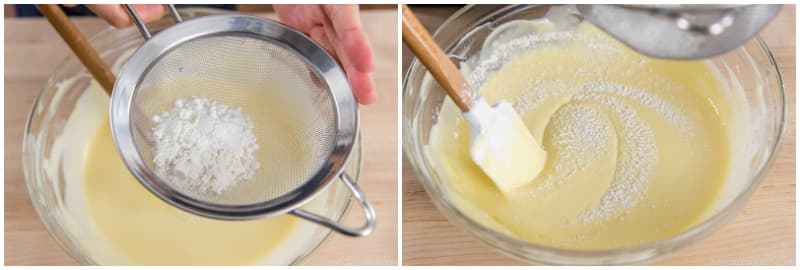
Image detailsNext, add 2 Tbsp cake flour and 2 tsp cornstarch to a sieve. Sift a little bit of the flour and cornstarch into the cream cheese mixture while you stir with a spatula. Incorporate the ingredients well before adding more. Keep sifting and blending until you‘ve added all the flour mixture. Take your time doing this. You don’t want any lumps.Just One Cookbook · Basque Cheesecake バスクチーズケーキDev reference Visual cue
until you‘ve added all the flour mixture.
Checks1
Visual cueInfoVisualuntil you‘ve added all the flour mixture.
Expected state: until you‘ve added all the flour mixture.
Inputs and tools2
Uses
- 2 Tbsp cake flour
- 2 tsp cornstarch ((or use potato starch or cake flour))
Why and source
This step has reviewed source-backed guidance.
- Source: Basque Cheesecake バスクチーズケーキ
Step 18
Add ⅛ tsp Diamond Crystal kosher salt and blend together. Make sure there are no lumps at this stage (before adding the heavy cream--more liquid).
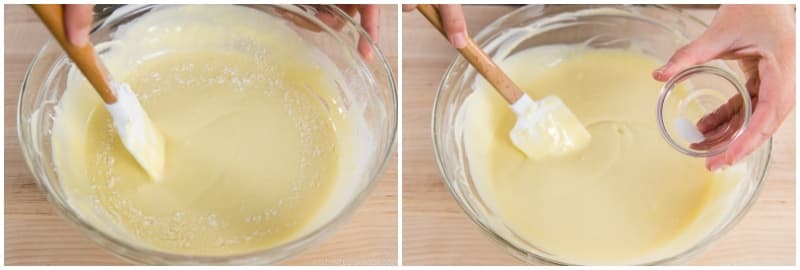
Image detailsAdd ⅛ tsp Diamond Crystal kosher salt and blend together. Make sure there are no lumps at this stage (before adding the heavy cream--more liquid).Just One Cookbook · Basque Cheesecake バスクチーズケーキDev reference Inputs and tools1
Uses
- ⅛ tsp Diamond Crystal kosher salt
Step 19
Gradually add 1 cup heavy (whipping) cream while you stir. Mix until it’s all combined.
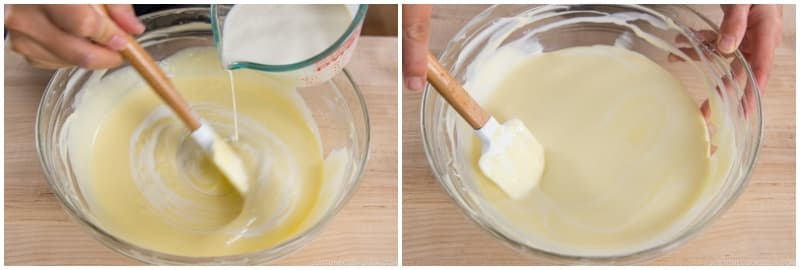
Image detailsGradually add 1 cup heavy (whipping) cream while you stir. Mix until it’s all combined.Just One Cookbook · Basque Cheesecake バスクチーズケーキDev reference Visual cue
until it’s all combined.
Checks1
Visual cueInfoVisualuntil it’s all combined.
Expected state: until it’s all combined.
Why and source
This step has reviewed source-backed guidance.
- Source: Basque Cheesecake バスクチーズケーキ
Step 20
Put all the ingredients for the cake batter in a blender (I use my Vitamix): 1 lb cream cheese, ½ cup sugar, 3 large eggs (50 g each w/o shell), 1 Tbsp lemon juice, 2 Tbsp cake flour, 2 tsp cornstarch, ⅛ tsp Diamond Crystal kosher salt, and 1 cup heavy (whipping) cream. Blend until very smooth, about 2 minutes. Then, let this mixture rest for 15 minutes to let the air bubbles in the batter settle, or else the cake may crack.
2 min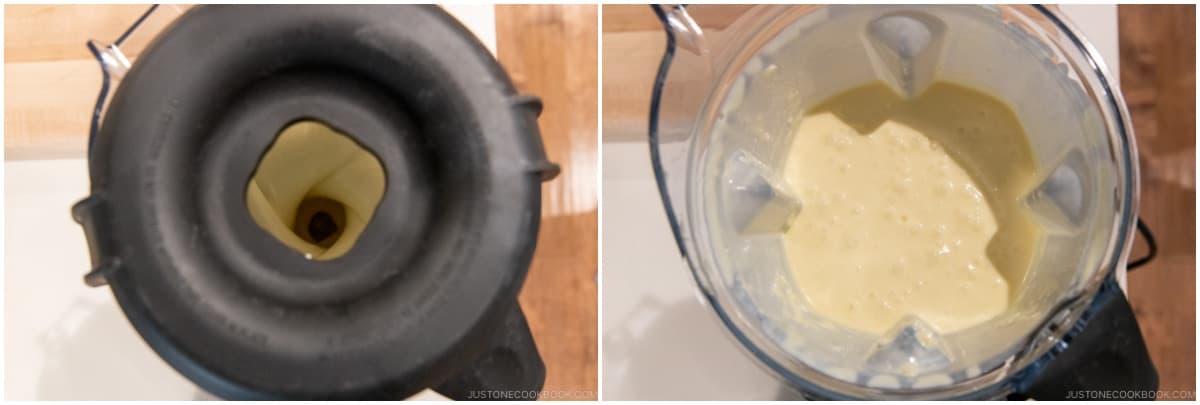
Image detailsPut all the ingredients for the cake batter in a blender (I use my Vitamix): 1 lb cream cheese, ½ cup sugar, 3 large eggs (50 g each w/o shell), 1 Tbsp lemon juice, 2 Tbsp cake flour, 2 tsp cornstarch, ⅛ tsp Diamond Crystal kosher salt, and 1 cup heavy (whipping) cream. Blend until very smooth, about 2 minutes. Then, let this mixture rest for 15 minutes to let the air bubbles in the batter settle, or else the cake may crack.Just One Cookbook · Basque Cheesecake バスクチーズケーキDev reference Visual cue
until very smooth, about 2 minutes.
Checks3
TextureInfoTextureuntil very smooth, about 2 minutes.
Expected state: until very smooth, about 2 minutes.
TimingInfoTimingabout 2 minutes
Target: 2 minute
Expected state: Blend until very smooth, about 2 minutes.
HoldingMain recipeSource holding instruction
Put all the ingredients for the cake batter in a blender (I use my Vitamix): 1 lb cream cheese, ½ cup sugar, 3 large eggs (50 g each w/o shell), 1 Tbsp lemon juice, 2 Tbsp cake flour, 2 tsp cornstarch, ⅛ tsp Diamond Crystal kosher salt, and 1 cup heavy (whipping) cream. Blend until very smooth, about 2 minutes. Then, let this mixture rest for 15 minutes to let the air bubbles in the batter settle, or else the cake may crack.
2 minWhy and source
This step has reviewed source-backed guidance.
- Source: Basque Cheesecake バスクチーズケーキ
Step 21
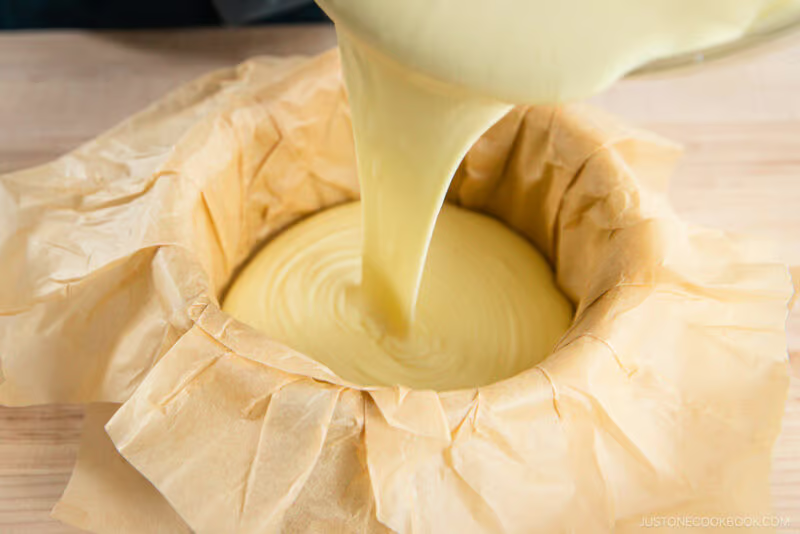
Pour the cake batter into the prepared pan in one go (avoid stop-and-go) so you don‘t create any air pockets. Tap the cake pan on the countertop a few times to eliminate air pockets.
Step 22
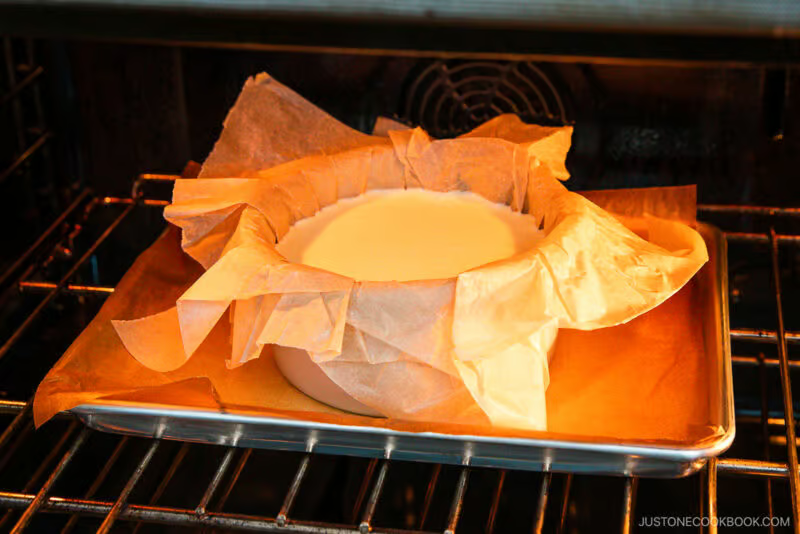
Pop any visible air bubbles with a bamboo skewer (or toothpick), then run the skewer through the batter to remove more bubbles. Place the cake pan on a baking sheet, just in case the cheesecake overflows during baking. Mine never did, but I still use a baking sheet to transfer the cake pan to and from the oven.
Step 23
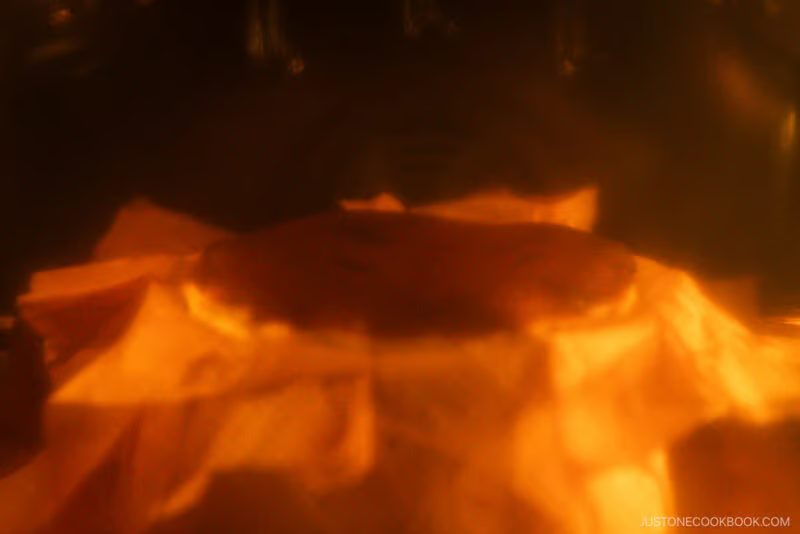
Transfer the baking sheet with cake pan into the preheated oven; do it quickly so you don't let much heat escape. Bake at 450ºF (230ºC) for a convection oven or 475ºF (245ºC) for a conventional oven until the top is dark amber/brown and the center is still very jiggly, about 30–35 minutes. Do not open the oven door while baking and lose heat. The top of my cake starts browning at the 30-minute mark, then gets dark brown within 5 minutes. Please keep an eye on your cheesecake, because every oven is different. Nami's Tips: If you love a “gooey“ or “oozy“ texture, then bake for less time, but you must chill your cake well before serving to firm it up. NEVER extend the bake time, even if the top hasn‘t turned dark, because you will overbake the cake. The filling will curdle and you can‘t fix it. If the top doesn‘t darken in 30–35 minutes, you will probably need to adjust the oven temperature (or oven rack or preheating time) next time.
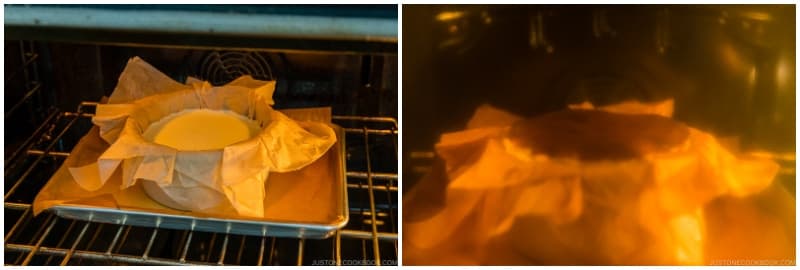
Image detailsTransfer the baking sheet with cake pan into the preheated oven; do it quickly so you don't let much heat escape. Bake at 450ºF (230ºC) for a convection oven or 475ºF (245ºC) for a conventional oven until the top is dark amber/brown and the center is still very jiggly, about 30–35 minutes. Do not open the oven door while baking and lose heat. The top of my cake starts browning at the 30-minute mark, then gets dark brown within 5 minutes. Please keep an eye on your cheesecake, because every oven is different. Nami's Tips: If you love a “gooey“ or “oozy“ texture, then bake for less time, but you must chill your cake well before serving to firm it up. NEVER extend the bake time, even if the top hasn‘t turned dark, because you will overbake the cake. The filling will curdle and you can‘t fix it. If the top doesn‘t darken in 30–35 minutes, you will probably need to adjust the oven temperature (or oven rack or preheating time) next time.Just One Cookbook · Basque Cheesecake バスクチーズケーキDev reference Visual cue
until the top is dark amber/brown and the center is still very jiggly, about 30–35 minutes.
Checks3
Visual cueInfoVisualuntil the top is dark amber/brown and the center is still very jiggly, about 30–35 minutes.
Expected state: until the top is dark amber/brown and the center is still very jiggly, about 30–35 minutes.
TimingInfoTimingabout 30–35 minutes
Target: 30-35 minute
Expected state: Bake at 450ºF (230ºC) for a convection oven or 475ºF (245ºC) for a conventional oven until the top is dark amber/brown and the center is still very jiggly, about 30–35 minutes.
ServiceMain recipeSource service instruction
Transfer the baking sheet with cake pan into the preheated oven; do it quickly so you don't let much heat escape. Bake at 450ºF (230ºC) for a convection oven or 475ºF (245ºC) for a conventional oven until the top is dark amber/brown and the center is still very jiggly, about 30–35 minutes. Do not open the oven door while baking and lose heat. The top of my cake starts browning at the 30-minute mark, then gets dark brown within 5 minutes. Please keep an eye on your cheesecake, because every oven is different. Nami's Tips: If you love a “gooey“ or “oozy“ texture, then bake for less time, but you must chill your cake well before serving to firm it up. NEVER extend the bake time, even if the top hasn‘t turned dark, because you will overbake the cake. The filling will curdle and you can‘t fix it. If the top doesn‘t darken in 30–35 minutes, you will probably need to adjust the oven temperature (or oven rack or preheating time) next time.
Why and source
This step has reviewed source-backed guidance.
- Source: Basque Cheesecake バスクチーズケーキ
Step 24
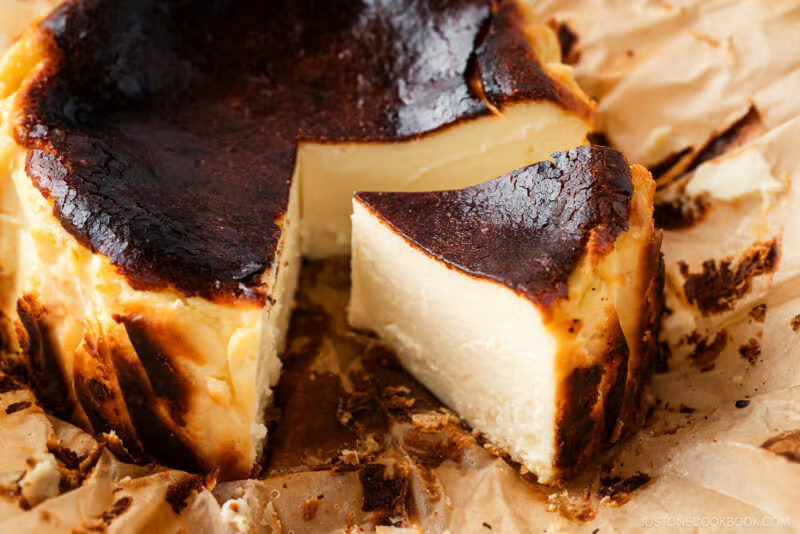
Take out the cake when the surface is a dark, burnt color. The middle of the cake should wobble when you gently shake the pan. Let the cheesecake cool in the pan on a wire rack until it reaches room temperature, about 2–3 hours. Make sure the air can circulate under the cake pan; don’t put it on the countertop directly. You can place it on top of your gas range burner grate, if it‘s not in use.
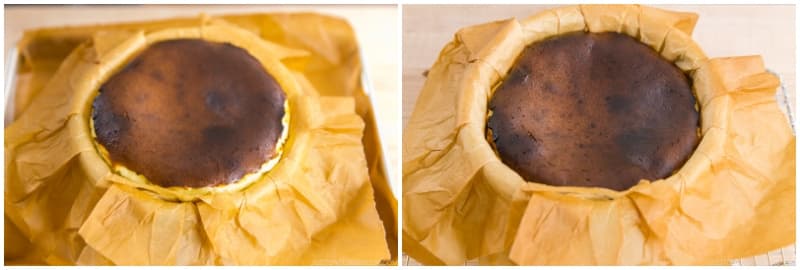
Image detailsTake out the cake when the surface is a dark, burnt color. The middle of the cake should wobble when you gently shake the pan. Let the cheesecake cool in the pan on a wire rack until it reaches room temperature, about 2–3 hours. Make sure the air can circulate under the cake pan; don’t put it on the countertop directly. You can place it on top of your gas range burner grate, if it‘s not in use.Just One Cookbook · Basque Cheesecake バスクチーズケーキDev reference Visual cue
until it reaches room temperature, about 2–3 hours.
Checks3
Visual cueInfoVisualuntil it reaches room temperature, about 2–3 hours.
Expected state: until it reaches room temperature, about 2–3 hours.
TimingInfoTimingabout 2–3 hours
Target: 120-180 minute
Expected state: Let the cheesecake cool in the pan on a wire rack until it reaches room temperature, about 2–3 hours.
HoldingMain recipeSource holding instruction
Take out the cake when the surface is a dark, burnt color. The middle of the cake should wobble when you gently shake the pan. Let the cheesecake cool in the pan on a wire rack until it reaches room temperature, about 2–3 hours. Make sure the air can circulate under the cake pan; don’t put it on the countertop directly. You can place it on top of your gas range burner grate, if it‘s not in use.
Why and source
This step has reviewed source-backed guidance.
- Source: Basque Cheesecake バスクチーズケーキ
Step 25
You can serve the cake either chilled or at room temperature (which we like, too). To chill it for a firmer texture, cover the room-temperature cake in the pan with a tea towel (don‘t use plastic, as condensation may drip onto the cake), and place in the refrigerator for 4 hours.
Step 26
Remove the cheesecake from the cake pan and carefully peel back the parchment paper. If you have chilled the cake, let it stand at room temperature for at least 30 minutes or up to 2 hours before serving.
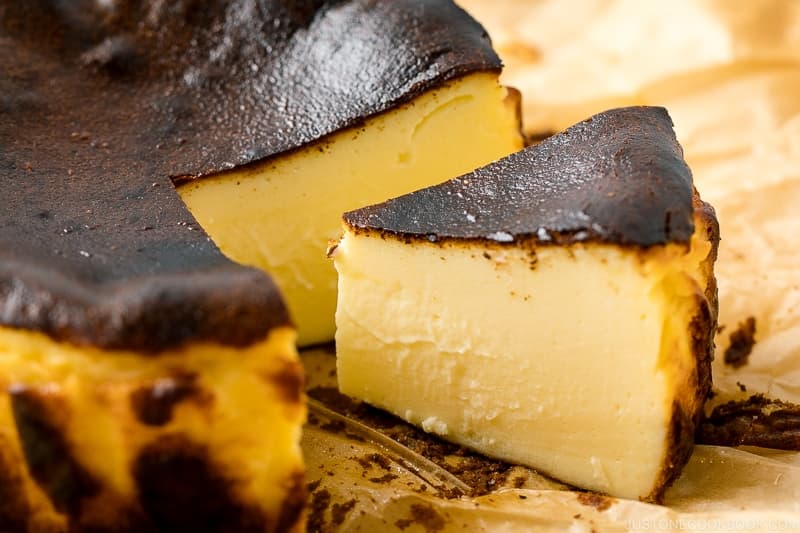
Image detailsRemove the cheesecake from the cake pan and carefully peel back the parchment paper. If you have chilled the cake, let it stand at room temperature for at least 30 minutes or up to 2 hours before serving.Just One Cookbook · Basque Cheesecake バスクチーズケーキDev reference Checks2
TimingInfoTiming30 minutes
Target: 30 minute
Expected state: If you have chilled the cake, let it stand at room temperature for at least 30 minutes or up to 2 hours before serving.
ServiceMain recipeSource service instruction
Remove the cheesecake from the cake pan and carefully peel back the parchment paper. If you have chilled the cake, let it stand at room temperature for at least 30 minutes or up to 2 hours before serving.
Why and source
This step has reviewed source-backed guidance.
- Source: Basque Cheesecake バスクチーズケーキ
Step 27
You can store the cheesecake in the refrigerator for up to 3 days.
Handling and Storage
Reviewed hold, storage, make-ahead, and service-timing guidance.
Variations and Customizations
Looking to change things up?
Try these easy and tasty ideas! Bake on the shorter end of the time range and chill overnight.
What to Serve with Basque Cheesecake
This Basque burnt cheesecake works year-round and shines with simple beverages.
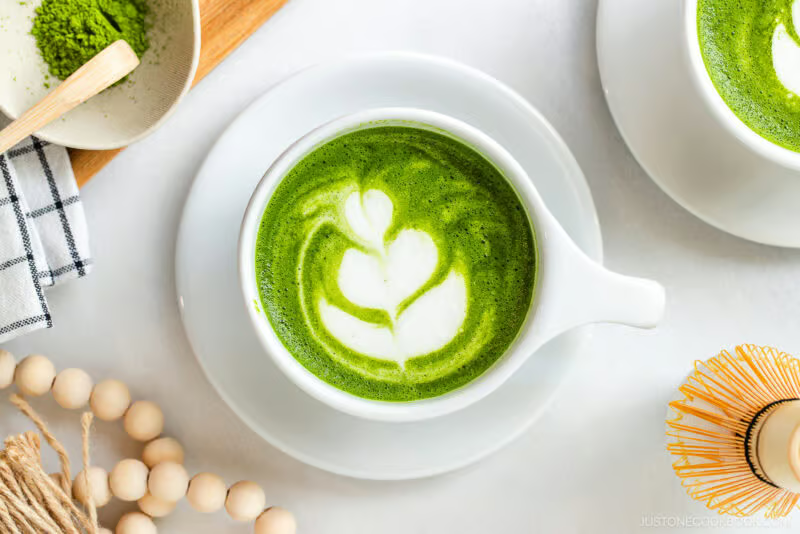
With coffee – It’s delicious with an espresso or Japanese Iced Coffee. With matcha – Serve creamy and cozy Matcha Latte to balance the richness nicely.
Storage and Reheating Tips
To store: Once the Basque cheesecake has cooled to room temperature, store it in an airtight container and refrigerate for up to 3 days.
To reheat: This cheesecake is best enjoyed chilled or at room temperature. If chilled, let it stand at room temp for 30 minutes to 2 hours before serving.
Can I make this Basque cheesecake recipe ahead of time?
Basque cheesecake is an excellent make-ahead dessert.
You can bake it one day in advance, let it cool completely, and refrigerate it. Chilling also helps the texture set and makes slicing cleaner, especially if you prefer a firmer center.
Learn More
Extra cooking notes, tests, and source details kept out of the step-by-step method.
Why this works
Quick kitchen reasons behind the main choices.
Why is the center still gooey after chilling?
If the center stays raw even after chilling, the cheesecake needed slightly more baking time.
Every oven behaves differently, so small adjustments are normal. A jiggly center when warm is expected, but it should set more once chilled.
Article photos
Photos used with the article notes.
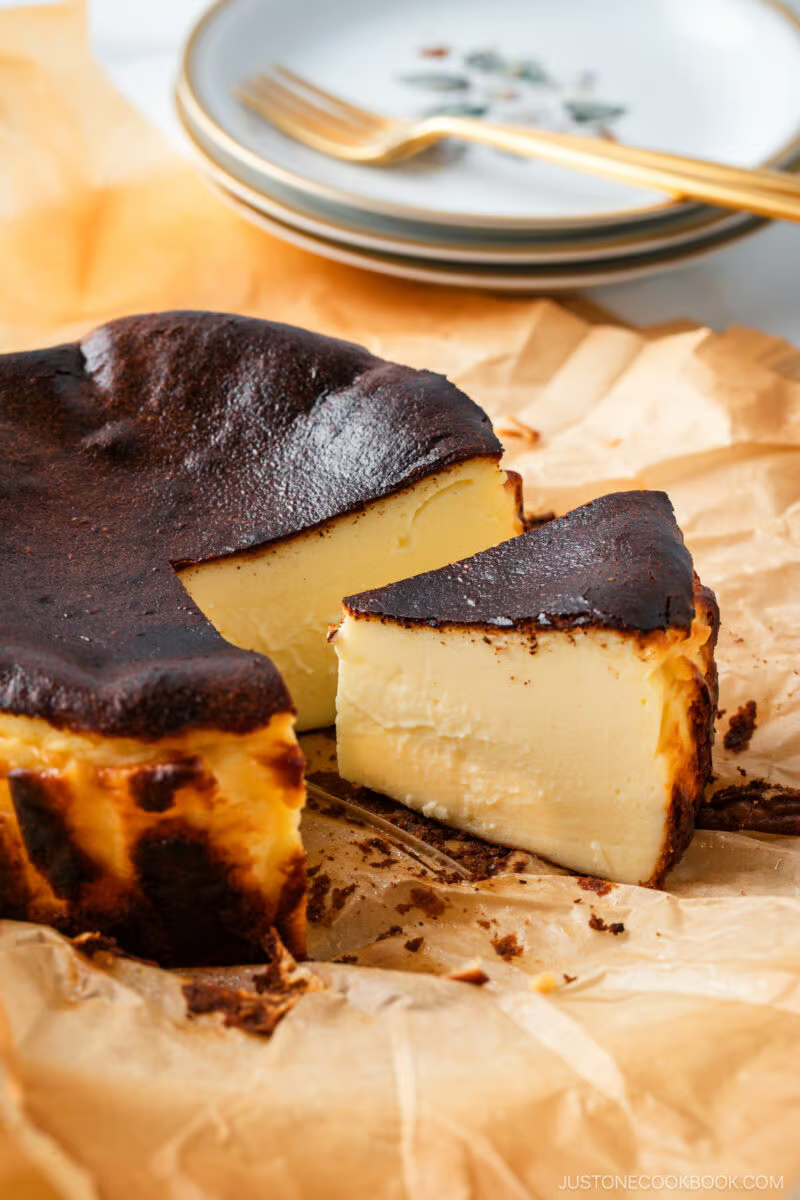
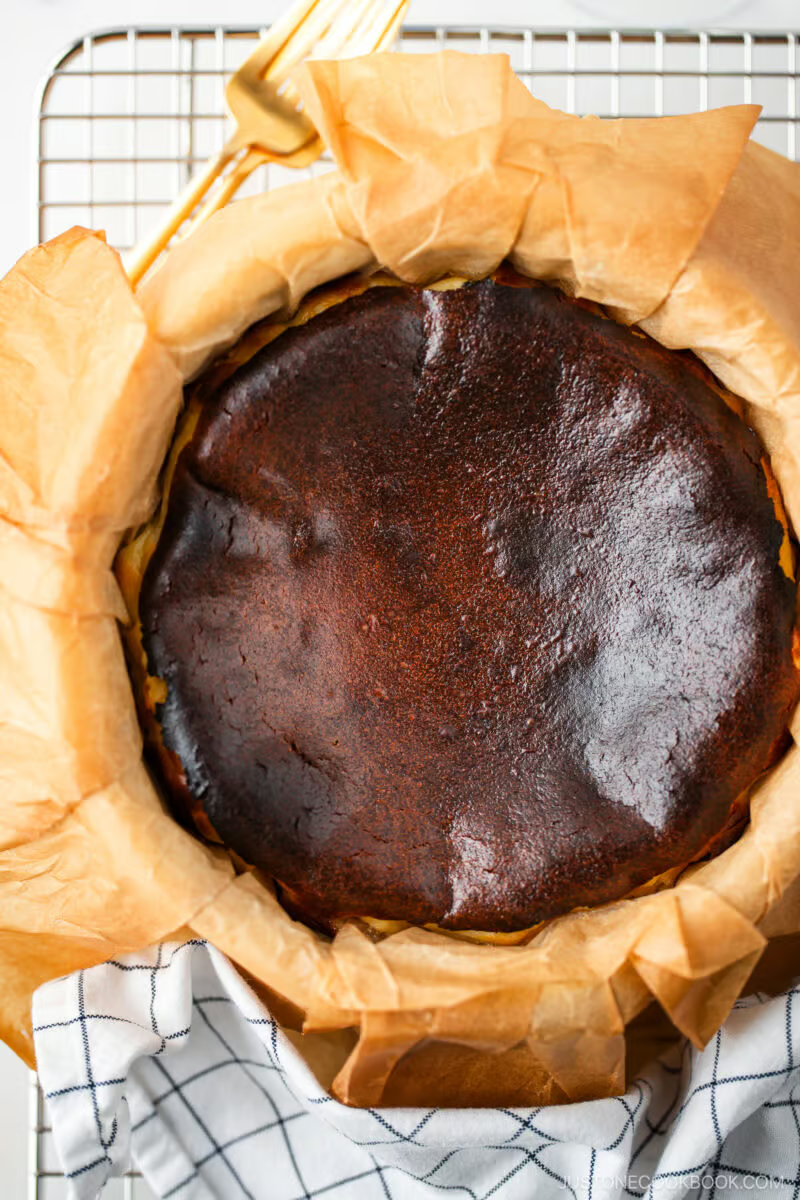
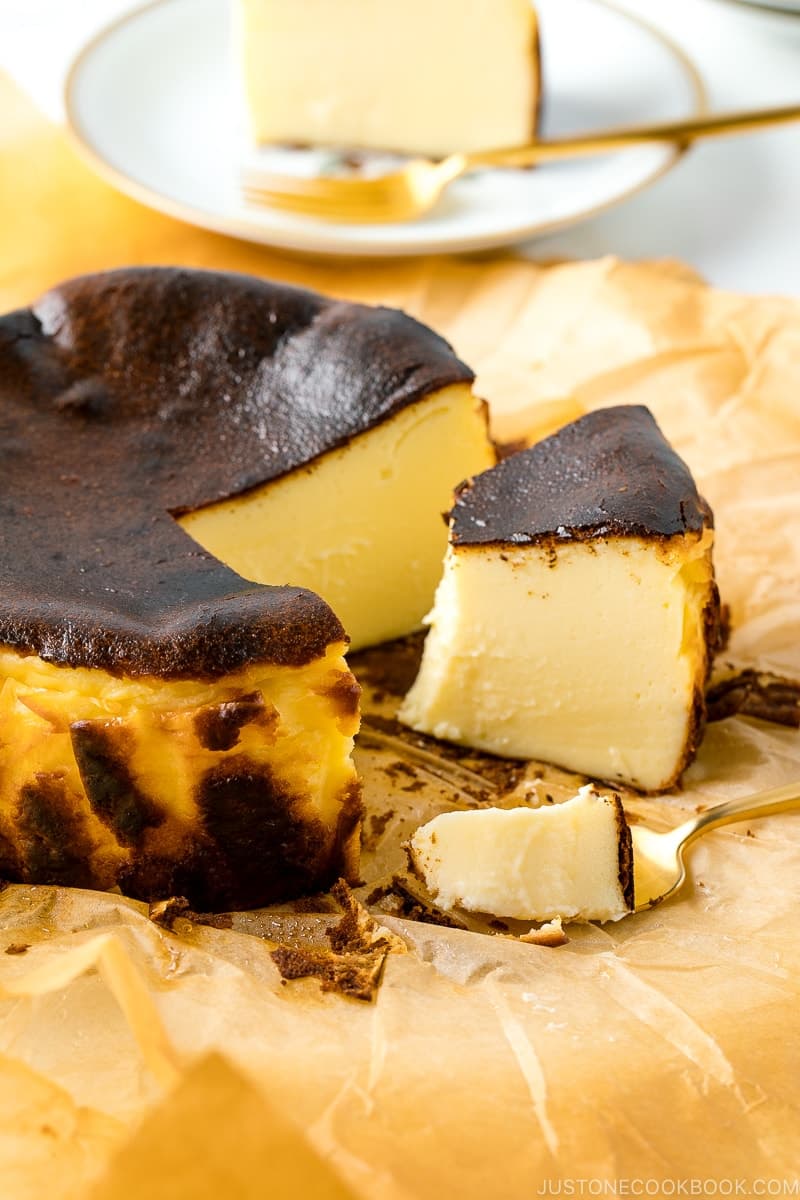
Source: Basque Cheesecake バスクチーズケーキ
Recipe structure
Components and intermediate outputs created by the method.
Main recipe
Recipe card ingredients and steps.
1, 1 6-inch cake
Batter
Source step 9 creates or uses batter.
Filling
Source step 23 creates or uses filling.
Mixture
Source step 10 creates or uses mixture.
Recipe Utilities
Account actions, source details, export, and reporting stay available without interrupting the cooking flow.
Source and Origin
Origin declaration
Adapted from source
Imported from the just-one-cookbook page for dev review.
Copy risk: Unchecked
Basque Cheesecake バスクチーズケーキ
Article
View source
My Kitchen Actions
Login is required.
My Kitchen keeps saved recipes, private notes, adaptations, cooking logs, imports, and exports tied to your account.
Export
Public recipe exports include only approved public content. Personal backup exports require login.
Export history
No exports yet.