Japanese Salted Salmon (Shiozake)
Master Japanese Salted Salmon (Shiozake) recipe at home. Learn to slice fillets, salt and cure it, then broil crisp, flavorful fish everyone will love.
Dish: Japanese Salted Salmon
Variant: Japanese Salted Salmon (Shiozake)
- Total time
- 20 min
- Active time
- 10 min
- Yield
8, 8 Japanese-style fillets (with 3 additional odd-sized pieces)8, 8 Japanese-style fillets (with 3 additional odd-sized pieces)
- Difficulty
- Medium

Ingredients and Constraints
Ingredients
- Optional
Ingredient watchpoints1 watchpoint
Short requirements and tradeoffs to check while gathering ingredients; detailed source notes stay expandable.
Daikon Radish
2 inches daikon radish ((grated; optional))
The source row includes a form, size, temperature, preparation, or handling detail.
Details and source
Additional ingredient notes
Ingredients for Japanese Salted Salmon
Japanese-style salmon fillets – thinner and smaller than Western-style fillets; find them in the Japanese grocery store. salt – I use Diamond Crystal kosher salt sake Find the printable recipe with measurements below.
Ingredients US CUSTOMARY METRIC 1X 2X 3X
1.3 lb skin-on Japanese-style salmon fillets (store bought or cut your own; I recommend sockeye salmon; see end Notes) 3 Tbsp Diamond Crystal kosher salt (5% of the salmon‘s weight in salt of any kind; see Notes) 1–2 Tbsp sake For Serving 2
Notes
Ingredient Notes Salmon fillet: I recommend sockeye salmon because it’s firm and lean, but I’ve also used fatty Atlantic salmon) for this recipe.
I sliced the entire left side of wild sockeye salmon from Costco. Salt: You can use any type of salt, but please go by the weight.
Method Overview
Structured method notes that are separate from the step timeline.
What is Japanese Salted Salmon?
Japanese salted salmon—called shiozake or shiojake (塩鮭)—is made by cleaning thin, skin-on fillets with sake, then curing them with salt.
The result is salmon with a firm texture, deeply savory flavor, and skin that crisps beautifully when broiled. Traditionally, salting was a way to preserve the season’s abundant salmon catch—and the technique has been a staple of the Japanese table ever since.
How to Make Japanese Salted Salmon
Cut a side of salmon into fillets (optional).
See How to Cut Salmon into Japanese-Style Fillets for my step-by-step photos. Sprinkle sake over the fillets and let them rest for 10 minutes.


Show 2 more media items


Nami’s Recipe Tips
These simple tips will help you make Japanese salted salmon every time.
Use Japanese-style fillets. Thin fillets cook faster and keep the skin on top for a crispy broiled fish.

Variations
Here are a few easy ways to make this dish your own.
Adjust the salt ratio. The standard is 5% of the salmon’s weight, but you can reduce it to 3–4% for a milder flavor.

Can I reduce the salt in Japanese salted salmon?
Yes, you can reduce the salt to 3–4% of the salmon’s weight for a milder flavor.
Just know that less salt means a shorter shelf life, so plan to cook it sooner.
How do you remove salt from salted salmon when it’s too salty?
If your shiozake turns out too salty, soak the fillets in cold water for 20–30 minutes, then pat dry before cooking.
For a gentler approach, use lightly salted water (about 1% salt)—this draws out excess salt more evenly without making the flesh watery. The lightly salted water method, called yobijio (呼び塩), is a traditional Japanese technique used for desalting cured fish and vegetables.
Source video
Source video
Method Timeline
Prep
ActivePrep
10 min
Prep time from the source recipe card.
Cook
ActiveCook
10 min
Cook time from the source recipe card.
Total
PassiveTotal
20 min
Total time from the source recipe card.
Step 1
Before You Start: Please note that this recipe has a curing time of 2 days.
Step 2
If you're using pre-cut fillets, jump to the "To Salt the Salmon" section below. To cut fillets from a side of salmon, follow my detailed instructions with photos in How to Cut Salmon into Japanese-Style Fillets. Place a side of salmon skin side down with the narrow tail end to your left and cut off the narrowest part. Tilt your knife back 30 degrees and slice the salmon diagonally toward the tail into fillets about 1 inch (2.5 cm) thick. This side of salmon yielded 8 Japanese-style fillets and 3 odd-sized pieces.
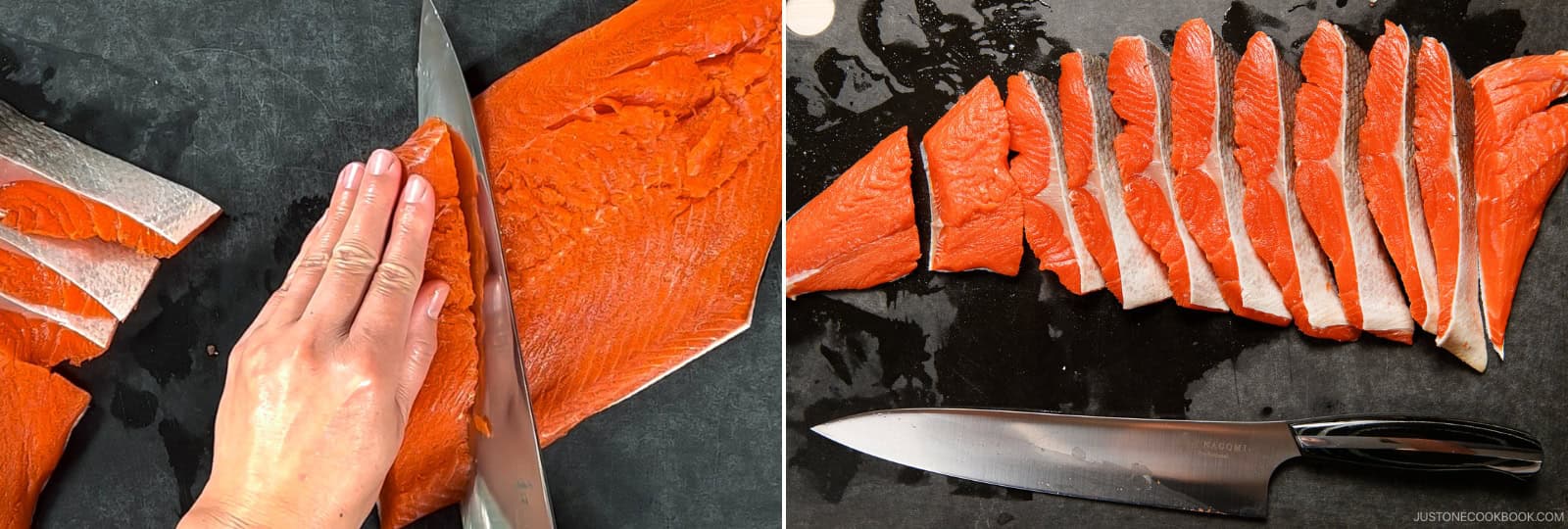
Image detailsIf you're using pre-cut fillets, jump to the "To Salt the Salmon" section below. To cut fillets from a side of salmon, follow my detailed instructions with photos in How to Cut Salmon into Japanese-Style Fillets. Place a side of salmon skin side down with the narrow tail end to your left and cut off the narrowest part. Tilt your knife back 30 degrees and slice the salmon diagonally toward the tail into fillets about 1 inch (2.5 cm) thick. This side of salmon yielded 8 Japanese-style fillets and 3 odd-sized pieces.Just One Cookbook · Japanese Salted Salmon (Shiozake) 塩鮭Dev reference Inputs and tools2
Uses
- 1.3 lb skin-on Japanese-style salmon fillets ((store bought or cut your own; I recommend sockeye salmon; see end Notes))
- 3 Tbsp Diamond Crystal kosher salt ((5% of the salmon‘s weight in salt of any kind; see Notes))
Step 3
Sprinkle 1–2 Tbsp sake over 1.3 lb skin-on Japanese-style salmon fillets. Turn to coat all sides. Let sit for 10 minutes. Pat the salmon dry with a paper towel.
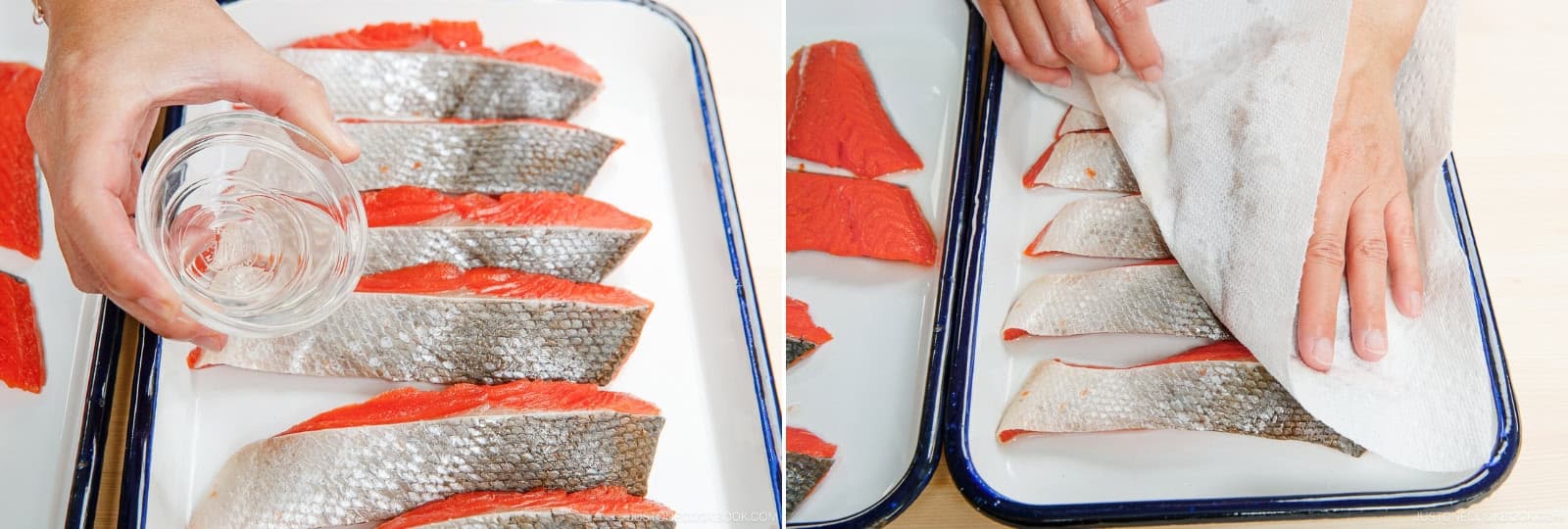
Image detailsSprinkle 1–2 Tbsp sake over 1.3 lb skin-on Japanese-style salmon fillets. Turn to coat all sides. Let sit for 10 minutes. Pat the salmon dry with a paper towel.Just One Cookbook · Japanese Salted Salmon (Shiozake) 塩鮭Dev reference Checks1
TimingInfoTimingfor 10 minutes
Target: 10 minute
Expected state: Let sit for 10 minutes.
Inputs and tools1
Uses
- 1–2 Tbsp sake
Why and source
This step has reviewed source-backed guidance.
Step 4
Sprinkle some of the salt on the skin, then the remaining salt on both sides. Press any leftover salt onto the skin. Nami's Tip: I use 5% of the salmon's weight in salt. In Japan, the salt concentration ranges from 3–8% or more; see my blog post for more information.
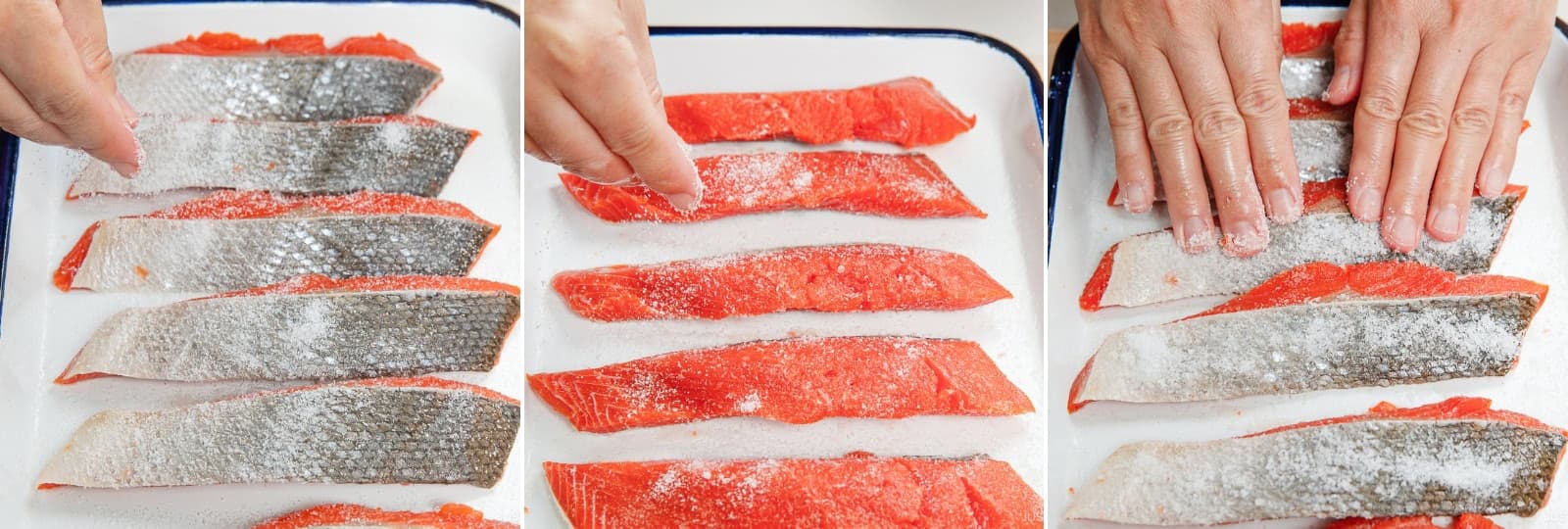
Image detailsSprinkle some of the salt on the skin, then the remaining salt on both sides. Press any leftover salt onto the skin.Nami's Tip: I use 5% of the salmon's weight in salt. In Japan, the salt concentration ranges from 3–8% or more; see my blog post for more information.Just One Cookbook · Japanese Salted Salmon (Shiozake) 塩鮭Dev reference Checks1
HoldingMain recipeSource holding instruction
Sprinkle some of the salt on the skin, then the remaining salt on both sides. Press any leftover salt onto the skin. Nami's Tip: I use 5% of the salmon's weight in salt. In Japan, the salt concentration ranges from 3–8% or more; see my blog post for more information.
Why and source
This step has reviewed source-backed guidance.
Step 5
Line the bottom of an airtight container with a paper towel to absorb moisture. Place a few salted fillets skin side up in a single layer in the container, then place another paper towel on top. Repeat for the second and third layers. Nami's Tip: The salt will draw out the moisture from the salmon.
Step 6
Lay a final sheet of paper towel on top. Cover and refrigerate for 2 days.
Step 7
Open the container after 2 days and discard the wet paper towels. The fillets will be darker and firmer. Gently pat them dry with a clean paper towel. The salted salmon fillets are now ready to use. To cook them now, jump to the “To Broil“ section. To freeze the fillets to use later, see the next step.
Step 8
Wrap the cured salmon fillets individually or in pairs to freeze and cook later. To wrap two fillets together in the same sheet of plastic wrap, see the next step. Nami's Tip: I usually wrap two fillets together, as I often need two for bento boxes or four for a family meal.
Step 9
To wrap two fillets together, fold one corner over one fillet, covering it completely. Place the second fillet next to it, separated by the plastic layer. Roll both tightly in the plastic wrap. Wrap the rest of the fillets, put them in a freezer bag, and store in the freezer for up to 1 month. Nami's Tip: Separating the fillets with a layer of plastic wrap keeps them from fusing together when frozen. This is helpful when you need to take out just one frozen fillet.
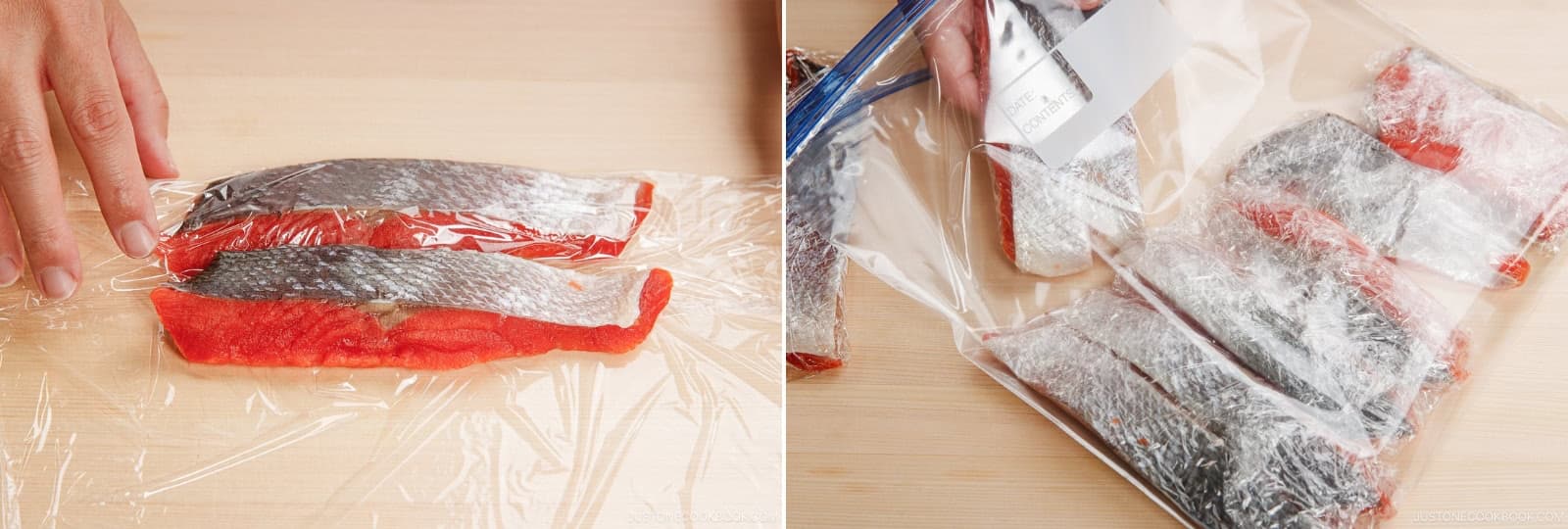
Image detailsTo wrap two fillets together, fold one corner over one fillet, covering it completely. Place the second fillet next to it, separated by the plastic layer. Roll both tightly in the plastic wrap. Wrap the rest of the fillets, put them in a freezer bag, and store in the freezer for up to 1 month. Nami's Tip: Separating the fillets with a layer of plastic wrap keeps them from fusing together when frozen. This is helpful when you need to take out just one frozen fillet.Just One Cookbook · Japanese Salted Salmon (Shiozake) 塩鮭Dev reference Checks1
HoldingMain recipeSource holding instruction
To wrap two fillets together, fold one corner over one fillet, covering it completely. Place the second fillet next to it, separated by the plastic layer. Roll both tightly in the plastic wrap. Wrap the rest of the fillets, put them in a freezer bag, and store in the freezer for up to 1 month. Nami's Tip: Separating the fillets with a layer of plastic wrap keeps them from fusing together when frozen. This is helpful when you need to take out just one frozen fillet.
Why and source
This step has reviewed source-backed guidance.
Step 10
The night before cooking the salmon, place the frozen wrapped fillets in the refrigerator overnight to defrost completely. Let the salmon sit on the counter for 15–20 minutes to warm to room temperature.
Step 11
Gather all the ingredients. Place the oven rack in the center position, about 9 inches (23 cm) away from the top heating element. Preheat the oven broiler on High (550ºF/288ºC) for 5 minutes. Line a baking sheet with aluminum foil and apply a thin coat of (spray) cooking oil. Place the salmon on top, skin side up (for crispy skin). Nami's Tip: I use foil for easy clean up. When broiling, you don‘t control the temperature in the oven. Instead, you control the distance between the broiler and the surface of the food. It‘s similar to using hotter and cooler zones on your grill.
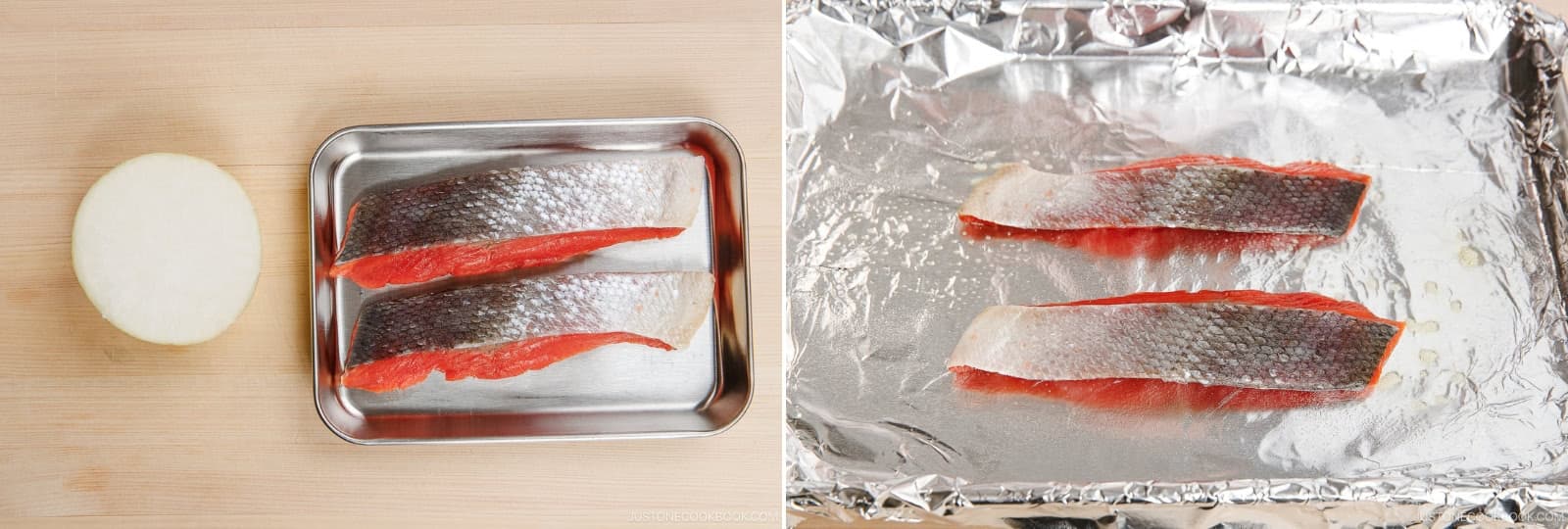
Image detailsGather all the ingredients. Place the oven rack in the center position, about 9 inches (23 cm) away from the top heating element. Preheat the oven broiler on High (550ºF/288ºC) for 5 minutes. Line a baking sheet with aluminum foil and apply a thin coat of (spray) cooking oil. Place the salmon on top, skin side up (for crispy skin). Nami's Tip: I use foil for easy clean up. When broiling, you don‘t control the temperature in the oven. Instead, you control the distance between the broiler and the surface of the food. It‘s similar to using hotter and cooler zones on your grill.Just One Cookbook · Japanese Salted Salmon (Shiozake) 塩鮭Dev reference Checks1
TimingInfoTimingfor 5 minutes
Target: 5 minute
Expected state: Preheat the oven broiler on High (550ºF/288ºC) for 5 minutes.
Why and source
This step has reviewed source-backed guidance.
Step 12
Broil the salmon for 8–10 minutes, until well done—it should be flaky and more dry. No need to flip it. Nami's Tip: The cooking time varies depending on the thickness of the fish and the distance between the broiler and the food.
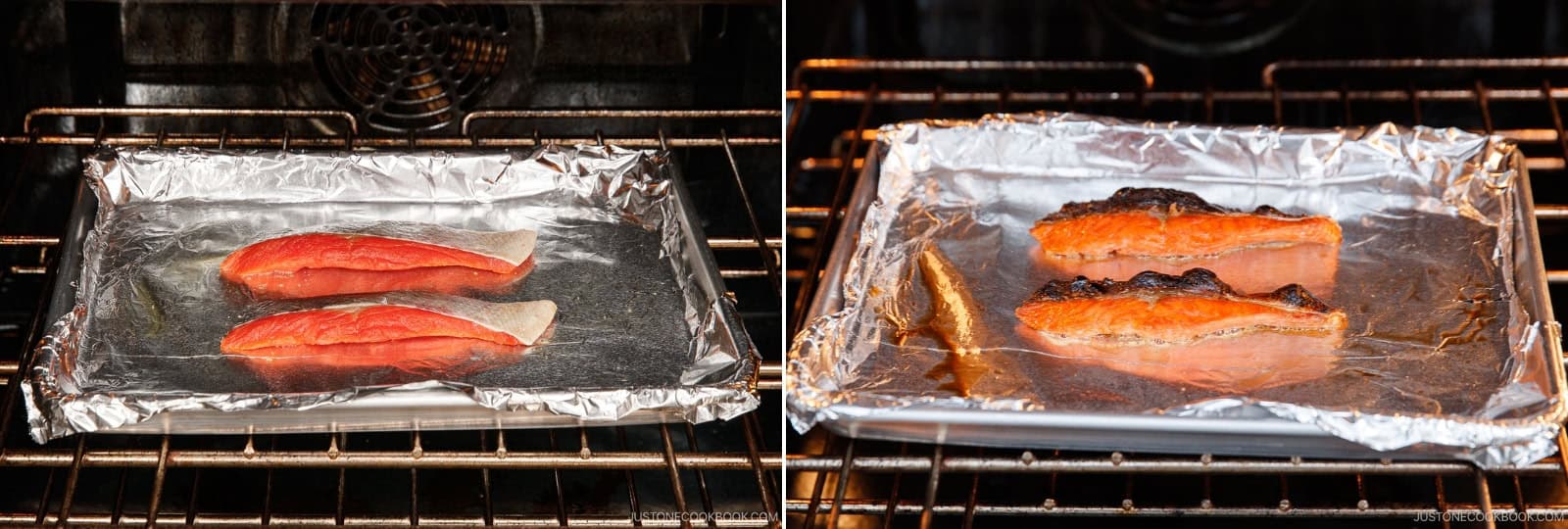
Image detailsBroil the salmon for 8–10 minutes, until well done—it should be flaky and more dry. No need to flip it.Nami's Tip: The cooking time varies depending on the thickness of the fish and the distance between the broiler and the food.Just One Cookbook · Japanese Salted Salmon (Shiozake) 塩鮭Dev reference Visual cue
until well done—it should be flaky and more dry.
Checks2
TextureInfoTextureuntil well done—it should be flaky and more dry.
Expected state: until well done—it should be flaky and more dry.
TimingInfoTimingfor 8–10 minutes
Target: 8-10 minute
Expected state: Broil the salmon for 8–10 minutes, until well done—it should be flaky and more dry.
Why and source
This step has reviewed source-backed guidance.
Step 13
If you don't have a broiler, preheat the oven to 425°F (218ºC) with the rack placed in the middle position. Bake the salmon on a baking sheet lined with parchment paper for 10–12 minutes, until well done (more dry and flaky).
Step 14
If you prefer, cook the fillets on a wire fish grill on medium heat over a stovetop or direct fire. Cook about 5 minutes on each side, until well done (more dry and flaky).
medium heat5 min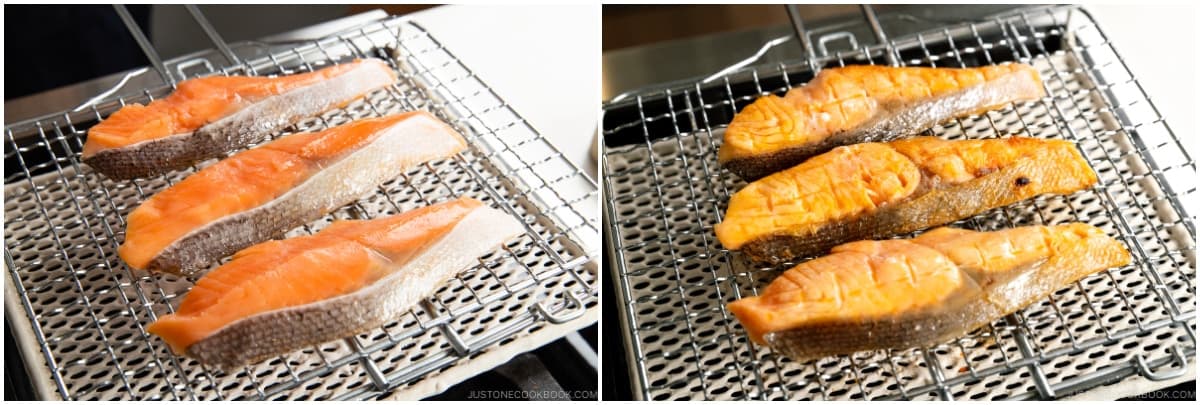
Image detailsIf you prefer, cook the fillets on a wire fish grill on medium heat over a stovetop or direct fire. Cook about 5 minutes on each side, until well done (more dry and flaky).Just One Cookbook · Japanese Salted Salmon (Shiozake) 塩鮭Dev reference Visual cue
until well done (more dry and flaky).
Checks2
TextureInfoTextureuntil well done (more dry and flaky).
Expected state: until well done (more dry and flaky).
TimingInfoTimingabout 5 minutes
Target: 5 minute
Expected state: Cook about 5 minutes on each side, until well done (more dry and flaky).
Why and source
This step has reviewed source-backed guidance.
Step 15
Peel 2 inches daikon radish. (I use a ceramic grater.) Grate the daikon and gently squeeze out most of the liquid, keeping it moist. Serve the broiled salmon with grated daikon on the side. Nami's Tip: I also served Tamagoyaki (Japanese Sweet Rolled Omelet) and Spinach Salad with Sesame Dressing in this meal.
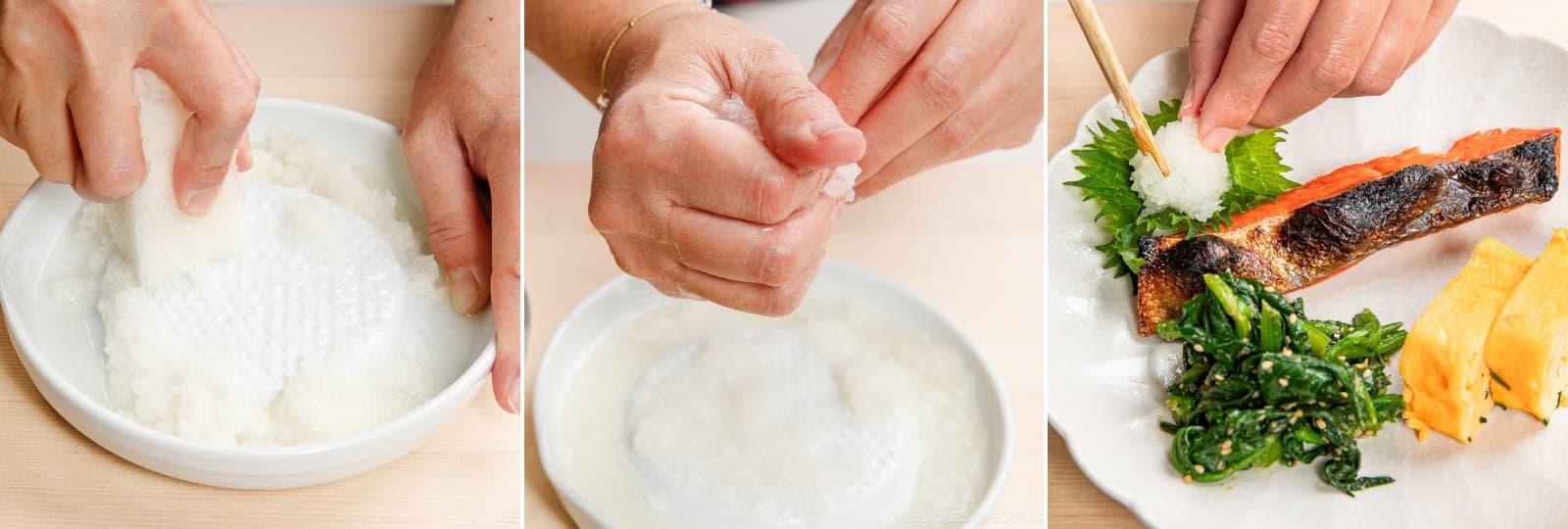
Image detailsPeel 2 inches daikon radish. (I use a ceramic grater.) Grate the daikon and gently squeeze out most of the liquid, keeping it moist. Serve the broiled salmon with grated daikon on the side. Nami's Tip: I also served Tamagoyaki (Japanese Sweet Rolled Omelet) and Spinach Salad with Sesame Dressing in this meal.Just One Cookbook · Japanese Salted Salmon (Shiozake) 塩鮭Dev reference Checks1
ServiceMain recipeSource service instruction
Peel 2 inches daikon radish. (I use a ceramic grater.) Grate the daikon and gently squeeze out most of the liquid, keeping it moist. Serve the broiled salmon with grated daikon on the side. Nami's Tip: I also served Tamagoyaki (Japanese Sweet Rolled Omelet) and Spinach Salad with Sesame Dressing in this meal.
Inputs and tools1
Uses
- 2 inches daikon radish ((grated; optional))
Why and source
This step has reviewed source-backed guidance.
Step 16
Store in an airtight container in the refrigerator for up to 3 days and in the freezer for up to 2 weeks. Do not refreeze previously frozen fish.
Handling and Storage
Reviewed hold, storage, make-ahead, and service-timing guidance.
What to Serve with Japanese Salted Salmon
This recipe makes a delicious protein for a traditional Japanese breakfast, bento lunch box, or rice ball filling.
Miso Soup with Yuzu Kosho – Umami-rich miso pairs well with the savory salmon. 4 Easy Soy Sauce Pickles – The crisp texture and acidity cut through the salmon’s richness.


Learn More
Extra cooking notes, tests, and source details kept out of the step-by-step method.
Why this works
Quick kitchen reasons behind the main choices.
How salty is shiozake?
Japanese salted salmon is intentionally salty—meant to be eaten in small portions alongside plain rice and mild side dishes, not on its own.
In Japan, a 5% salt ratio is standard, creating a bold, savory flavor that complements plain rice perfectly.
Article photos
Photos used with the article notes.


Source: Japanese Salted Salmon (Shiozake) 塩鮭
Recipe structure
Components and intermediate outputs created by the method.
Main recipe
Recipe card ingredients and steps.
8, 8 Japanese-style fillets (with 3 additional odd-sized pieces)
Dressing
Source step 15 creates or uses dressing.
Extra useful notes
Short source-backed recommendations and facts that do not need a step.
Salmon fillet: I recommend sockeye salmon because it’s firm and lean, but I’ve also used fatty Atlantic salmon) for this recipe.
Salmon fillet: I recommend sockeye salmon because it’s firm and lean, but I’ve also used fatty Atlantic salmon) for this recipe. I sliced the entire left side of wild sockeye salmon from Costco.
Salt: You can use any type of salt, but please go by the weight.
Salt: You can use any type of salt, but please go by the weight. 1 Tbsp Diamond Crystal salt weighs 10 g. For 600 g salmon, I used 30 g salt (5 percent of the salmon‘s weight).
Recipe Utilities
Account actions, source details, export, and reporting stay available without interrupting the cooking flow.
Source and Origin
Origin declaration
Adapted from source
Imported from the just-one-cookbook page for dev review.
Copy risk: Unchecked
Japanese Salted Salmon (Shiozake) 塩鮭
Article
View source
My Kitchen Actions
Login is required.
My Kitchen keeps saved recipes, private notes, adaptations, cooking logs, imports, and exports tied to your account.
Export
Public recipe exports include only approved public content. Personal backup exports require login.
Export history
No exports yet.