Japanese Chicken Curry
Master authentic Japanese Chicken Curry from scratch. Our foolproof recipe features a homemade roux and secret tips for the most flavorful, rich sauce.
Dish: Japanese Chicken Curry
Variant: Japanese Chicken Curry
- Total time
- 1 hr 10 min
- Active time
- 20 min
- Yield
8, 8 (the leftovers freeze well!)8, 8 (the leftovers freeze well!)
- Difficulty
- Medium
- Equipment
- 2 required
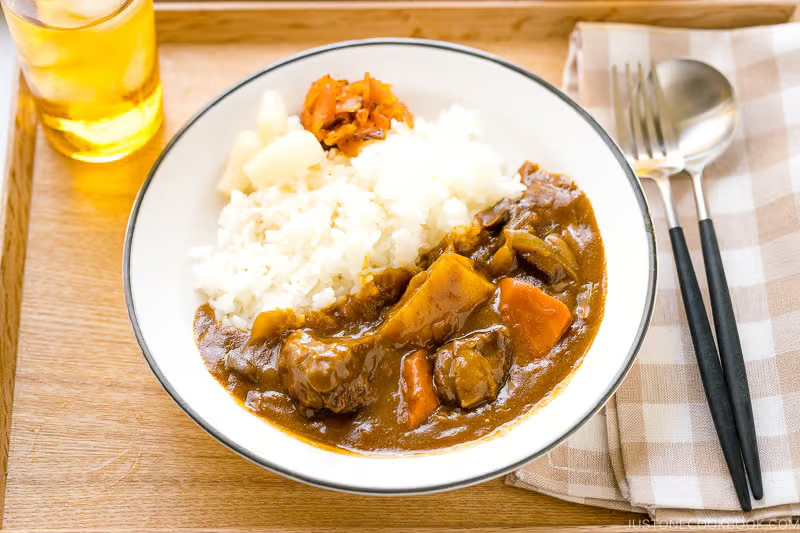
Ingredients and Constraints
Ingredients
Ingredient watchpoints1 watchpoint
Short requirements and tradeoffs to check while gathering ingredients; detailed source notes stay expandable.
Ginger
1 tsp ginger ((grated))
The source row includes a form, size, temperature, preparation, or handling detail.
Details and source
Additional ingredient notes
Secret Ingredients – Personalize Your Curry
My mom always adds some grated apples and different condiments to the curry.
She says, “If you use just the boxed curry roux, your curry will always taste the same. It will not be different from your neighbor’s curry.” So she taught me two tricks.
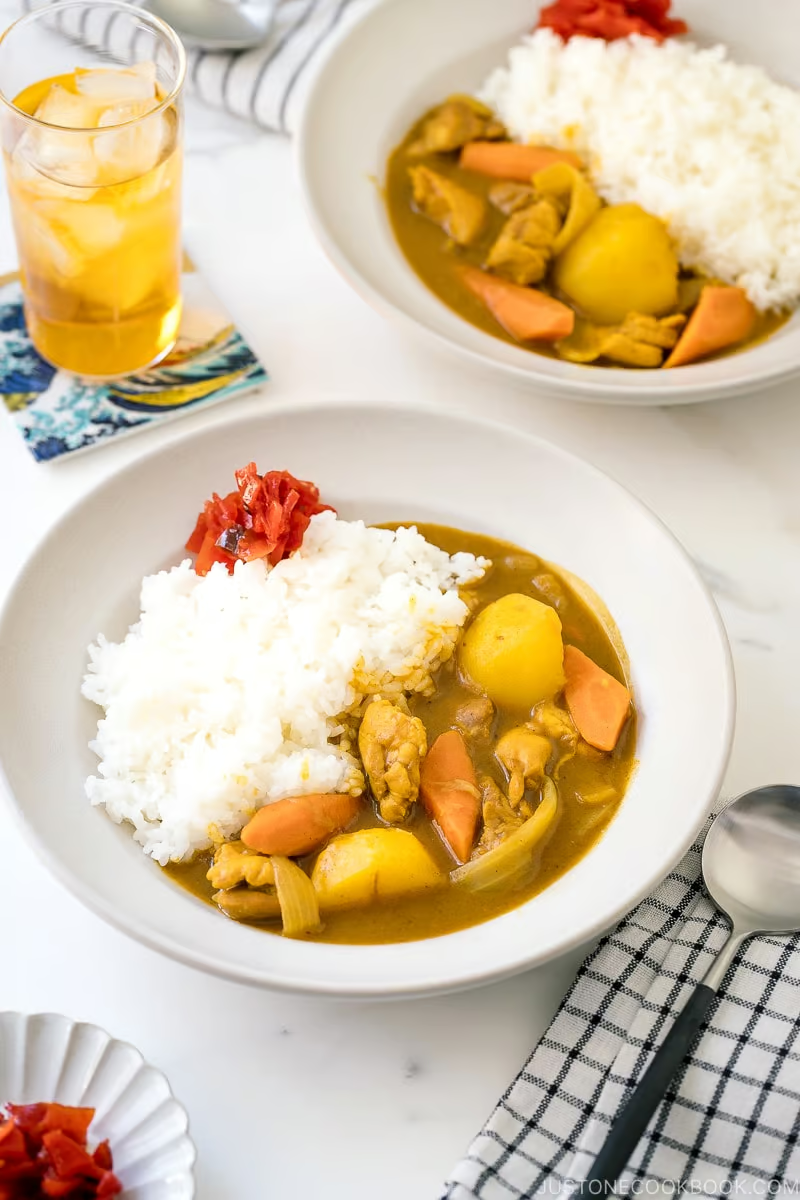
Tip #1: Cut ingredients into uniform shape
This helps to cook everything evenly at the same time.
Chicken: I recommend a Japanese cutting technique called sogigiri (そぎ切り), which slices the ingredient at an angle for more surface area. Onions: I cut into thick wedges for additional texture. Carrots: It takes time to cook carrots, so I recommend another Japanese cutting technique called rangiri (乱切り), which is a rotating cut. You rotate the ingredients as you cut. This creates a more open surface. Potatoes: I recommend Yukon gold potatoes for curry if you prefer to keep the potato shape in the final presentation. Russet potatoes tend to get dissolved by the end of cooking. Cut into 2 inches (5 cm) size, which is ideal.
Tip #3: Cover the ingredients with just enough broth (or water)
When you add the broth/water, be sure the ingredients are covered with enough water and not submerged completely.
The “barely covering” situation is called hita hita (ひたひた) in Japanese. The ingredients will release more moisture into the cooking liquid as you simmer.
Tip #4: Add “Secret Ingredients” to the broth
Add your ‘secret ingredients’ with the broth before you bring everything to a simmer, before adding the curry roux.
Ingredients US CUSTOMARY METRIC 1X 2X 3X
2 onions (large; 1.5 lb, 670 g) 2 carrots (6.7 oz, 190 g) 3 Yukon gold potatoes (15 oz, 432 g) 1 tsp ginger (grated) 2 cloves garlic ½ apple (6 oz, 170 g) 1½ lb boneless, skinless chicken thighs (see Notes for substitutions) freshly ground
Notes
Substitutions: You can substitute the chicken with beef, pork, shrimp, seafood, tofu, mushrooms, and other vegetables.
Since tofu, mushrooms, and vegetables cook quickly, you may not need to simmer them for 15 minutes, except for dense root vegetables like carrots and potatoes here. You can sauté mushrooms and softer vegetables (squash, zucchini, eggplant, etc.) and simmer for 5 minutes or until tender.
Required setup
Equipment
large pot
Source recipe card equipment.
Method Overview
Structured method notes that are separate from the step timeline.
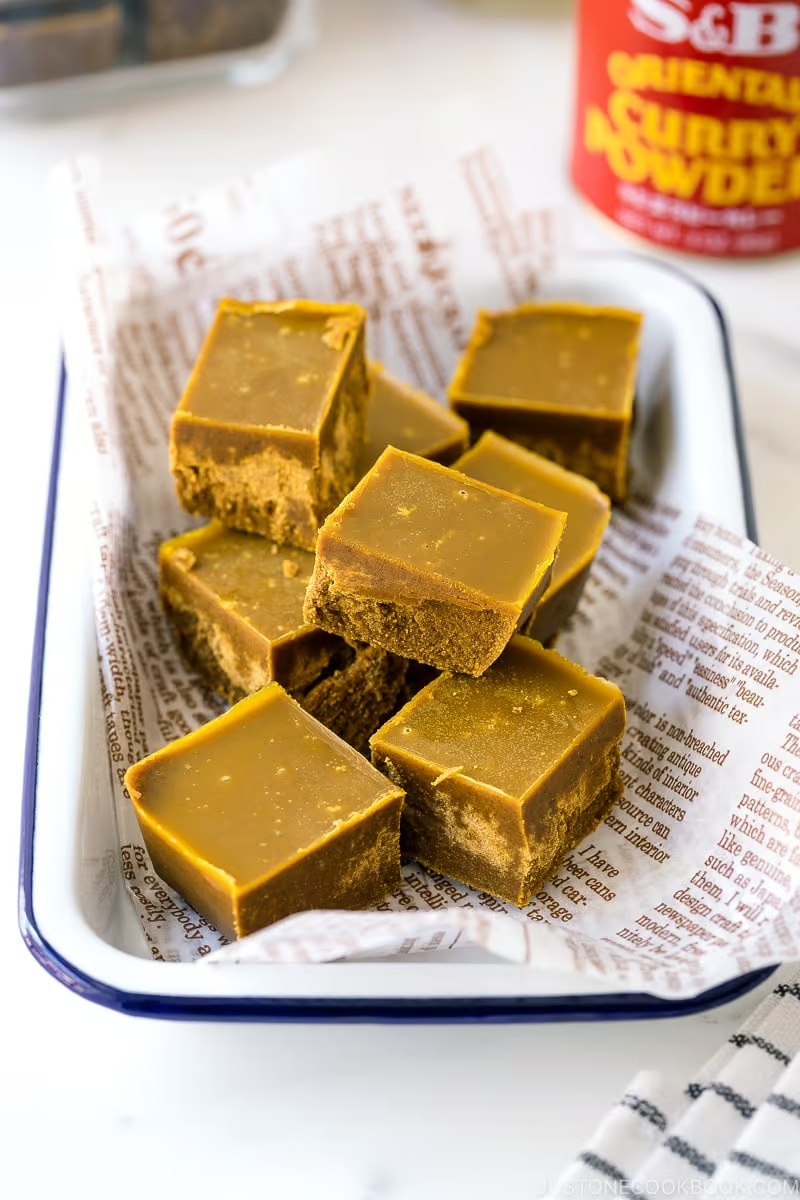
Homemade Japanese Curry Roux
Although the boxed stuff may spare you some time in the kitchen, you’ll be surprised at how easy it is to make your own Japanese Curry Roux at home.
And just like all curries, curry roux is best made from scratch. What are the other good reasons for homemade roux?
Tip #2: Cook the onion till tender and golden
The nicely browned onions add a ton of flavor to the final curry.
If you have an additional 5-10 minutes, caramelize the onion.
Tip #5: Do not forget to skim
Skimming is a significant step in Japanese cooking.
We skim the scum and impurities to achieve a refined taste. Get a fine mesh skimmer and fill up the measuring cup with water.
Tip #6: Add two cubes of curry roux at a time
Make sure all the curry roux cubes are dissolved completely.
You don’t want to bite into a chunk of curry cube while eating! Fill up a ladle with broth and add two cubes.
Tip #7: Watch out when simmering curry
Always watch the curry after you add the roux.
The thick curry sauce gets burnt easily at the bottom of the pot. Need to simmer uncovered for 10 minutes after adding curry roux.
Source video
Source video
Method Timeline
Prep
ActivePrep
20 min
Prep time from the source recipe card.
Cook
ActiveCook
50 min
Cook time from the source recipe card.
Total
PassiveTotal
1 hr 10 min
Total time from the source recipe card.
Step 1
Gather all the ingredients. Please read my blog post on the “secret ingredient” we add to the curry. For this recipe, I add ginger, garlic, apple, honey, soy sauce, and ketchup.
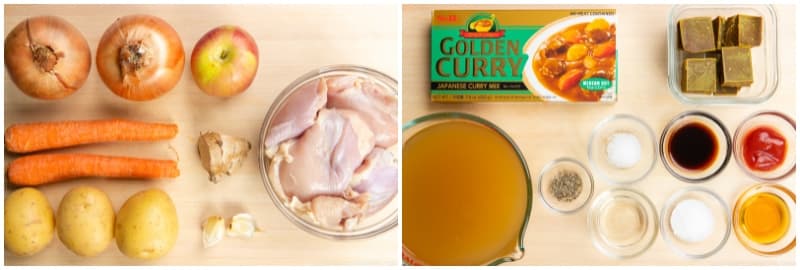
Image detailsGather all the ingredients. Please read my blog post on the “secret ingredient” we add to the curry. For this recipe, I add ginger, garlic, apple, honey, soy sauce, and ketchup.Just One Cookbook · Japanese Chicken Curry (Video) チキンカレーDev reference Inputs and tools6
Uses
- 1 tsp ginger ((grated))
- 2 cloves garlic
- ½ apple ((6 oz, 170 g))
- 1 Tbsp honey
- 1 Tbsp soy sauce
- 1 Tbsp ketchup
Step 2
Cut 2 onions into wedges. I like to have the texture of the onions in my curry, so I cut them into thick wedges. If you prefer, you can mince or thinly slice the onions so they disintegrate into the sauce.
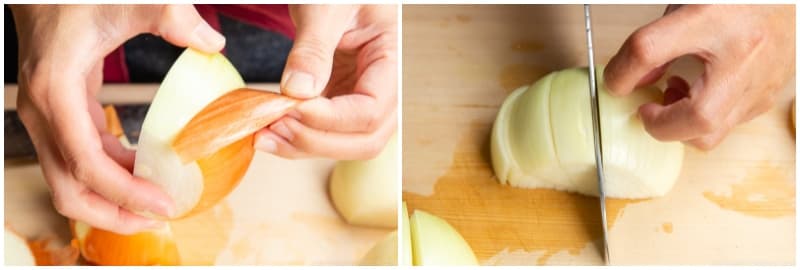
Image detailsCut 2 onions into wedges. I like to have the texture of the onions in my curry, so I cut them into thick wedges. If you prefer, you can mince or thinly slice the onions so they disintegrate into the sauce.Just One Cookbook · Japanese Chicken Curry (Video) チキンカレーDev reference Inputs and tools1
Uses
- 2 onions ((large; 1.5 lb, 670 g))
Step 3
Peel 2 carrots and cut them into rolling wedges (it‘s called rangiri in Japanese). This type of cut creates more surface area, which helps the carrots absorb more flavor and cook faster.
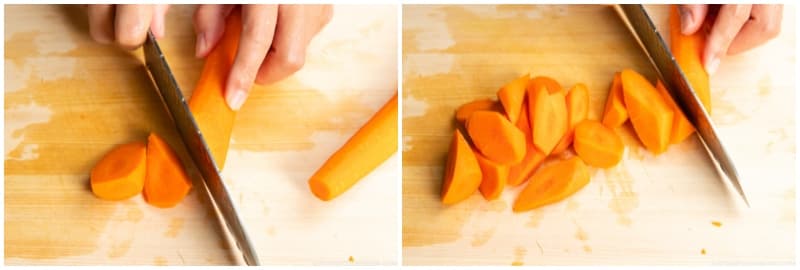
Image detailsPeel 2 carrots and cut them into rolling wedges (it‘s called rangiri in Japanese). This type of cut creates more surface area, which helps the carrots absorb more flavor and cook faster.Just One Cookbook · Japanese Chicken Curry (Video) チキンカレーDev reference Inputs and tools1
Uses
- 2 carrots ((6.7 oz, 190 g))
Step 4
Peel 3 Yukon gold potatoes and cut them into quarters. Soak them in water for 15 minutes to remove excess starch. Tip: Yukon gold potatoes hold their shape well. You can use russet potatoes, but they tend to disintegrate into the broth during cooking, so cut them into 6 pieces each and add to the pot toward the end of cooking.
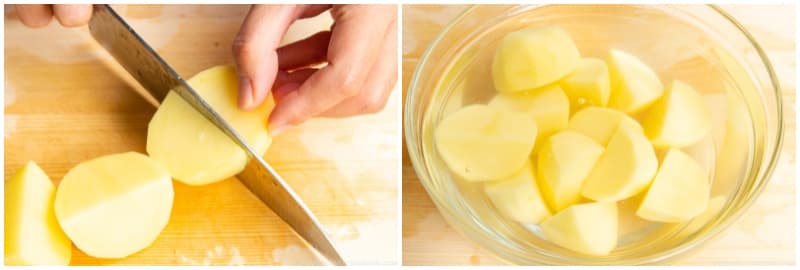
Image detailsPeel 3 Yukon gold potatoes and cut them into quarters. Soak them in water for 15 minutes to remove excess starch. Tip: Yukon gold potatoes hold their shape well. You can use russet potatoes, but they tend to disintegrate into the broth during cooking, so cut them into 6 pieces each and add to the pot toward the end of cooking.Just One Cookbook · Japanese Chicken Curry (Video) チキンカレーDev reference Checks1
TimingInfoTimingfor 15 minutes
Target: 15 minute
Expected state: Soak them in water for 15 minutes to remove excess starch.
Inputs and tools2
Uses
- 3 Yukon gold potatoes ((15 oz, 432 g))
- 4 cups chicken stock/broth ((for lower sodium, use water only or half stock and half water))
Why and source
This step has reviewed source-backed guidance.
Step 5
Grate the ginger (I use a ceramic grater) and measure 1 tsp ginger with the juice. Set aside. Mince 2 cloves garlic and set aside (I use a garlic press later when adding to the pot).
Step 6
Cut ½ apple into quarters, remove the core, and peel the skin.
Step 7
Grate the apple and set aside. Note: You also could use 1 small lunchbox apple for 8 servings.
Step 8
Cut off the extra fat from 1½ lb boneless, skinless chicken thighs and discard it. Then, cut the chicken into bite-sized pieces. I recommend cutting it diagonally (it‘s called sogigiri in Japanese) to create more surface area and flatten each piece so it cooks faster. Season with freshly ground black pepper. Tip: If you will use homemade curry roux, you can lightly season the chicken with kosher salt as well.
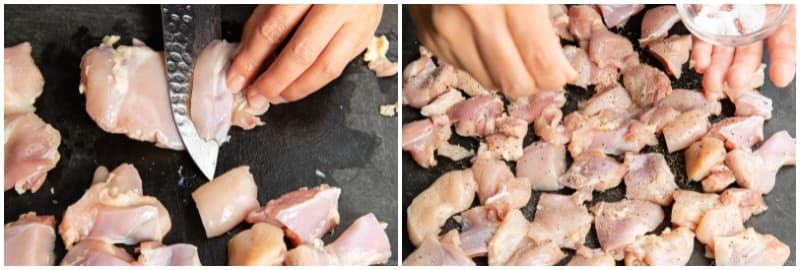
Image detailsCut off the extra fat from 1½ lb boneless, skinless chicken thighs and discard it. Then, cut the chicken into bite-sized pieces. I recommend cutting it diagonally (it‘s called sogigiri in Japanese) to create more surface area and flatten each piece so it cooks faster. Season with freshly ground black pepper. Tip: If you will use homemade curry roux, you can lightly season the chicken with kosher salt as well.Just One Cookbook · Japanese Chicken Curry (Video) チキンカレーDev reference Inputs and tools3
Uses
- 1½ lb boneless, skinless chicken thighs ((see Notes for substitutions))
- freshly ground black pepper
- 1 package Japanese curry roux
Step 9
Heat 1½ Tbsp neutral oil in a large pot over medium heat and add the onion.
medium heatPot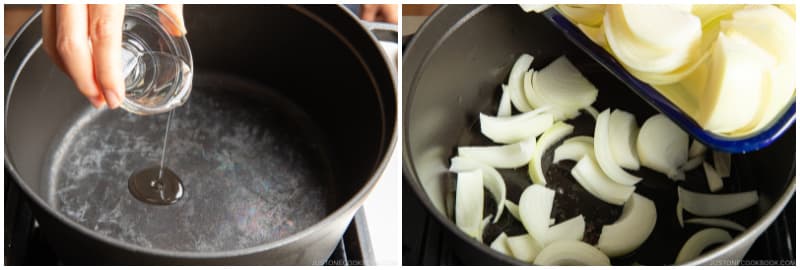
Image detailsHeat 1½ Tbsp neutral oil in a large pot over medium heat and add the onion.Just One Cookbook · Japanese Chicken Curry (Video) チキンカレーDev reference Inputs and tools2
Uses
- 1½ Tbsp neutral oil ((for cooking))
Equipment
Step 10
Sauté the onions, stirring occasionally, until they become translucent and tender, about 5 minutes. Don‘t stir them too often because they won’t develop a golden color. Cooked onions add amazing flavor, so don't skip this step. If you have extra time, definitely sauté the onions an additional 5 minutes to add more color and flavor.
5 min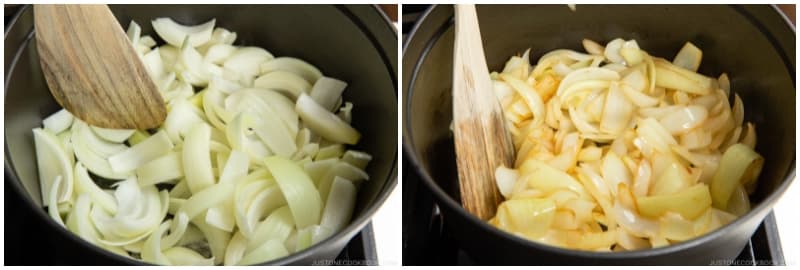
Image detailsSauté the onions, stirring occasionally, until they become translucent and tender, about 5 minutes. Don‘t stir them too often because they won’t develop a golden color. Cooked onions add amazing flavor, so don't skip this step. If you have extra time, definitely sauté the onions an additional 5 minutes to add more color and flavor.Just One Cookbook · Japanese Chicken Curry (Video) チキンカレーDev reference Visual cue
until they become translucent and tender, about 5 minutes.
Checks2
TextureInfoTextureuntil they become translucent and tender, about 5 minutes.
Expected state: until they become translucent and tender, about 5 minutes.
TimingInfoTimingabout 5 minutes
Target: 5 minute
Expected state: Sauté the onions, stirring occasionally, until they become translucent and tender, about 5 minutes.
Why and source
This step has reviewed source-backed guidance.
Step 11
Add the minced garlic (I pass it through a garlic press for a finer texture) and grated ginger and mix well together.
Step 12
Add the chicken and cook, stirring frequently, until it‘s no longer pink on the outside. If the onions are getting too brown, reduce the heat to medium low temporarily.
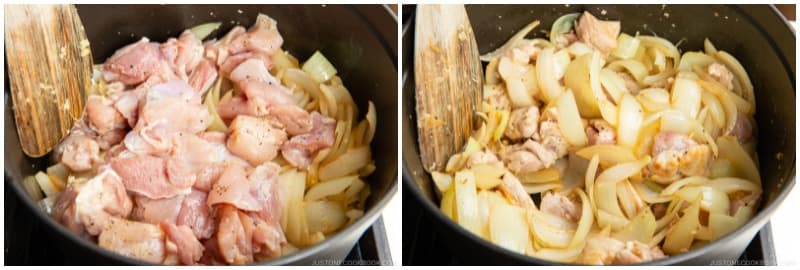
Image detailsAdd the chicken and cook, stirring frequently, until it‘s no longer pink on the outside. If the onions are getting too brown, reduce the heat to medium low temporarily.Just One Cookbook · Japanese Chicken Curry (Video) チキンカレーDev reference Visual cue
until it‘s no longer pink on the outside.
Checks1
Visual cueInfoVisualuntil it‘s no longer pink on the outside.
Expected state: until it‘s no longer pink on the outside.
Why and source
This step has reviewed source-backed guidance.
Step 13
Add 4 cups chicken stock/broth. To reduce the sodium, you can substitute with water only or use half stock and half water, if you prefer. Tip: If you‘re using my homemade curry roux, you don‘t need to worry as it does not contain salt.
Step 14
Add the grated apple, 1 Tbsp honey, 1 Tbsp soy sauce, and 1 Tbsp ketchup (or any condiment you choose to add). Please read my blog post for details.
Step 15
Add the carrots and Yukon gold potatoes (if you‘re using russet potatoes, add them later in the last 15–20 minutes of cooking). The broth should barely cover the ingredients. Don‘t worry; we don‘t want too much liquid here, and additional liquid will be released from the meat and vegetables.
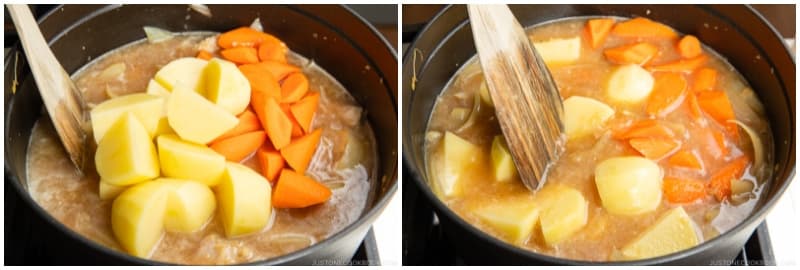
Image detailsAdd the carrots and Yukon gold potatoes (if you‘re using russet potatoes, add them later in the last 15–20 minutes of cooking). The broth should barely cover the ingredients. Don‘t worry; we don‘t want too much liquid here, and additional liquid will be released from the meat and vegetables.Just One Cookbook · Japanese Chicken Curry (Video) チキンカレーDev reference Checks1
TimingInfoTiming15–20 minutes
Target: 15-20 minute
Expected state: Add the carrots and Yukon gold potatoes (if you‘re using russet potatoes, add them later in the last 15–20 minutes of cooking).
Why and source
This step has reviewed source-backed guidance.
Step 16
Simmer, covered*, on medium-low heat for 15 minutes, stirring occasionally. *Simmer uncovered if the ingredients are completely submerged in the broth.
low heat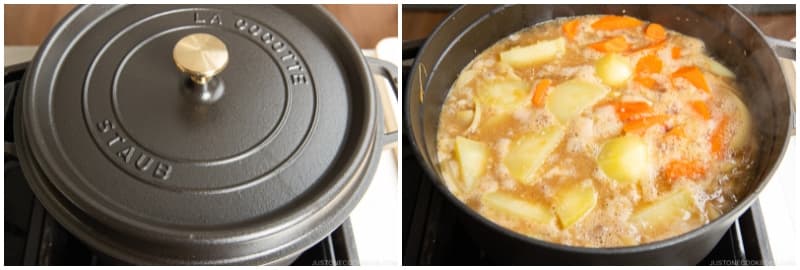
Image detailsSimmer, covered*, on medium-low heat for 15 minutes, stirring occasionally. *Simmer uncovered if the ingredients are completely submerged in the broth.Just One Cookbook · Japanese Chicken Curry (Video) チキンカレーDev reference Checks1
TimingInfoTimingfor 15 minutes
Target: 15 minute
Expected state: Simmer, covered*, on medium-low heat for 15 minutes, stirring occasionally. *Simmer uncovered if the ingredients are completely submerged in the broth.
Why and source
This step has reviewed source-backed guidance.
Step 17
Once boiling, use a fine-mesh strainer to skim the scum and foam from the surface of the broth.
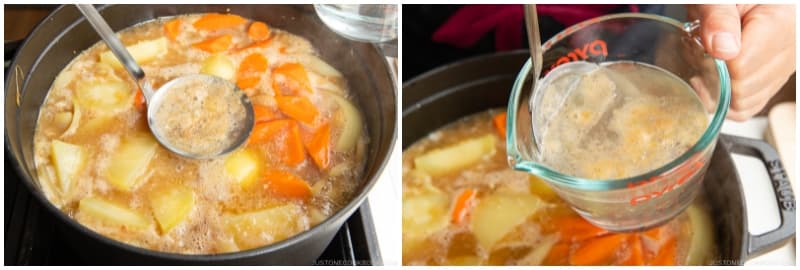
Image detailsOnce boiling, use a fine-mesh strainer to skim the scum and foam from the surface of the broth.Just One Cookbook · Japanese Chicken Curry (Video) チキンカレーDev reference Visual cue
Once boiling, use a fine-mesh strainer to skim the scum and foam from the surface of the broth.
Checks1
Visual cueInfoVisualOnce boiling, use a fine-mesh strainer to skim the scum and foam from the surface of the broth.
Expected state: Once boiling, use a fine-mesh strainer to skim the scum and foam from the surface of the broth.
Why and source
This step has reviewed source-backed guidance.
Step 18
Continue to cook covered until a wooden skewer goes through the carrots and potatoes.
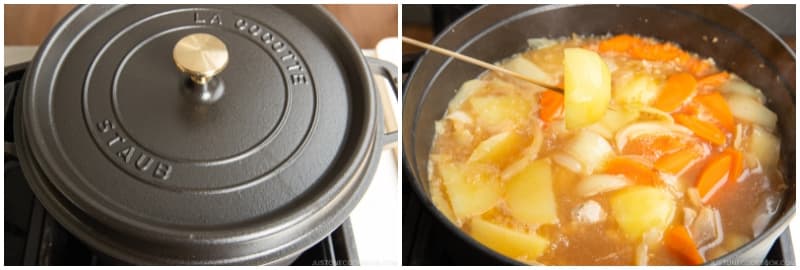
Image detailsContinue to cook covered until a wooden skewer goes through the carrots and potatoes.Just One Cookbook · Japanese Chicken Curry (Video) チキンカレーDev reference Visual cue
until a wooden skewer goes through the carrots and potatoes.
Checks1
Visual cueInfoVisualuntil a wooden skewer goes through the carrots and potatoes.
Expected state: until a wooden skewer goes through the carrots and potatoes.
Why and source
This step has reviewed source-backed guidance.
Step 19
Turn off the heat. From 1 package Japanese curry roux, put 1–2 cubes in a ladleful of cooking liquid. Slowly let it dissolve with a spoon or chopsticks and stir into the pot to incorporate. Repeat with the rest of the blocks, 2 cubes at a time. Tip: I use 1 full-sized box of store-bought curry roux, which is typically for 8–12 servings (be careful, as some brands offer a smaller box, which is 4 servings). With my homemade curry roux, I typically use 6–7 cubes for 8 servings (about 80% of the curry roux mixture if it hasn‘t solidified yet).
Warning:
be careful, as some brands offer a smaller box, which is 4 servings).
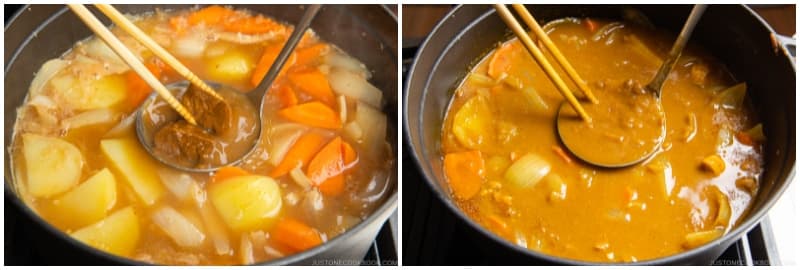
Image detailsTurn off the heat. From 1 package Japanese curry roux, put 1–2 cubes in a ladleful of cooking liquid. Slowly let it dissolve with a spoon or chopsticks and stir into the pot to incorporate. Repeat with the rest of the blocks, 2 cubes at a time. Tip: I use 1 full-sized box of store-bought curry roux, which is typically for 8–12 servings (be careful, as some brands offer a smaller box, which is 4 servings). With my homemade curry roux, I typically use 6–7 cubes for 8 servings (about 80% of the curry roux mixture if it hasn‘t solidified yet).Just One Cookbook · Japanese Chicken Curry (Video) チキンカレーDev reference Checks1
HoldingMain recipeSource holding instruction
Turn off the heat. From 1 package Japanese curry roux, put 1–2 cubes in a ladleful of cooking liquid. Slowly let it dissolve with a spoon or chopsticks and stir into the pot to incorporate. Repeat with the rest of the blocks, 2 cubes at a time. Tip: I use 1 full-sized box of store-bought curry roux, which is typically for 8–12 servings (be careful, as some brands offer a smaller box, which is 4 servings). With my homemade curry roux, I typically use 6–7 cubes for 8 servings (about 80% of the curry roux mixture if it hasn‘t solidified yet).
Why and source
This step has reviewed source-backed guidance.
Step 20
Simmer, uncovered, on medium-low heat, stirring frequently, until the curry becomes thick, about 5–10 minutes. If your curry is too thick, you can add water to thin the sauce. When you stir, make sure that no roux or food is stuck to the bottom of the pot; otherwise, it may burn.
low heat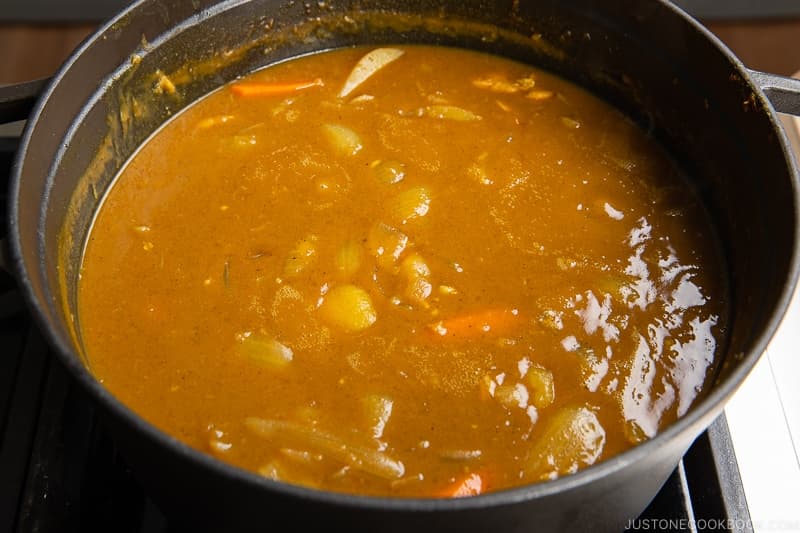
Image detailsSimmer, uncovered, on medium-low heat, stirring frequently, until the curry becomes thick, about 5–10 minutes. If your curry is too thick, you can add water to thin the sauce. When you stir, make sure that no roux or food is stuck to the bottom of the pot; otherwise, it may burn.Just One Cookbook · Japanese Chicken Curry (Video) チキンカレーDev reference Visual cue
until the curry becomes thick, about 5–10 minutes.
Checks2
TextureInfoTextureuntil the curry becomes thick, about 5–10 minutes.
Expected state: until the curry becomes thick, about 5–10 minutes.
TimingInfoTimingabout 5–10 minutes
Target: 5-10 minute
Expected state: Simmer, uncovered, on medium-low heat, stirring frequently, until the curry becomes thick, about 5–10 minutes.
Why and source
This step has reviewed source-backed guidance.
Step 21
If you use my unsalted homemade curry roux, taste the curry now and add salt to your liking. Tip: I recommend adding 2–4 tsp Diamond Crystal kosher salt, but this will vary based on the brand of the chicken broth and condiments you added.
Step 22
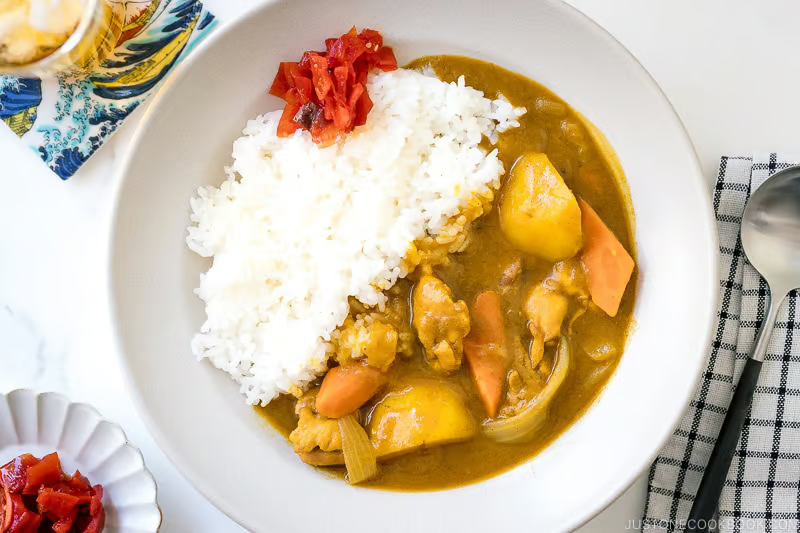
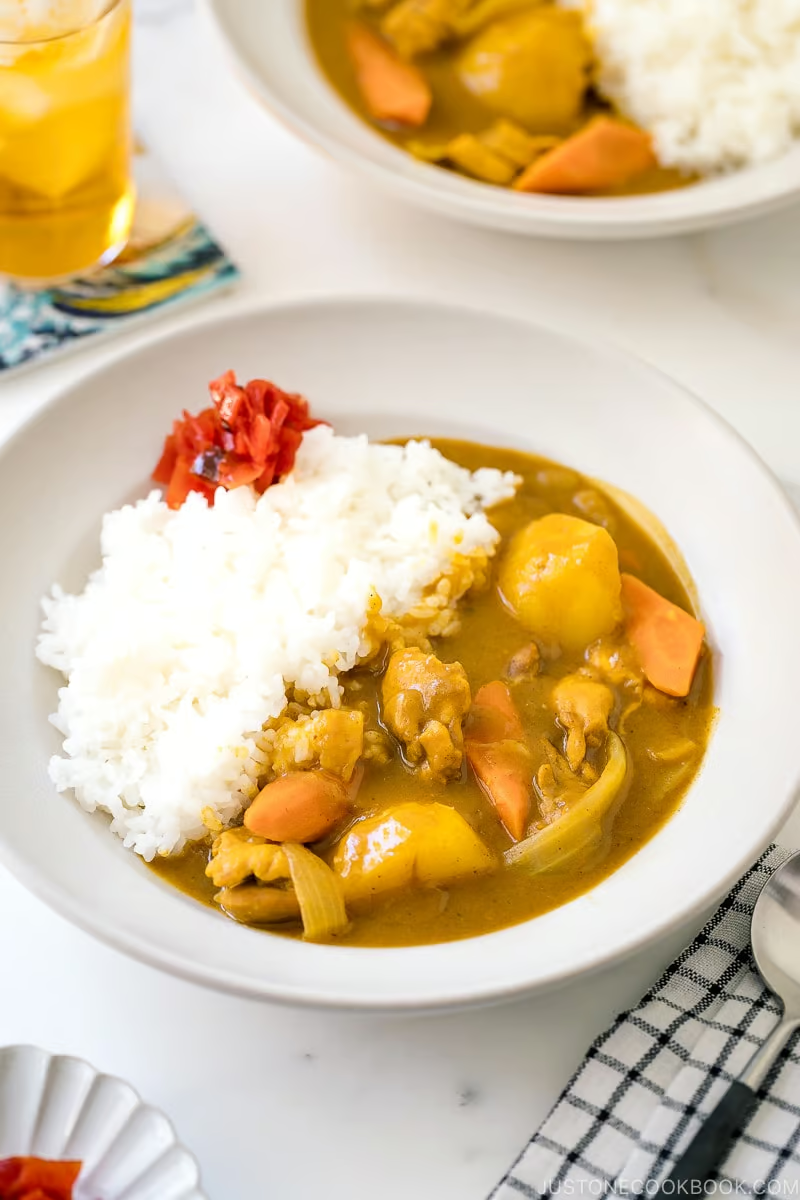
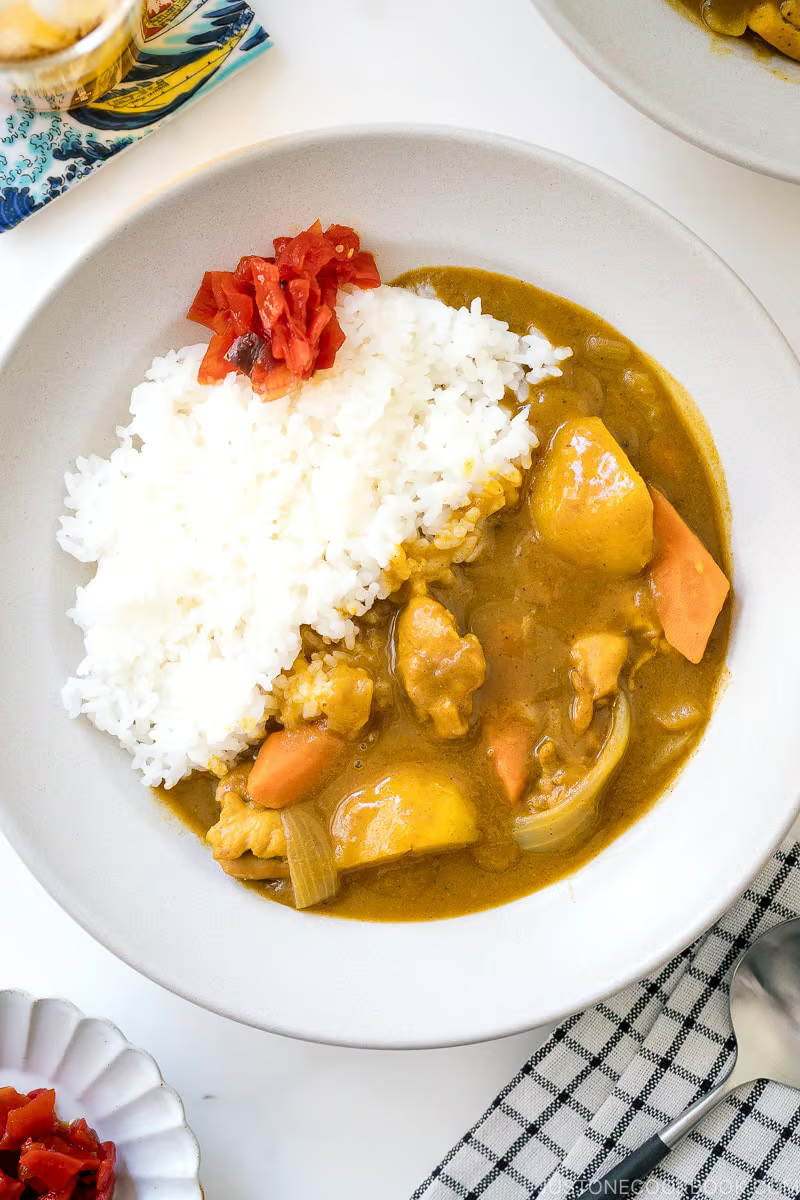
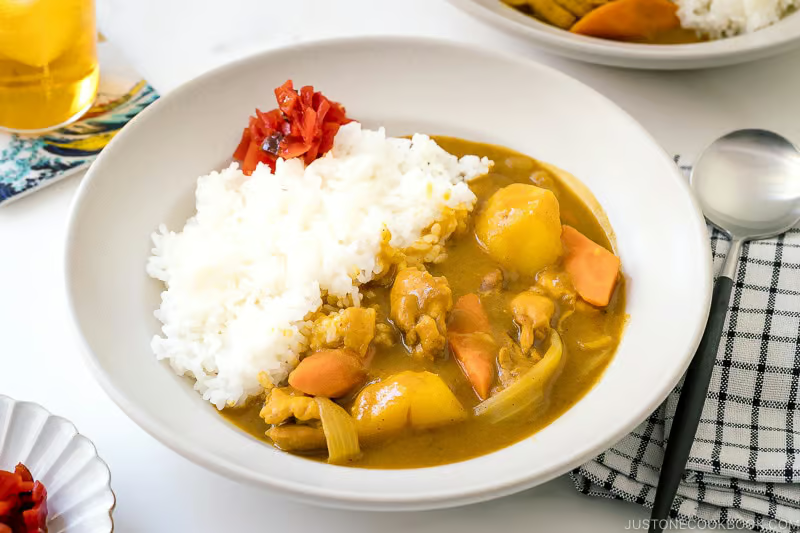
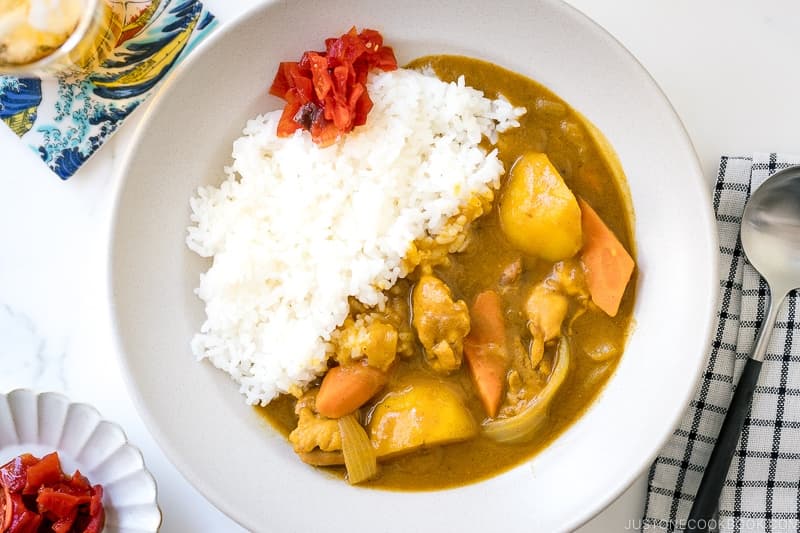
Serve the curry with steamed Japanese short-grain rice on the side. If you like, garnish with fukujinzuke (Japanese red pickled vegetables).
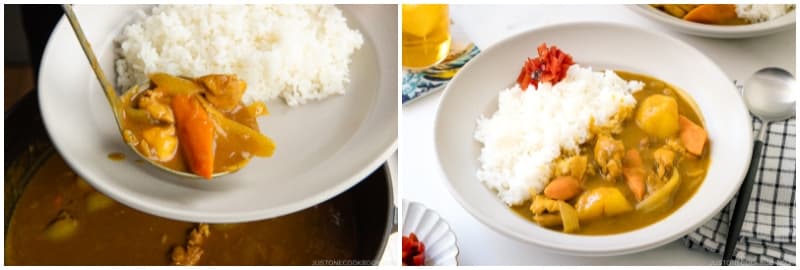
Image detailsServe the curry with steamed Japanese short-grain rice on the side. If you like, garnish with fukujinzuke (Japanese red pickled vegetables).Just One Cookbook · Japanese Chicken Curry (Video) チキンカレーDev reference Checks1
ServiceMain recipeSource service instruction
Serve the curry with steamed Japanese short-grain rice on the side. If you like, garnish with fukujinzuke (Japanese red pickled vegetables).
Inputs and tools2
Uses
- 8 servings cooked Japanese short-grain rice
- fukujinzuke (Japanese red pickled vegetables)
Why and source
This step has reviewed source-backed guidance.
Step 23
You can keep the leftovers in a glass airtight container (so no stains!) and store it in the refrigerator for up to 3 days and in the freezer for a month. The texture of the potatoes will change in the freezer, so you should take them out before freezing. Defrost the frozen curry in the refrigerator for 24 hours before you want to reheat it.
Step 24
Leftover curry sauce will thicken into a paste as it cools, so it tends to burn while reheating. To avoid this, stir ½ cup (120 ml) water or more into the leftover sauce until loosened. Then, gently reheat it on low heat. If the sauce seems thin, continue heating with the lid off to reduce the sauce.
low heat
Handling and Storage
Reviewed hold, storage, make-ahead, and service-timing guidance.
Tip #8: Make a big batch and store
Japanese curry is ideal for freezing.
I often cook up a big batch of leftovers and keep them in the refrigerator for a few days or in the freezer for up to a month. Starches like potatoes and sweet potatoes will change their texture after freezing, so remove them if you plan to freeze the curry.
What to Serve with Japanese Curry
We typically serve the Japanese curry over rice alongside fukujinzuke, a relish made of finely chopped vegetables such as daikon, eggplant, and lotus root, pickled in a soy sauce-based liquid.
It will warm you right up! I hope you enjoy this delicious Japanese Chicken Curry recipe!
For Serving
8 servings cooked Japanese short-grain rice fukujinzuke (Japanese red pickled vegetables) (optional; or make my Homemade Fukujinzuke).
Learn More
Extra cooking notes, tests, and source details kept out of the step-by-step method.
Why this works
Quick kitchen reasons behind the main choices.
The Base Flavor – Japanese Curry Roux
The reason why we can make Japanese curry in a short time is that we use the convenient Japanese Curry Sauce Mix (curry roux カレールー) that comes in a box.
The curry roux imparts a unique depth of aromatic spice flavor and creaminess to the dish. I’m not a big fan of “instant” or boxed food, but I have to say Japanese Curry Roux is an exception!
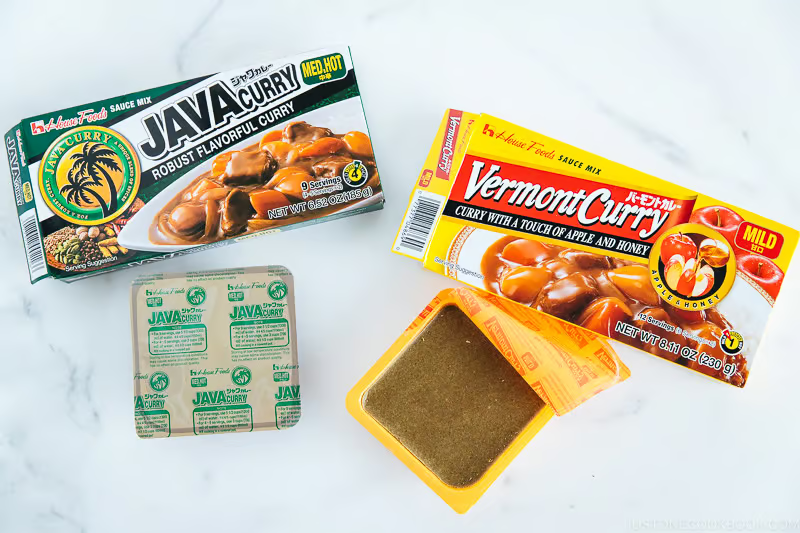
Spice Level
Each brand of curry roux usually comes with three levels of spiciness — Mild, Medium, or Hot.
Since these are packaged for Japanese taste, the hot level is not nearly as spicy as Thai or Indian curry.
Too Salty?
Some of you may find the pre-boxed curry roux salty, and I agree.
It does have a strong (salty) taste, which is why it goes well with plain steamed rice. The Japanese palate, in general, is gravitated to salty, savory foods.
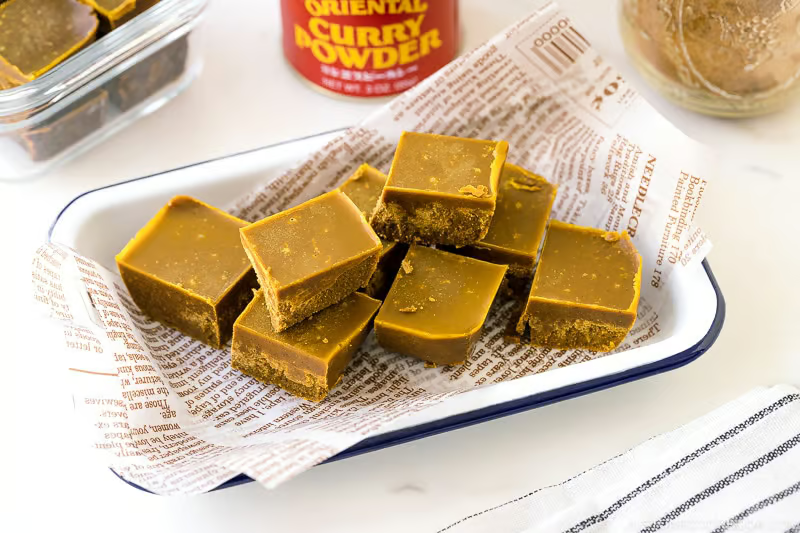
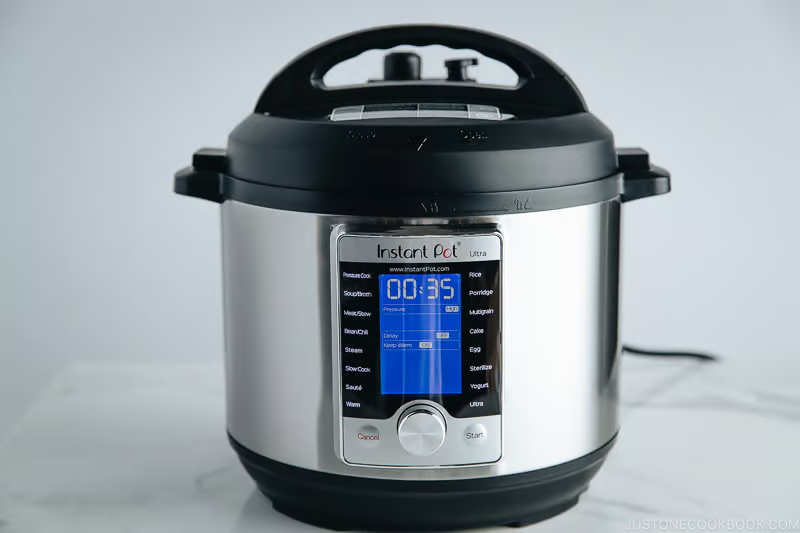
Make Japanese Curry in a Pressure Cooker
Do you own an Instant Pot or a pressure cooker?
You can also prepare this comfort dish using my Instant Pot (Pressure Cooker) Japanese Curry recipe.
For the Curry Sauce
1½ Tbsp neutral oil (for cooking) 4 cups chicken stock/broth (for lower sodium, use water only or half stock and half water) 1 Tbsp honey 1 Tbsp soy sauce 1 Tbsp ketchup 1 package Japanese curry roux (7–8 oz or 200–230 g; or make my Japanes
Article photos
Photos used with the article notes.
Source: Japanese Chicken Curry (Video) チキンカレー
Recipe structure
Components and intermediate outputs created by the method.
Main recipe
Recipe card ingredients and steps.
8, 8 (the leftovers freeze well!)
Garnish
Source step 22 creates or uses garnish.
Mixture
Source step 19 creates or uses mixture.
Paste
Source step 24 creates or uses paste.
Sauce
Source step 1 creates or uses sauce.
Extra useful notes
Short source-backed recommendations and facts that do not need a step.
Substitutions: You can substitute the chicken with beef, pork, shrimp, seafood, tofu, mushrooms, and other vegetables.
Substitutions: You can substitute the chicken with beef, pork, shrimp, seafood, tofu, mushrooms, and other vegetables. Since tofu, mushrooms, and vegetables cook quickly, you may not need to simmer them for 15 minutes, except for dense root vegetables like carrots and potatoes here. You can sauté mushrooms and softer vegetables (squash, zucchini, eggplant, etc.) and simmer for 5 minutes or until tender. If you use tofu, you just need to warm it up as it’s is already fully cooked. I recommend draining tofu for 15 minutes prior to use and adding it right after you add the curry roux. Warm it up for the last 5–10 minutes.
Recipe Utilities
Account actions, source details, export, and reporting stay available without interrupting the cooking flow.
Source and Origin
Origin declaration
Adapted from source
Imported from the just-one-cookbook page for dev review.
Copy risk: Unchecked
Japanese Chicken Curry (Video) チキンカレー
Article
View source
My Kitchen Actions
Login is required.
My Kitchen keeps saved recipes, private notes, adaptations, cooking logs, imports, and exports tied to your account.
Export
Public recipe exports include only approved public content. Personal backup exports require login.
Export history
No exports yet.