Chicken Katsu
Make Chicken Katsu at home—crispy, juicy, and ready in 30 minutes. Master this easy Japanese cutlet recipe with simple ingredients for a restaurant-worthy meal.
- Total time
- 30 min
- Active time
- 20 min
- Yield
- 2
- Difficulty
- Medium
Ingredients and Constraints
Ingredients
- Optional
- Optional
- Optional
Ingredient watchpoints3 watchpoints
Short requirements and tradeoffs to check while gathering ingredients; detailed source notes stay expandable.
Green Cabbage
shredded green cabbage ((optional))
The source row includes a form, size, temperature, preparation, or handling detail.
Details and source
Source: Chicken Katsu (Video) チキンカツ
Japanese Sesame Dressing
Japanese Sesame Dressing ((optional))
The source row includes a form, size, temperature, preparation, or handling detail.
Details and source
Source: Chicken Katsu (Video) チキンカツ
Tomatoes
tomato ((optional))
The source row includes a form, size, temperature, preparation, or handling detail.
Details and source
Source: Chicken Katsu (Video) チキンカツ
Additional ingredient notes
Ingredients for Chicken Katsu
Chicken breasts – boneless and skinless Kosher salt and black pepper All purpose flour Large eggs Panko (Japanese breadcrumbs) Neutral oil Tonkatsu sauce Find the printable recipe with measurements below.
JUMP TO RECIPE Substitutions Chicken breast: You could make it with chicken thighs or tenders. Dark meat takes longer to cook, so add 1–2 minutes of frying time for thighs. Panko: Japanese breadcrumbs have larger, lighter flakes and make a more delicate breading. I highly recommend using panko over traditional ground breadcrumbs. Oil: Any neutral-flavored oil will do, such as canola oil or vegetable oil. Tonkatsu sauce: Store-bought does a fine job, though I prefer making easy Homemade Tonkatsu Sauce with Worcestershire sauce, ketchup, soy sauce, and sugar.
Substitutions
Chicken breast: You could make it with chicken thighs or tenders.
Dark meat takes longer to cook, so add 1–2 minutes of frying time for thighs. Panko: Japanese breadcrumbs have larger, lighter flakes and make a more delicate breading. I highly recommend using panko over traditional ground breadcrumbs. Oil: Any neutral-flavored oil will do, such as canola oil or vegetable oil. Tonkatsu sauce: Store-bought does a fine job, though I prefer making easy Homemade Tonkatsu Sauce with Worcestershire sauce, ketchup, soy sauce, and sugar.
Ingredients US CUSTOMARY METRIC 1X 2X 3X
1 piece boneless, skinless chicken breast (9.5 oz, 270 g; or use the same weight of chicken thighs or tenders) ½ tsp Diamond Crystal kosher salt ⅛ tsp freshly ground black pepper 3 cups neutral oil (for deep-frying; enough for 1½ inches (3.
Before You Cook
Constraints, controls, and warnings to review before starting.
Decisions before cookingDetails1
Reviewed comparisons and tradeoffs that affect the path before the first active step.
What can I use instead of panko breadcrumbs?
You can use regular breadcrumbs in a pinch, but the texture will be denser than light and fluffy panko with its signature crunch.
Method Overview
Structured method notes that are separate from the step timeline.
Cooking
Deep fry one cutlet at a time in 340 °F (170 °C) oil for about 3 minutes, turning once, until golden brown.
Set on a wire rack or plate lined with paper towels.
Nami’s Recipe Tips
Fry singly in a skillet or pot to keep the oil hot and the crust light.
Watch the temperature—an instant-read thermometer takes out the guesswork. Shake off excess flour so loose crumbs don’t burn and darken the oil.
Source video
Source video
Method Timeline
Prep
ActivePrep
20 min
Prep time from the source recipe card.
Cook
ActiveCook
10 min
Cook time from the source recipe card.
Total
PassiveTotal
30 min
Total time from the source recipe card.
Step 1
If you prefer not to deep-fry, see my recipe for Baked Chicken Katsu.
Step 2
Gather all the ingredients.
Step 3
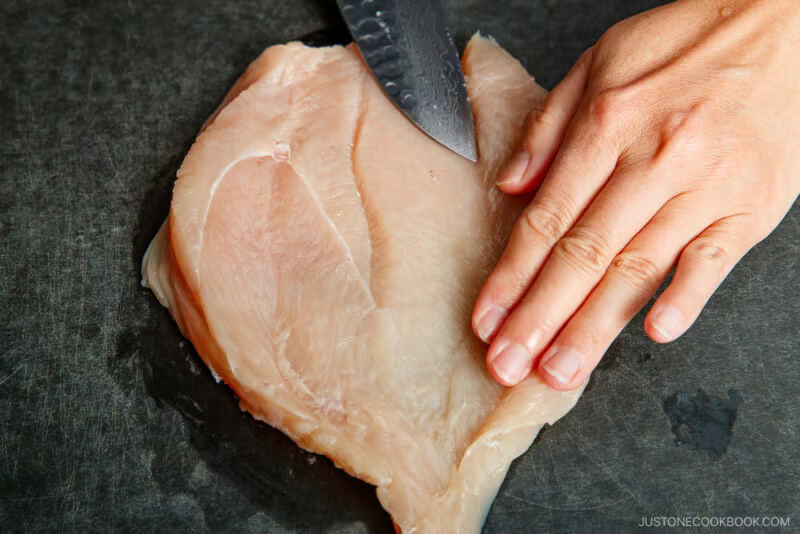
Butterfly the chicken breast so the meat is thinner and cooks faster; read more about it in my blog post and watch how in my video. You can use one of two methods. You can split the breast horizontally from the side with a knife, stopping before you cut all the way through. Then, open it like a book. The two sides will mirror each other, resembling a butterfly. Alternatively, you could use the Japanese cutting technique Kannon biraki (観音開き) that I demonstrate here. With a sharp knife, score the top of 1 piece boneless, skinless chicken breast down the middle about halfway through the thickness of the breast; do not cut completely through.
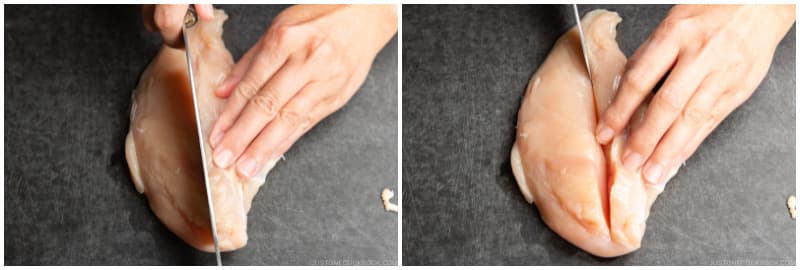
Image detailsButterfly the chicken breast so the meat is thinner and cooks faster; read more about it in my blog post and watch how in my video. You can use one of two methods. You can split the breast horizontally from the side with a knife, stopping before you cut all the way through. Then, open it like a book. The two sides will mirror each other, resembling a butterfly. Alternatively, you could use the Japanese cutting technique Kannon biraki (観音開き) that I demonstrate here. With a sharp knife, score the top of 1 piece boneless, skinless chicken breast down the middle about halfway through the thickness of the breast; do not cut completely through.Just One Cookbook · Chicken Katsu (Video) チキンカツDev reference Inputs and tools1
Uses
- 1 piece boneless, skinless chicken breast
Step 4
Then, turn the knife parallel to the cutting board and slice from the center toward the left side (or the right side, if you‘re left-handed) to make it evenly thin. Stop before you cut all the way through, and open it like a book. Imagine we‘re creating a French door.
Step 5
Turn the chicken 180 degrees and butterfly the second side, creating another “door.“
Step 6
Cut the chicken in half down the center. Now, you have two pieces.
Step 7
With a meat mallet or the back of the knife, pound the chicken pieces to an even thickness of about ¼–½ inch (6 mm–1.3 cm).
Step 8
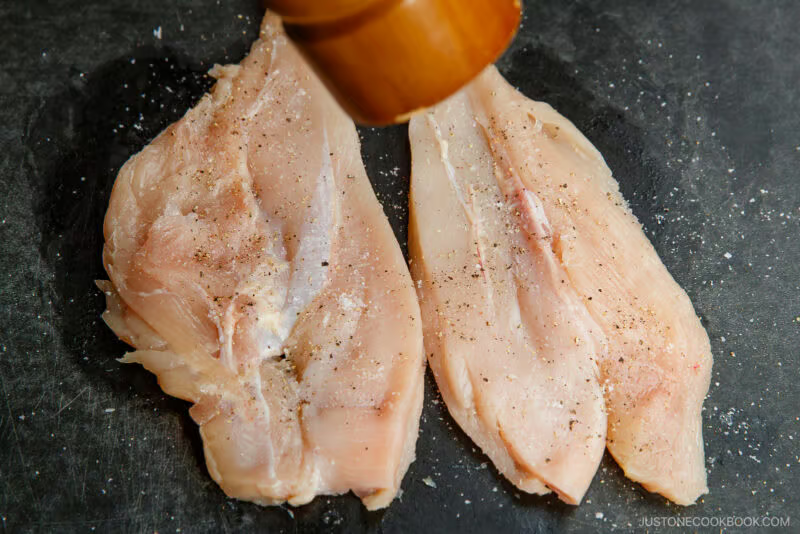
Season both sides with ½ tsp Diamond Crystal kosher salt and ⅛ tsp freshly ground black pepper.
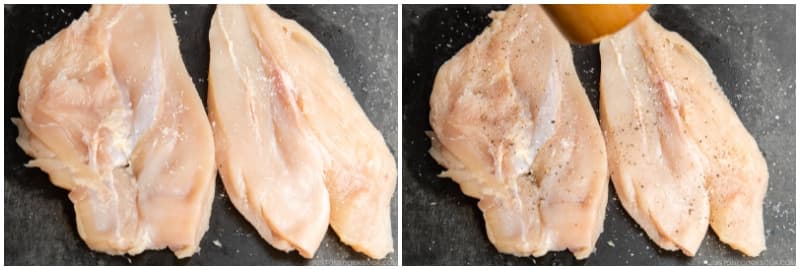
Image detailsSeason both sides with ½ tsp Diamond Crystal kosher salt and ⅛ tsp freshly ground black pepper.Just One Cookbook · Chicken Katsu (Video) チキンカツDev reference Inputs and tools2
Uses
- ½ tsp Diamond Crystal kosher salt
- ⅛ tsp freshly ground black pepper
Step 9
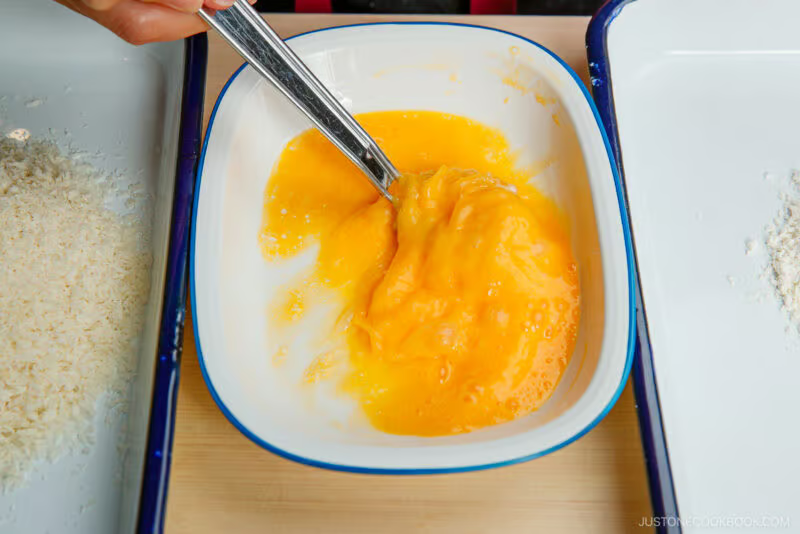
Add 3 cups neutral oil to a medium-size, heavy-bottomed pot (I use a Staub 2.75 QT Dutch oven, 11 inches in diameter). Add enough so the oil is 1½ inches (3.8 cm) deep; dip a chopstick in it to measure. Start preheating it to 340ºF (170ºC) over medium-low heat (or low heat, if you need more time to bread the chicken). For the breading, prepare three bowls or trays: One with 3 Tbsp all-purpose flour (plain flour), one with 1 cup panko (Japanese breadcrumbs), and one with 1 large egg (50 g each w/o shell).
low heat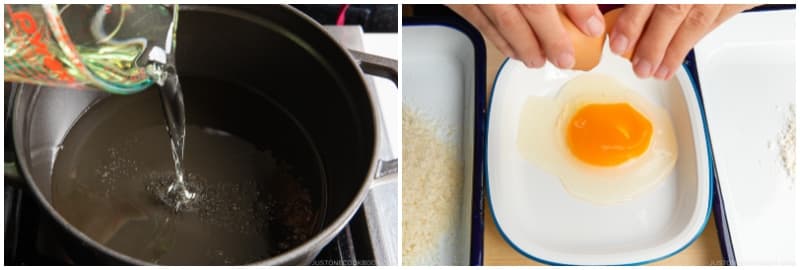
Image detailsAdd 3 cups neutral oil to a medium-size, heavy-bottomed pot (I use a Staub 2.75 QT Dutch oven, 11 inches in diameter). Add enough so the oil is 1½ inches (3.8 cm) deep; dip a chopstick in it to measure. Start preheating it to 340ºF (170ºC) over medium-low heat (or low heat, if you need more time to bread the chicken). For the breading, prepare three bowls or trays: One with 3 Tbsp all-purpose flour (plain flour), one with 1 cup panko (Japanese breadcrumbs), and one with 1 large egg (50 g each w/o shell).Just One Cookbook · Chicken Katsu (Video) チキンカツDev reference Inputs and tools5
Uses
- 3 cups neutral oil ((for deep-frying; enough for 1½ inches (3.8 cm) of oil in the pot))
- 3 Tbsp all-purpose flour (plain flour)
- 1 cup panko (Japanese breadcrumbs)
- 1 large egg (50 g each w/o shell)
- ½ Tbsp neutral oil ((for the egg))
Step 10
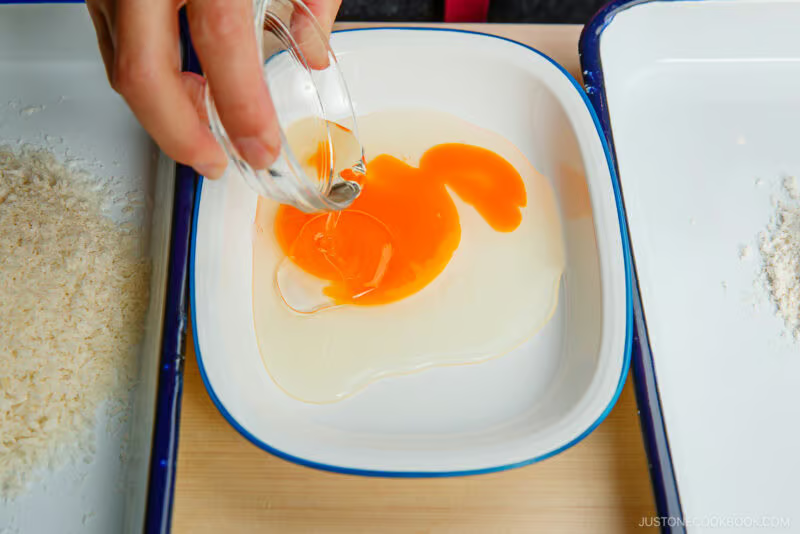
Add ½ Tbsp neutral oil to the egg and whisk it together. Tip: By adding oil, the breading won’t detach from the chicken while deep-frying and this will help seal in the chicken's juices and flavor.
Step 11
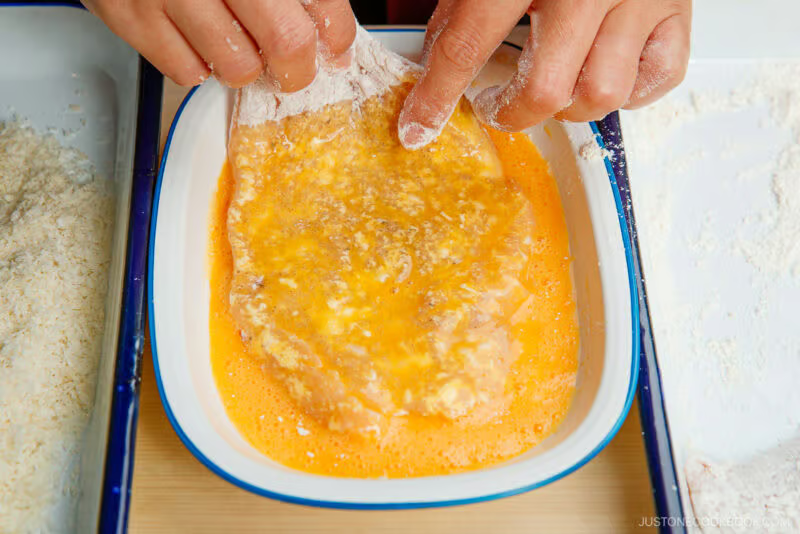
Dredge the chicken in flour and shake off the excess. Then, coat it with the egg mixture.
Step 12
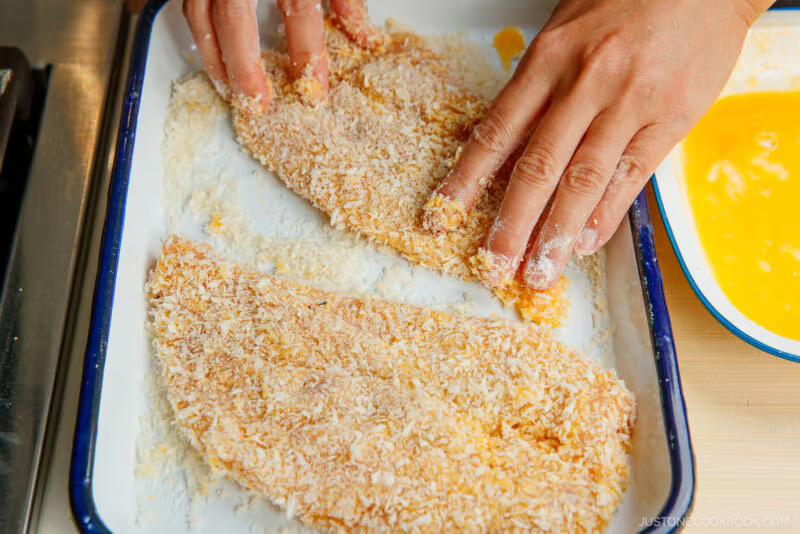
Finally, coat the chicken with panko and gently press it to adhere to the cutlet. Gently shake off any excess, then place the breaded cutlet onto a tray or plate. Repeat with the other piece.
Step 13
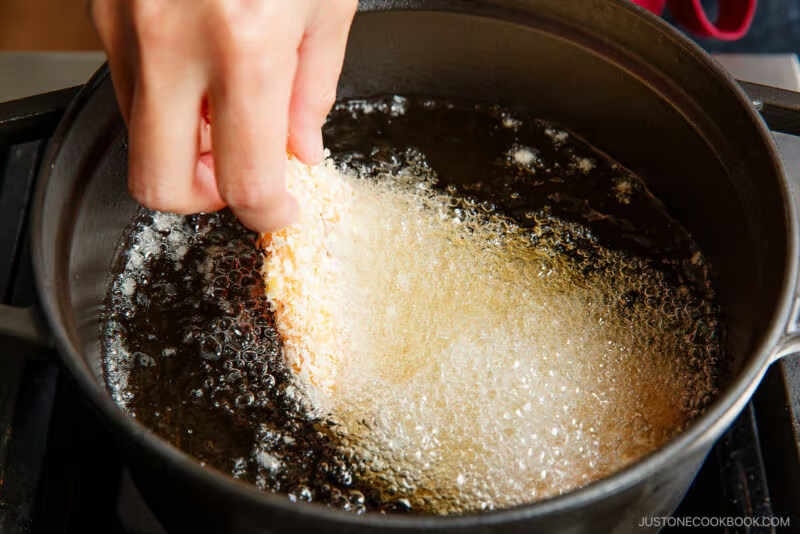
If the oil isn't hot enough (340ºF or 170ºC), increase the heat to medium. Once it reached the right temperature, carefully add one breaded cutlet to the oil. I recommend frying one at a time, as adding too many will lower the oil temperature too fast. Keep the heat on medium and adjust as needed to maintain the right temperature. Nami's tip: If you are new to deep-frying, learn more tips on my How to Deep Fry Food page. I recommend using an instant-read thermometer to monitor the oil temperature.
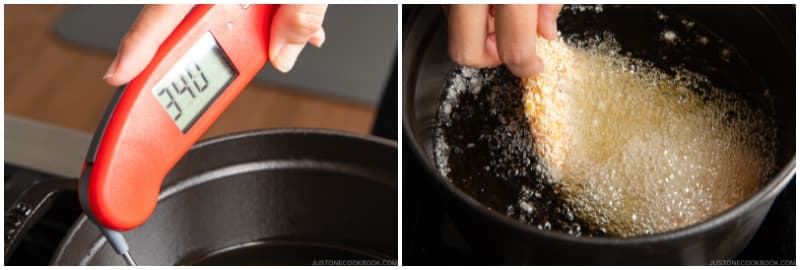
Image detailsIf the oil isn't hot enough (340ºF or 170ºC), increase the heat to medium. Once it reached the right temperature, carefully add one breaded cutlet to the oil. I recommend frying one at a time, as adding too many will lower the oil temperature too fast. Keep the heat on medium and adjust as needed to maintain the right temperature. Nami's tip: If you are new to deep-frying, learn more tips on my How to Deep Fry Food page. I recommend using an instant-read thermometer to monitor the oil temperature.Just One Cookbook · Chicken Katsu (Video) チキンカツDev reference Visual cue
Once it reached the right temperature, carefully add one breaded cutlet to the oil.
Checks1
Visual cueInfoVisualOnce it reached the right temperature, carefully add one breaded cutlet to the oil.
Expected state: Once it reached the right temperature, carefully add one breaded cutlet to the oil.
Why and source
This step has reviewed source-backed guidance.
- Source: Chicken Katsu (Video) チキンカツ
Step 14
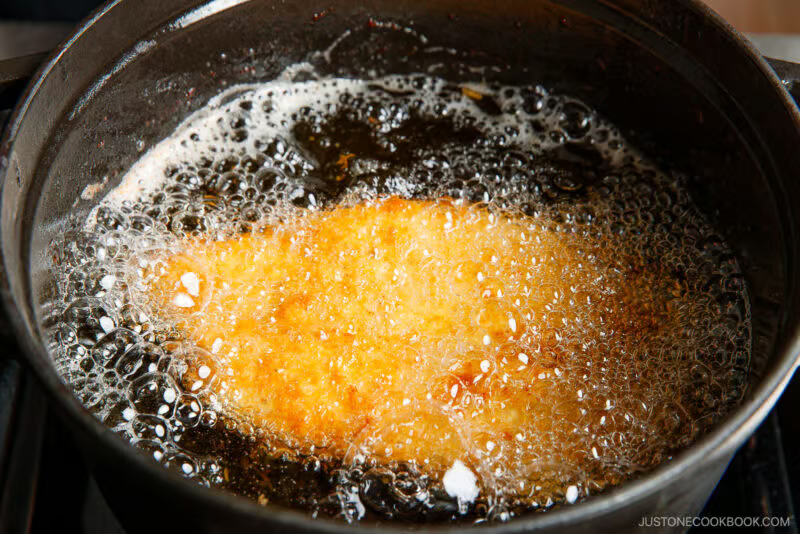
Deep-fry for a total of 3 minutes, flipping it over at the halfway point. Tip: Do not overcrowd the pot. Your ingredients should take up no more than about half of the oil surface area. If you add too much food, the temperature will drop quickly and the chicken will absorb too much oil.
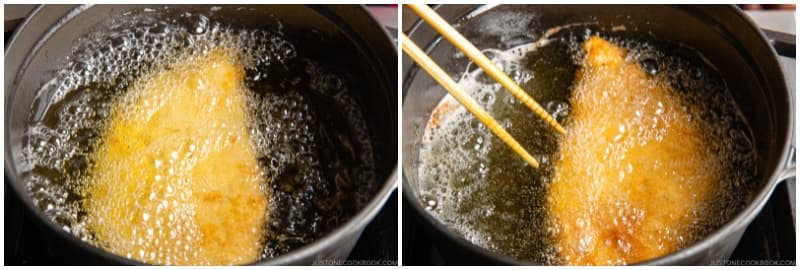
Image detailsDeep-fry for a total of 3 minutes, flipping it over at the halfway point. Tip: Do not overcrowd the pot. Your ingredients should take up no more than about half of the oil surface area. If you add too much food, the temperature will drop quickly and the chicken will absorb too much oil.Just One Cookbook · Chicken Katsu (Video) チキンカツDev reference Checks1
TimingInfoTiming3 minutes
Target: 3 minute
Expected state: Deep-fry for a total of 3 minutes, flipping it over at the halfway point.
Why and source
This step has reviewed source-backed guidance.
- Source: Chicken Katsu (Video) チキンカツ
Step 15
Cook until both sides are golden brown. Remove the chicken and let the oil drip off by holding the cutlet vertically over the pot for a few seconds. Then, transfer it to a wire rack or tray lined with paper towels. If possible, keep it on its side to drain excess oil.
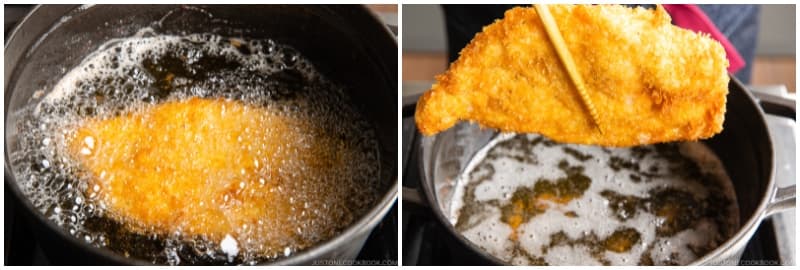
Image detailsCook until both sides are golden brown. Remove the chicken and let the oil drip off by holding the cutlet vertically over the pot for a few seconds. Then, transfer it to a wire rack or tray lined with paper towels. If possible, keep it on its side to drain excess oil.Just One Cookbook · Chicken Katsu (Video) チキンカツDev reference Visual cue
until both sides are golden brown.
Checks1
Visual cueInfoVisualuntil both sides are golden brown.
Expected state: until both sides are golden brown.
Why and source
This step has reviewed source-backed guidance.
- Source: Chicken Katsu (Video) チキンカツ
Step 16
Scoop up and discard any fried crumbs in the oil with a fine-mesh strainer. Then, cook the other cutlet. Tip: Throughout cooking, keep the oil clean of crumbs, which can burn and make the oil dark and dirty.
Step 17
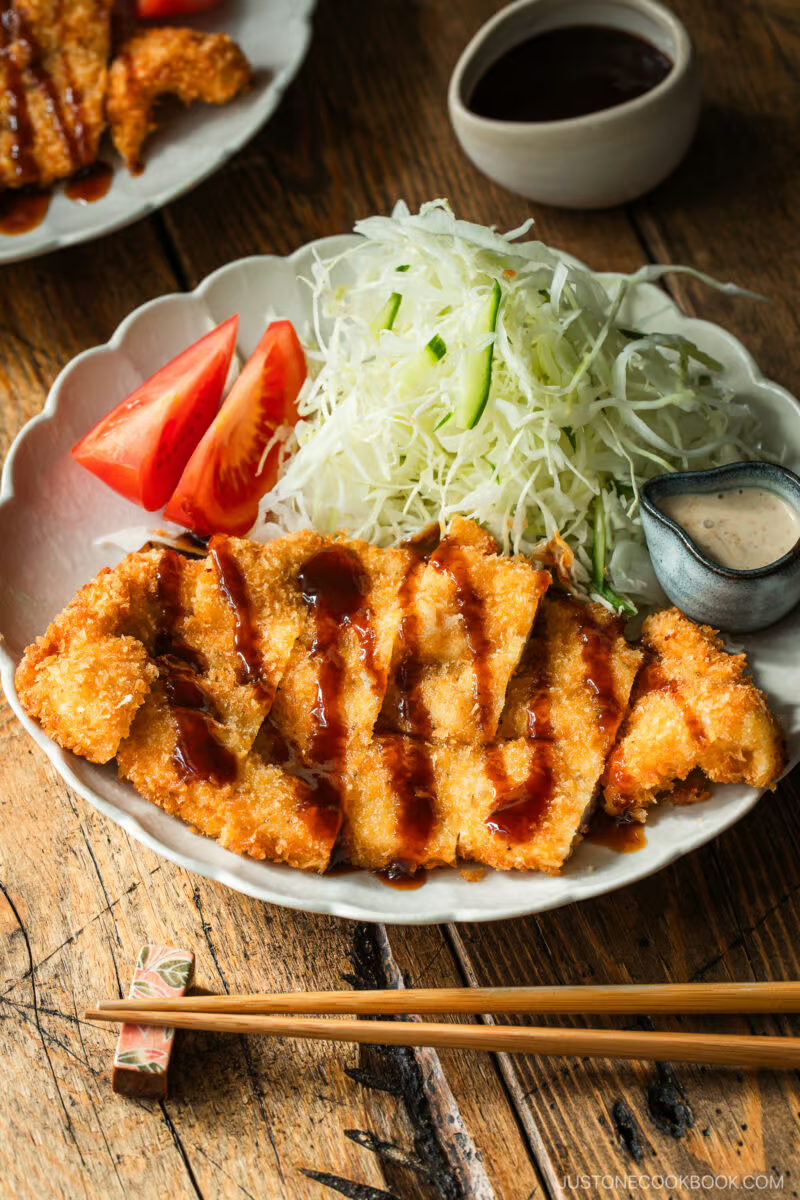
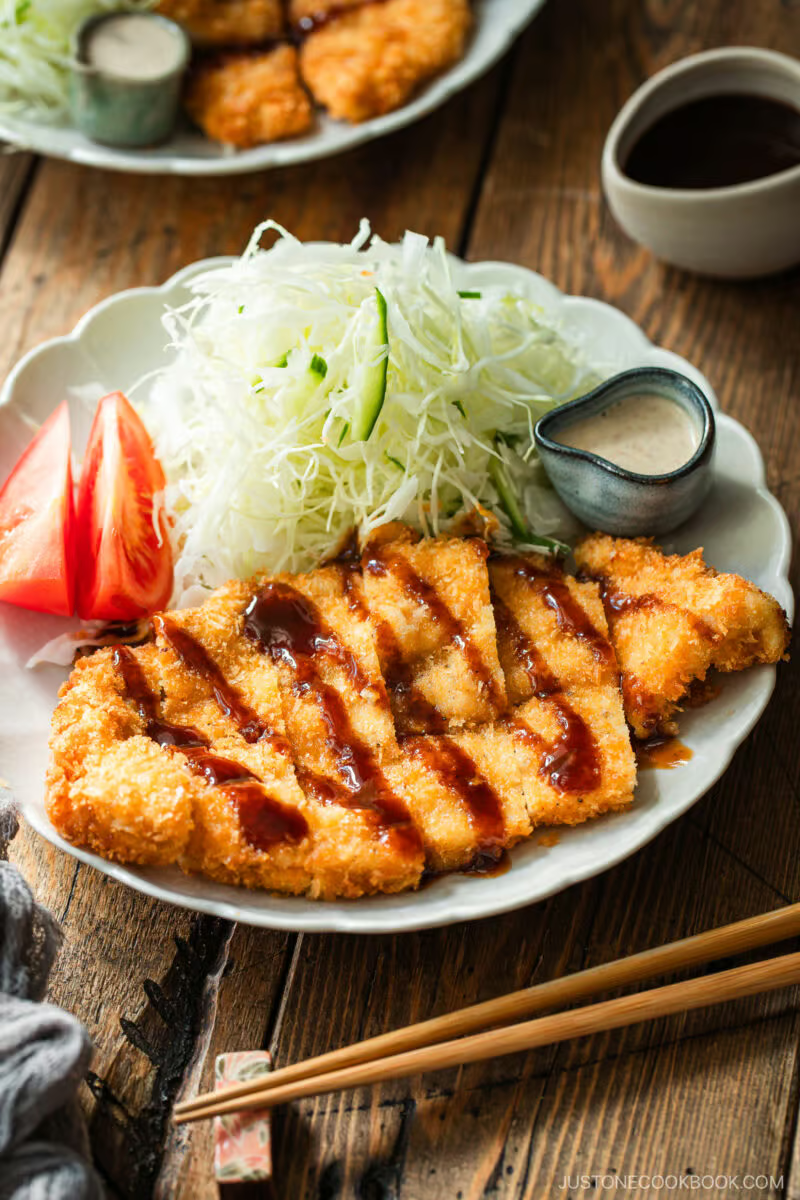
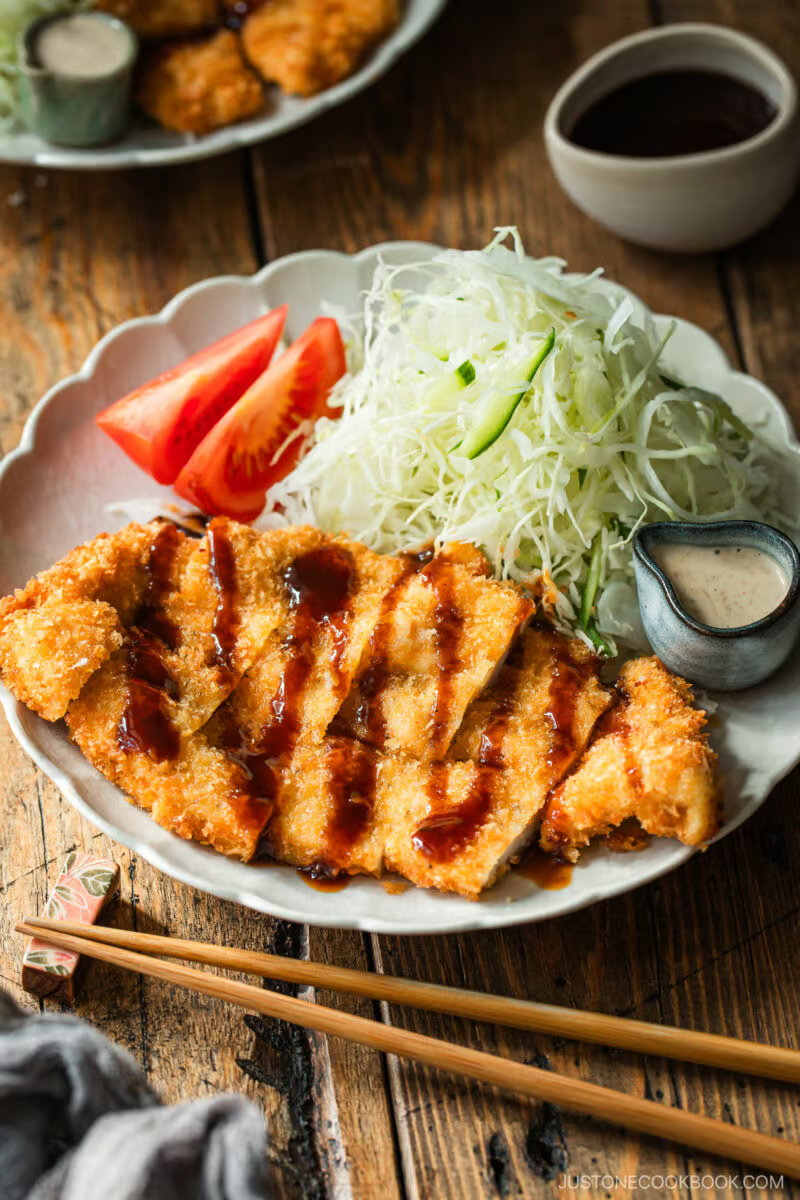
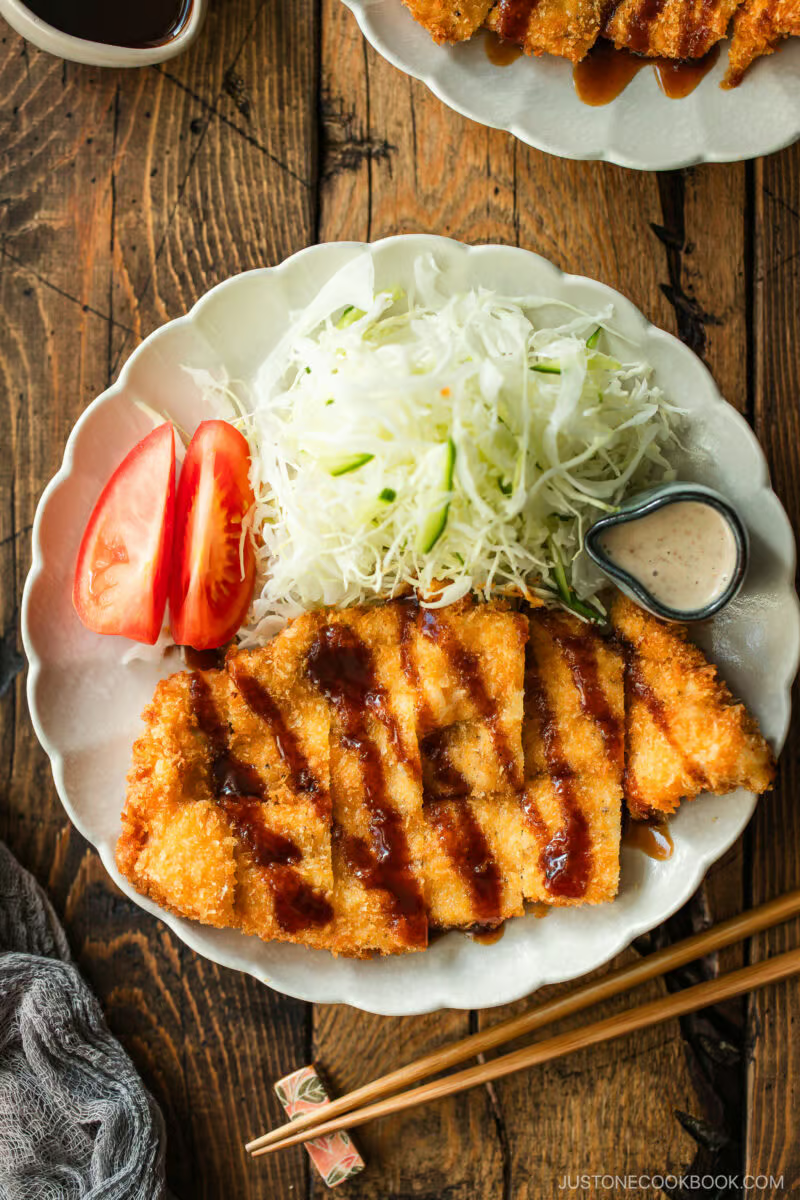
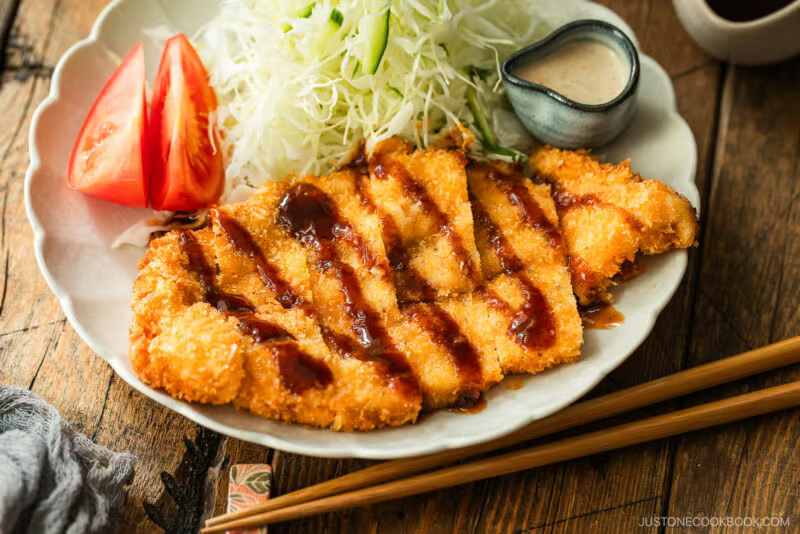
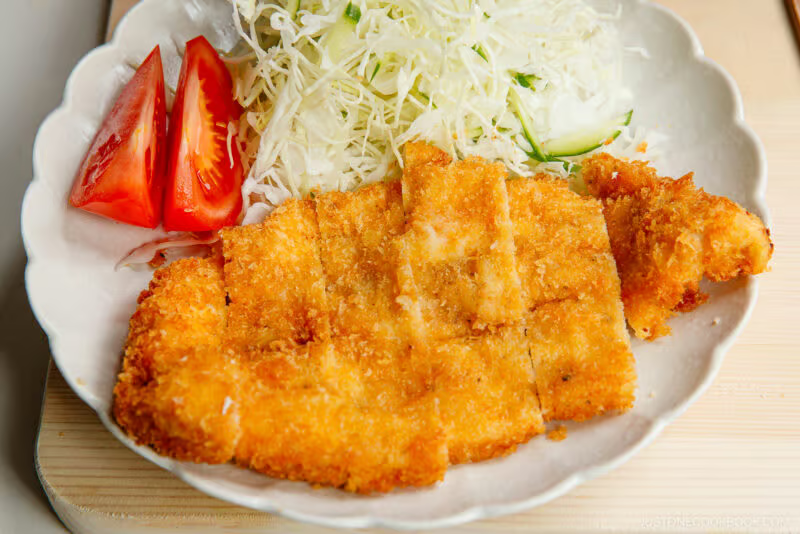
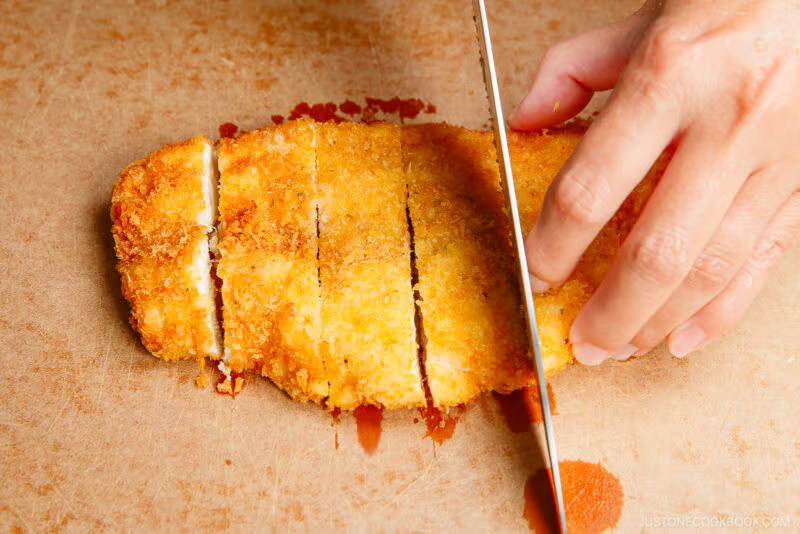
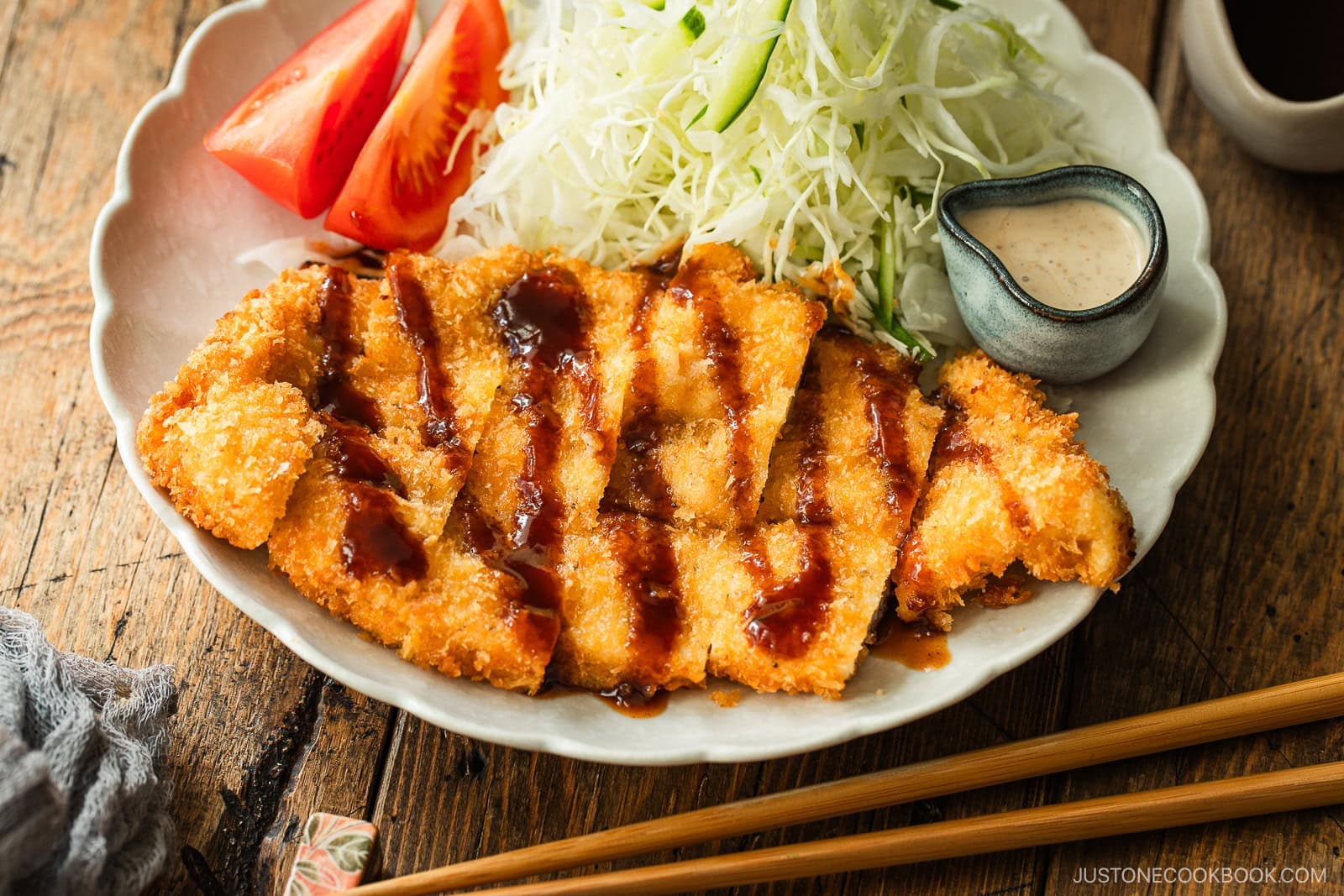
Cut the chicken katsu into 1-inch (2.5 cm) pieces and serve it with tonkatsu sauce. Typically, I serve it with a side of shredded green cabbage and my Japanese Sesame Dressing. I also add a few wedges of tomato for color.
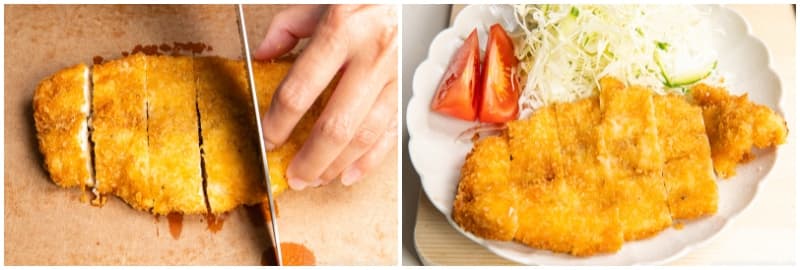
Image detailsCut the chicken katsu into 1-inch (2.5 cm) pieces and serve it with tonkatsu sauce. Typically, I serve it with a side of shredded green cabbage and my Japanese Sesame Dressing. I also add a few wedges of tomato for color.Just One Cookbook · Chicken Katsu (Video) チキンカツDev reference Checks1
ServiceMain recipeSource service instruction
Cut the chicken katsu into 1-inch (2.5 cm) pieces and serve it with tonkatsu sauce. Typically, I serve it with a side of shredded green cabbage and my Japanese Sesame Dressing. I also add a few wedges of tomato for color.
Inputs and tools4
Uses
- tonkatsu sauce
- shredded green cabbage ((optional))
- Japanese Sesame Dressing ((optional))
- tomato ((optional))
Why and source
This step has reviewed source-backed guidance.
- Source: Chicken Katsu (Video) チキンカツ
Step 18
Transfer the leftovers to an airtight container and store them in the refrigerator for up to 2 days or in the freezer for up to a month. To reheat, bake at 350ºF (180ºC) for 15–20 minutes if defrosted (in the refrigerator overnight) or for 30 minutes from frozen. Check that the inside is warm before serving.
Handling and Storage
Reviewed hold, storage, make-ahead, and service-timing guidance.
What to Serve with Chicken Katsu
While katsu is typically served with white rice, shredded cabbage, and tonkatsu sauce, you can get creative with my suggestions below.
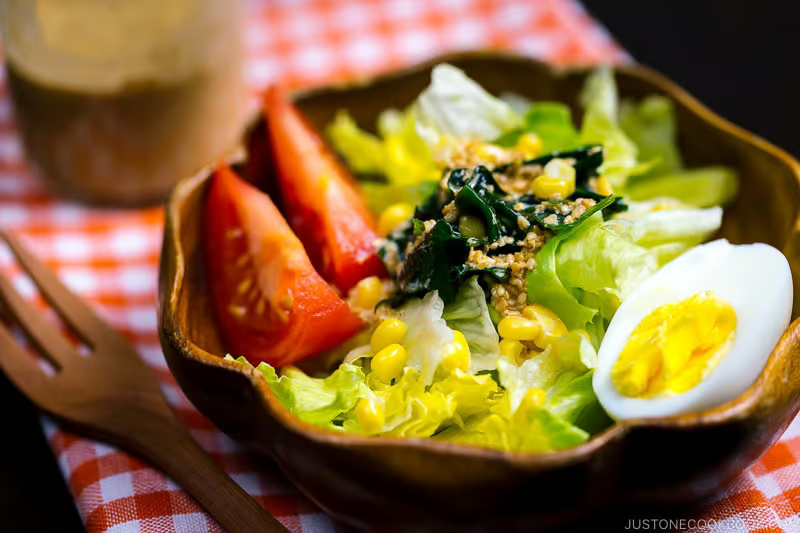
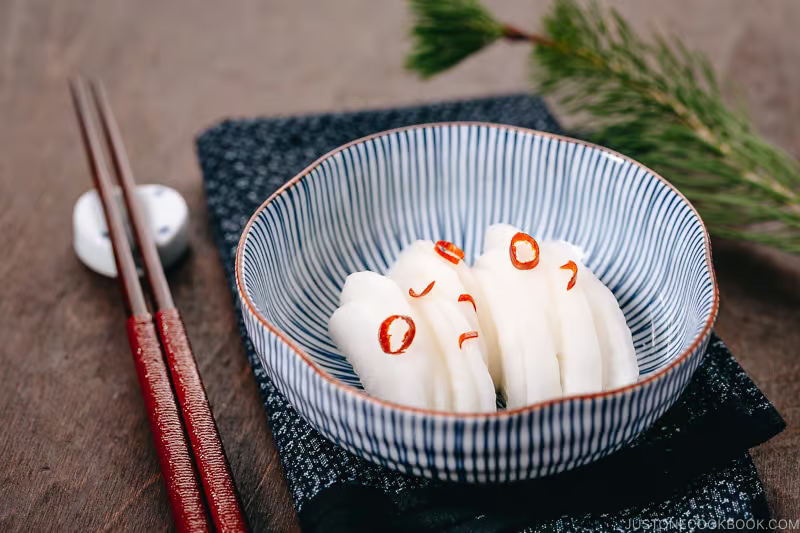
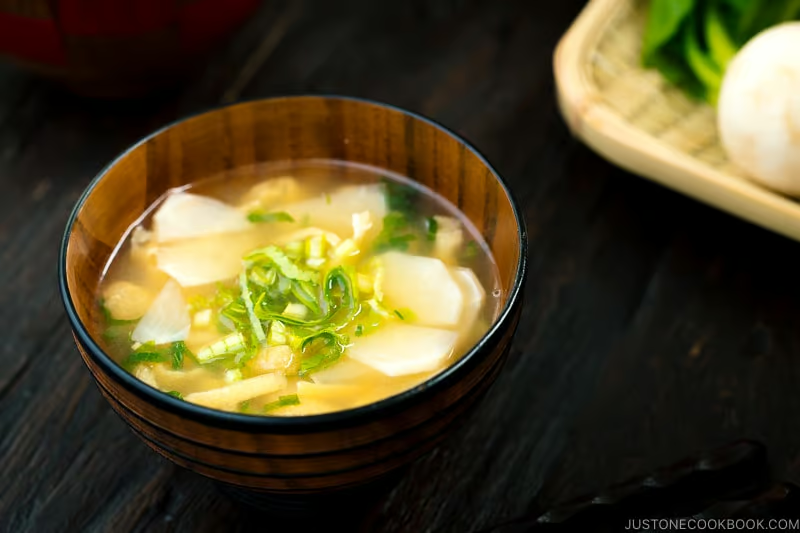
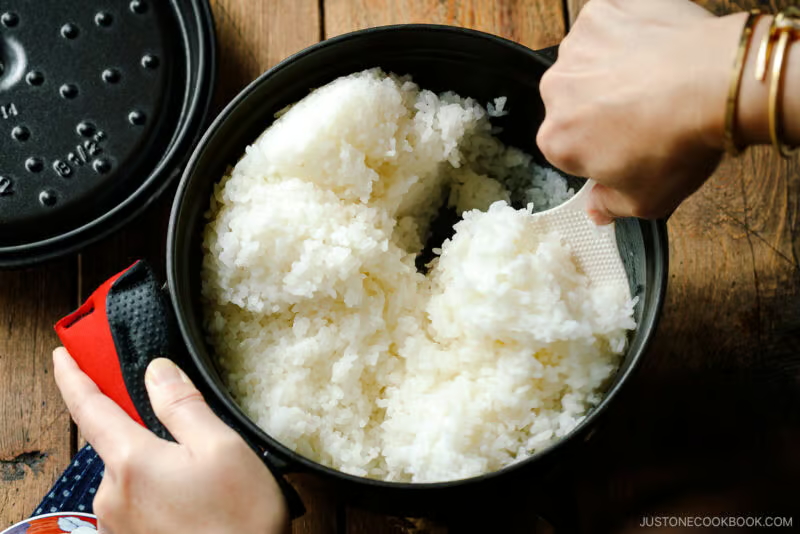
White rice: Learn How to Cook Japanese Rice in a pot on the stove! Cabbage salad: Drizzle with Japanese Sesame Dressing. Pickles: Crunchy‑sweet Pickled Daikon brightens each bite. Soup: A bowl of Vegetable Miso Soup rounds out the meal.
Show 1 more media item
Storage and Reheating Tips
To store: Cool, then refrigerate in an airtight container for 4–5 days or freeze up to 1 month.
To reheat: Bake at 350 °F (180 °C) for 15–20 minutes (30–40 minutes from frozen) until crisp.
Can I freeze chicken katsu?
Cool the fried chicken cutlets, separate with parchment, and freeze for quick lunches.
Learn More
Extra cooking notes, tests, and source details kept out of the step-by-step method.
Why this works
Quick kitchen reasons behind the main choices.
Why I Love This Recipe
Takes just 30 minutes – The cooking process is very simple!
Short ingredient list – Most ingredients are in the fridge and pantry. Crunchy, juicy, and flavorful – Pair it with salad, rice, or Japanese curry!
Preparation
Butterfly and pound the chicken until ¼–½ inch thick; season both sides with salt and pepper.
Set up a breading station with three shallow bowls or trays of flour, beaten eggs (whisked with a splash of oil), and panko. Dredge each chicken cutlet in flour, dip in egg, and coat evenly with panko.
Show 3 more media items
Variations and Customizations
Go gluten‑free with cornstarch and gluten‑free panko.
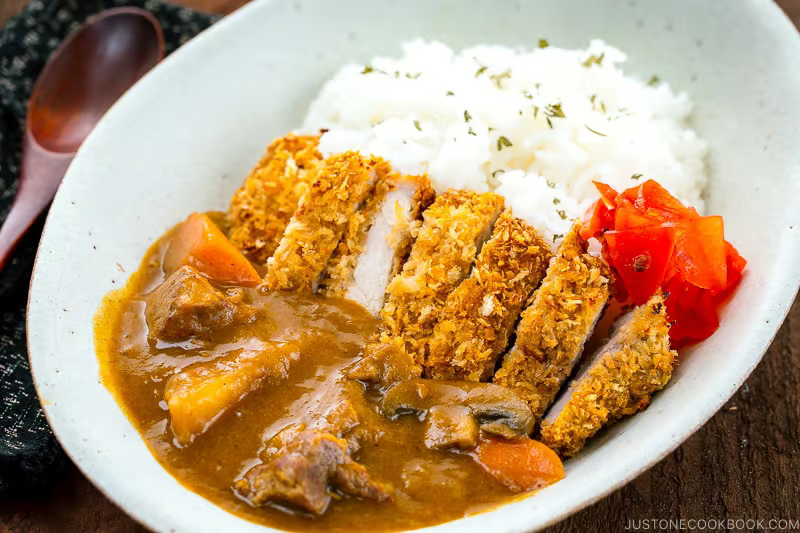
Try pork loin for classic tonkatsu. Repurpose leftovers to make Katsu Curry.
Can I prep ahead?
Yes, you can butterfly, bread, and refrigerate cutlets up to 3 hours before frying.
Article photos
Photos used with the article notes.
Source: Chicken Katsu (Video) チキンカツ
Recipe structure
Components and intermediate outputs created by the method.
Main recipe
Recipe card ingredients and steps.
2
Dressing
Source step 17 creates or uses dressing.
Mixture
Source step 11 creates or uses mixture.
Sauce
Source step 17 creates or uses sauce.
Recipe Utilities
Account actions, source details, export, and reporting stay available without interrupting the cooking flow.
Source and Origin
Origin declaration
Adapted from source
Imported from the just-one-cookbook page for dev review.
Copy risk: Unchecked
Chicken Katsu (Video) チキンカツ
Article
View source
My Kitchen Actions
Login is required.
My Kitchen keeps saved recipes, private notes, adaptations, cooking logs, imports, and exports tied to your account.
Export
Public recipe exports include only approved public content. Personal backup exports require login.
Export history
No exports yet.