Tonkatsu (Japanese Pork Cutlet)
Discover the secret to perfectly crispy, golden-brown Tonkatsu. Our guide ensures juicy pork every time. Pairs with katsu sauce!
Dish: Tonkatsu
Variant: Tonkatsu (Japanese Pork Cutlet)
- Total time
- 30 min
- Active time
- 15 min
- Yield
- 2
- Difficulty
- Medium
- Equipment
- 1 required
Ingredients and Constraints
Ingredients
Ingredient watchpoints1 watchpoint
Short requirements and tradeoffs to check while gathering ingredients; detailed source notes stay expandable.
Japanese Cucumber
1 Japanese or Persian cucumber
The source ingredient row lists alternatives.
Details and source
Acceptable alternatives: Persian Cucumber
Additional ingredient notes
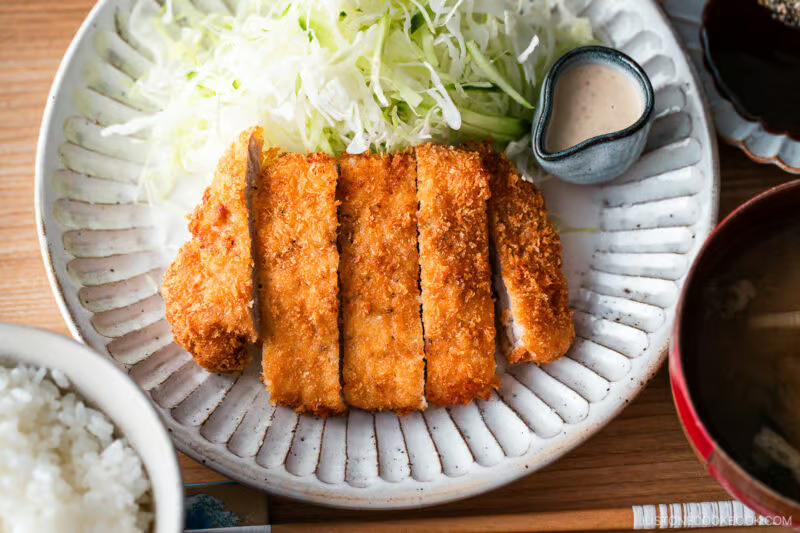
Ingredients for Tonkatsu
Pork loin or pork tenderloin fillet – These cuts have an essential layer of fat that gives the meat an extra tender bite.
Salt and black pepper All-purpose flour Large eggs Panko breadcrumbs Any neutral flavored oil, such as vegetable oil – for deep-frying Tonkatsu sauce Black and white sesame seeds – optional, for the dipping sauce Find the printable recipe with measurements below. JUMP TO RECIPE Substitutions Pork loin: You can use chicken breast to make Chicken Katsu!
Substitutions
Pork loin: You can use chicken breast to make Chicken Katsu!
Tonkatsu sauce: You can find this savory, tangy sauce in a Japanese grocery store or on Amazon. I prefer making Homemade Tonkatsu Sauce with Worcestershire sauce, oyster sauce, ketchup, and sugar because it’s so easy and just as delicious.
Required setup
Equipment
Source recipe card equipment.
Method Overview
Structured method notes that are separate from the step timeline.
Preparation
Step 1 – Make the dipping sauce.
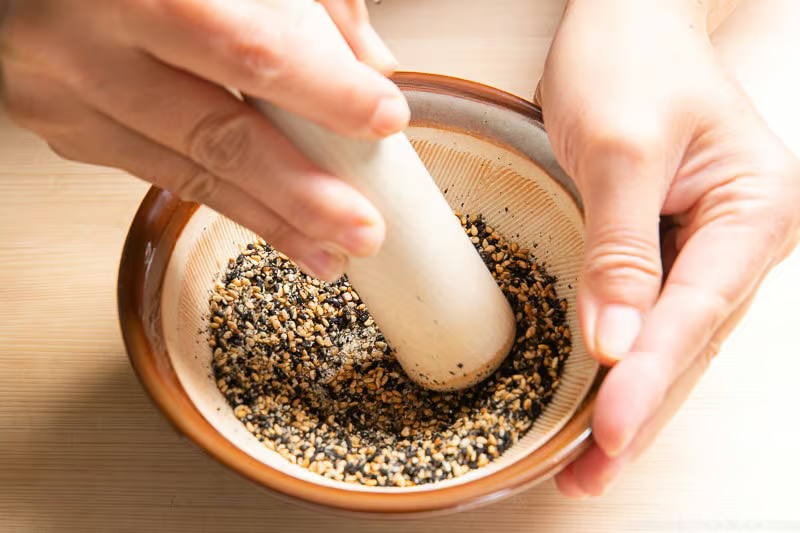
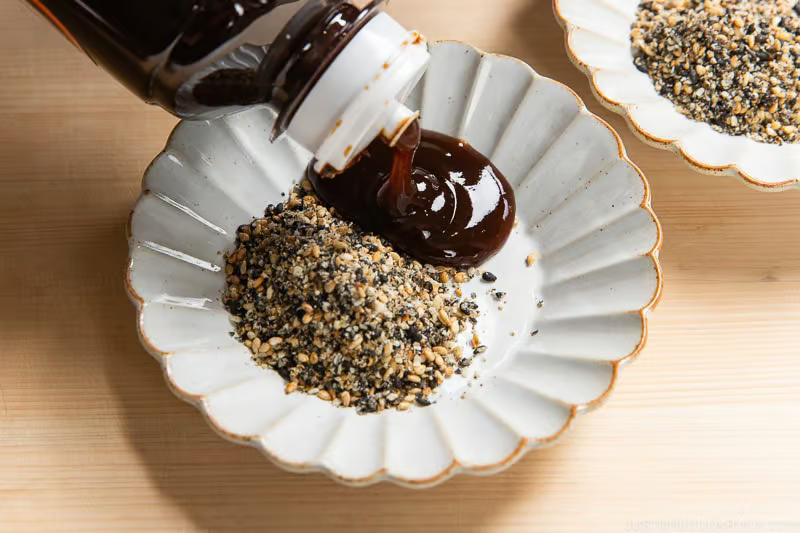
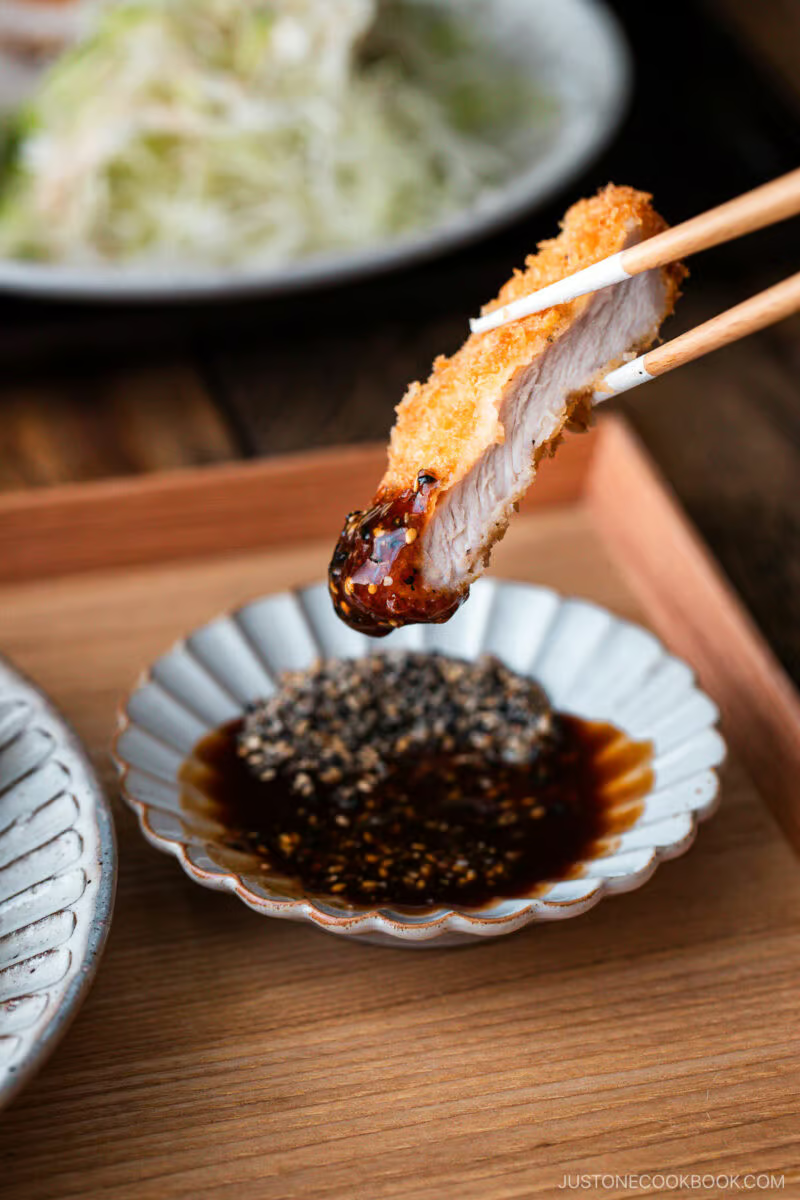
Grind the sesame seeds in a mortar and pestle. Divide the powder into small sauce bowls and top with tonkatsu sauce.
Show 5 more media items
Cooking
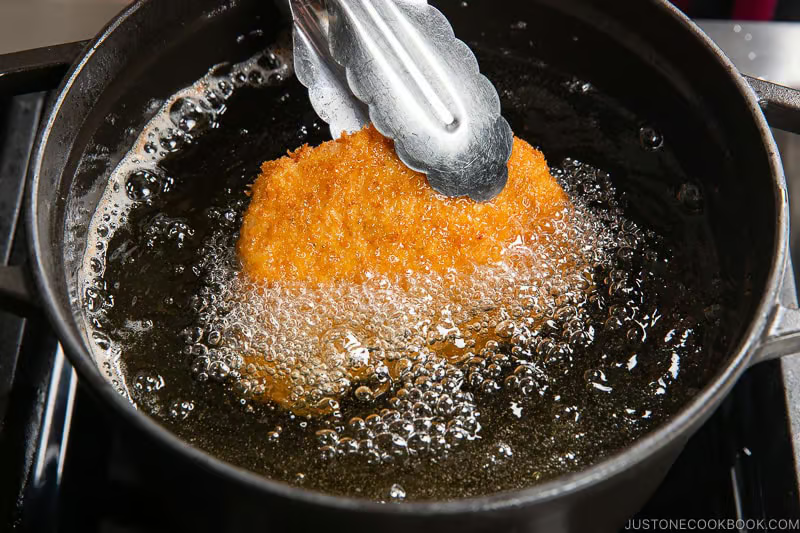
Cook one cutlet in the hot oil for 1 minute, then flip and cook for another minute.
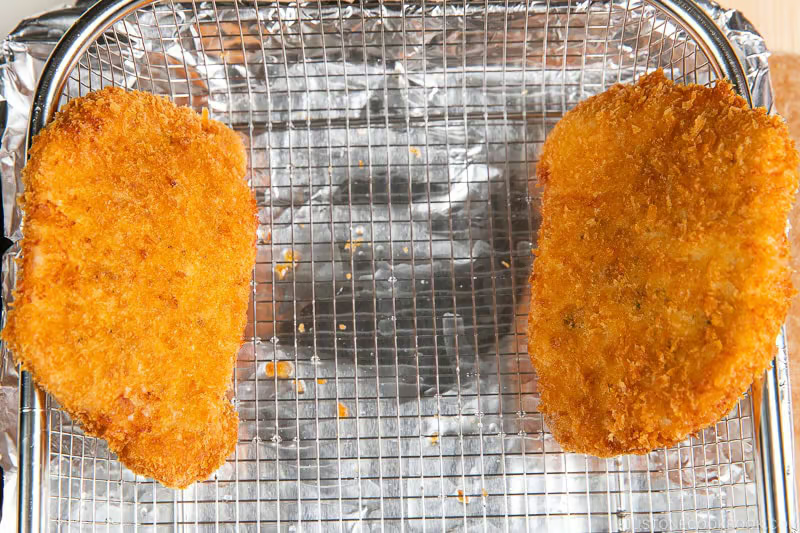
Transfer to a wire rack and fry the other cutlets. Step 6 – Fry a second time.
Show 1 more media item
Nami’s Recipe Tips
Shake off the excess flour – This will prevent flour and panko from falling into the oil, which will make the oil dark and affect the tonkatsu’s flavor.
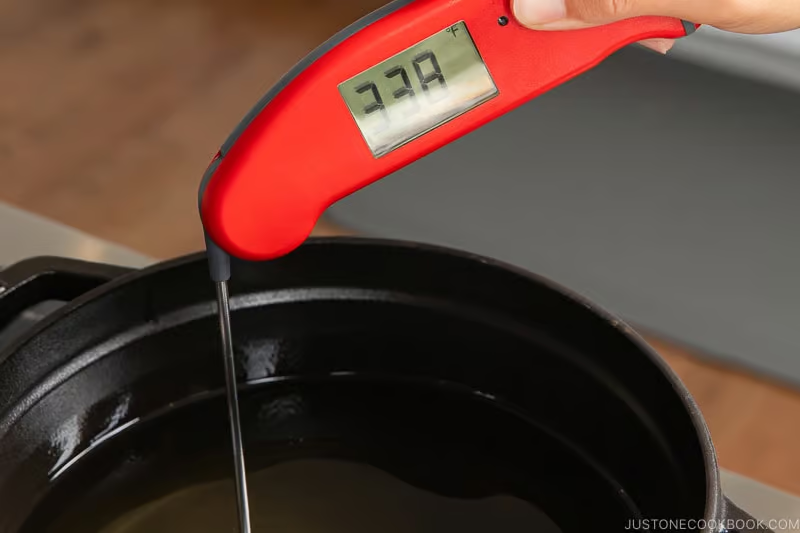
Monitor the oil temperature – The most accurate way to keep the oil at the optimal temperature is with an instant-read thermometer. I highly recommend using one so there’s no guesswork involved.
Complete Your Meal
Homemade Miso Soup (Video) 味噌汁 616 20 minutes minutes How to Cook Japanese Rice in a Pot on the Stove (Video) 173 30 minutes minutes Japanese Potato Salad (Video) ポテトサラダ 249 1 hour hour 20 minutes minutes Wafu Dressing (Japanese Salad Dress
Why did the pork become tough?
It’s likely the pork was overcooked.
When in doubt, use an instant-read thermometer to check the internal temperature of the pork. Ideally, the pork should register an internal temperature of 145°F.
Source video
Source video
Method Timeline
Prep
ActivePrep
15 min
Prep time from the source recipe card.
Cook
ActiveCook
15 min
Cook time from the source recipe card.
Total
PassiveTotal
30 min
Total time from the source recipe card.
Step 1
If you prefer not to deep-fry, see my recipe for Baked Tonkatsu.
Step 2
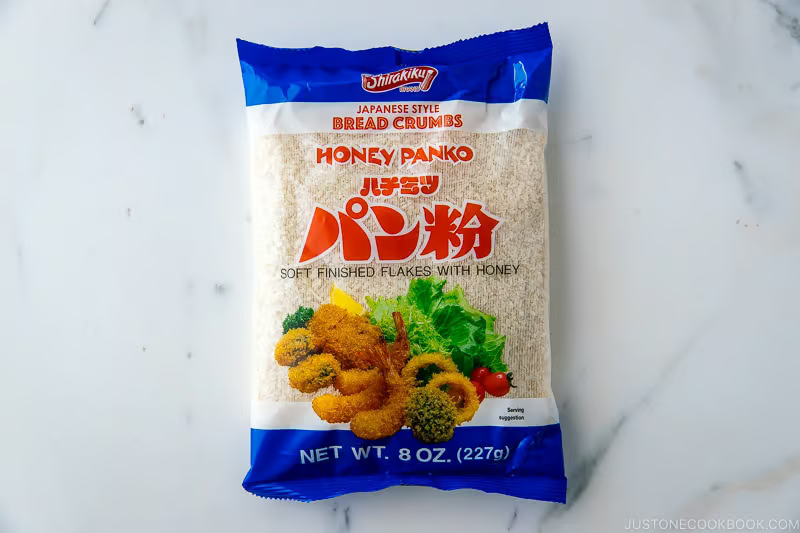
Gather all the ingredients. I highly recommend using fresh panko (called nama panko) from a Japanese grocery store, if available. If you can’t get it, follow my instructions below to make fresh panko using dried panko. Make sure to use a Japanese brand of panko from Japan. Western “panko breadcrumbs” are a bit different from authentic Japanese panko.
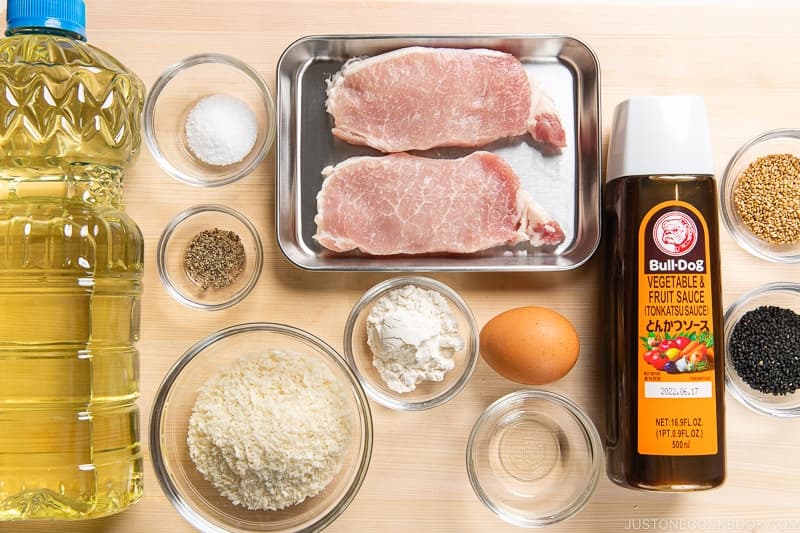
Image detailsGather all the ingredients. I highly recommend using fresh panko (called nama panko) from a Japanese grocery store, if available. If you can’t get it, follow my instructions below to make fresh panko using dried panko. Make sure to use a Japanese brand of panko from Japan. Western “panko breadcrumbs” are a bit different from authentic Japanese panko.Just One Cookbook · Tonkatsu (Japanese Pork Cutlet) (Video) とんかつDev reference Checks1
HoldingMain recipeSource holding instruction
Gather all the ingredients. I highly recommend using fresh panko (called nama panko) from a Japanese grocery store, if available. If you can’t get it, follow my instructions below to make fresh panko using dried panko. Make sure to use a Japanese brand of panko from Japan. Western “panko breadcrumbs” are a bit different from authentic Japanese panko.
Inputs and tools1
Uses
- ½ cup panko (Japanese breadcrumbs)
Why and source
This step has reviewed source-backed guidance.
Step 3
In Japan, we serve tonkatsu with a side of fresh shredded cabbage. To prepare it, shred ¼ head green cabbage very finely with a sharp knife or slicer. I love to use a cabbage slicer (you can get one from Amazon or JOC Goods) because it saves time and energy! I also thinly slice 1 Japanese or Persian cucumber diagonally, then cut them into thin strips. Toss the cabbage and cucumber together and set aside. Prepare 4 Tbsp Japanese sesame dressing (store bought or make homemade Japanese Sesame Dressing) and keep refrigerated until ready to serve.
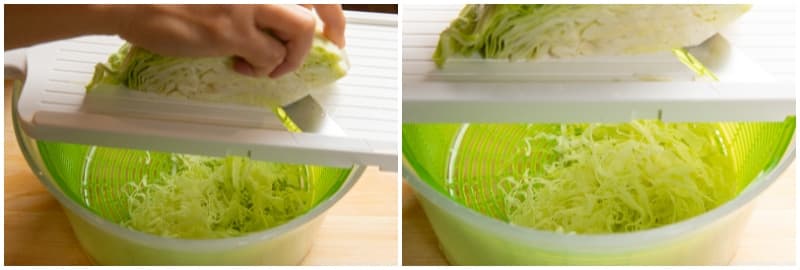
Image detailsIn Japan, we serve tonkatsu with a side of fresh shredded cabbage. To prepare it, shred ¼ head green cabbage very finely with a sharp knife or slicer. I love to use a cabbage slicer (you can get one from Amazon or JOC Goods) because it saves time and energy! I also thinly slice 1 Japanese or Persian cucumber diagonally, then cut them into thin strips. Toss the cabbage and cucumber together and set aside. Prepare 4 Tbsp Japanese sesame dressing (store bought or make homemade Japanese Sesame Dressing) and keep refrigerated until ready to serve.Just One Cookbook · Tonkatsu (Japanese Pork Cutlet) (Video) とんかつDev reference Visual cue
until ready to serve.
Checks2
Visual cueInfoVisualuntil ready to serve.
Expected state: until ready to serve.
HoldingMain recipeSource holding instruction
In Japan, we serve tonkatsu with a side of fresh shredded cabbage. To prepare it, shred ¼ head green cabbage very finely with a sharp knife or slicer. I love to use a cabbage slicer (you can get one from Amazon or JOC Goods) because it saves time and energy! I also thinly slice 1 Japanese or Persian cucumber diagonally, then cut them into thin strips. Toss the cabbage and cucumber together and set aside. Prepare 4 Tbsp Japanese sesame dressing (store bought or make homemade Japanese Sesame Dressing) and keep refrigerated until ready to serve.
Inputs and tools3
Uses
- ¼ head green cabbage
- 1 Japanese or Persian cucumber
- 4 Tbsp Japanese sesame dressing
Why and source
This step has reviewed source-backed guidance.
Step 4
Grind 1 Tbsp toasted white sesame seeds and 1 Tbsp toasted black sesame seeds with a Japanese mortar and pestle. Leave some seeds unground for texture.
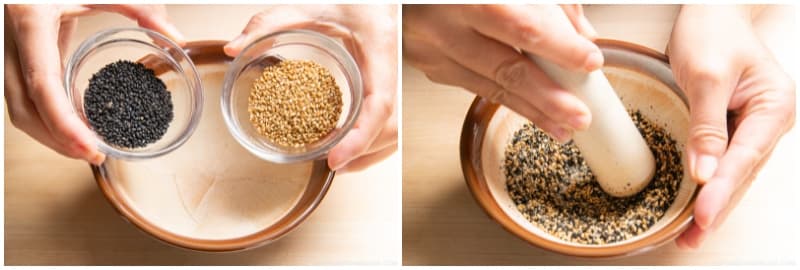
Image detailsGrind 1 Tbsp toasted white sesame seeds and 1 Tbsp toasted black sesame seeds with a Japanese mortar and pestle. Leave some seeds unground for texture.Just One Cookbook · Tonkatsu (Japanese Pork Cutlet) (Video) とんかつDev reference Inputs and tools2
Uses
- 1 Tbsp toasted white sesame seeds
- 1 Tbsp toasted black sesame seeds
Step 5
Divide the ground sesame seeds among individual dipping plates or bowls. Then divide 4 Tbsp tonkatsu sauce (store bought or homemade) among them. Set aside until ready to serve. Each person can mix it together when ready to eat. Note: In Japan, we often drizzle straight tonkatsu sauce on our cutlets without adding sesame seeds. Feel free to serve this dish with straight tonkatsu sauce instead, if you prefer.
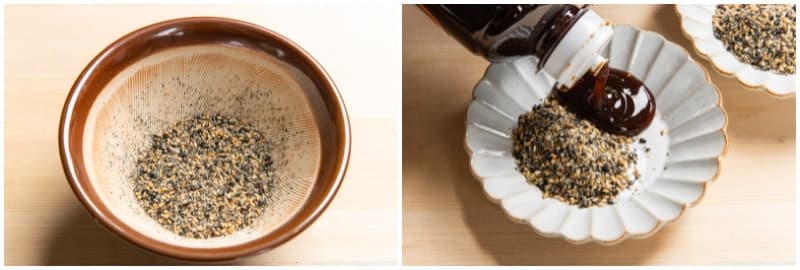
Image detailsDivide the ground sesame seeds among individual dipping plates or bowls. Then divide 4 Tbsp tonkatsu sauce (store bought or homemade) among them. Set aside until ready to serve. Each person can mix it together when ready to eat. Note: In Japan, we often drizzle straight tonkatsu sauce on our cutlets without adding sesame seeds. Feel free to serve this dish with straight tonkatsu sauce instead, if you prefer.Just One Cookbook · Tonkatsu (Japanese Pork Cutlet) (Video) とんかつDev reference Visual cue
until ready to serve.
Checks2
Visual cueInfoVisualuntil ready to serve.
Expected state: until ready to serve.
HoldingMain recipeSource holding instruction
Divide the ground sesame seeds among individual dipping plates or bowls. Then divide 4 Tbsp tonkatsu sauce (store bought or homemade) among them. Set aside until ready to serve. Each person can mix it together when ready to eat. Note: In Japan, we often drizzle straight tonkatsu sauce on our cutlets without adding sesame seeds. Feel free to serve this dish with straight tonkatsu sauce instead, if you prefer.
Inputs and tools1
Uses
- 4 Tbsp tonkatsu sauce
Why and source
This step has reviewed source-backed guidance.
Step 6
If you are using dry panko from the store, place ½ cup panko (Japanese breadcrumbs) in a deep dish and spray with water until the panko is moist (I use a mister). Set aside for 15 minutes, or until the panko becomes soft and tender. Optionally, you can make fresh panko by pulsing some Shokupan (Japanese Pullman bread) in a food processor.
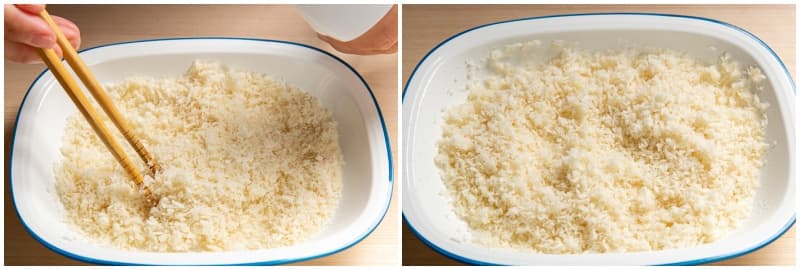
Image detailsIf you are using dry panko from the store, place ½ cup panko (Japanese breadcrumbs) in a deep dish and spray with water until the panko is moist (I use a mister). Set aside for 15 minutes, or until the panko becomes soft and tender. Optionally, you can make fresh panko by pulsing some Shokupan (Japanese Pullman bread) in a food processor.Just One Cookbook · Tonkatsu (Japanese Pork Cutlet) (Video) とんかつDev reference Visual cue
until the panko is moist (I use a mister).
Checks3
TextureInfoTextureuntil the panko is moist (I use a mister).
Expected state: until the panko is moist (I use a mister).
TimingInfoTimingfor 15 minutes
Target: 15 minute
Expected state: Set aside for 15 minutes, or until the panko becomes soft and tender.
HoldingMain recipeSource holding instruction
If you are using dry panko from the store, place ½ cup panko (Japanese breadcrumbs) in a deep dish and spray with water until the panko is moist (I use a mister). Set aside for 15 minutes, or until the panko becomes soft and tender. Optionally, you can make fresh panko by pulsing some Shokupan (Japanese Pullman bread) in a food processor.
Why and source
This step has reviewed source-backed guidance.
Step 7
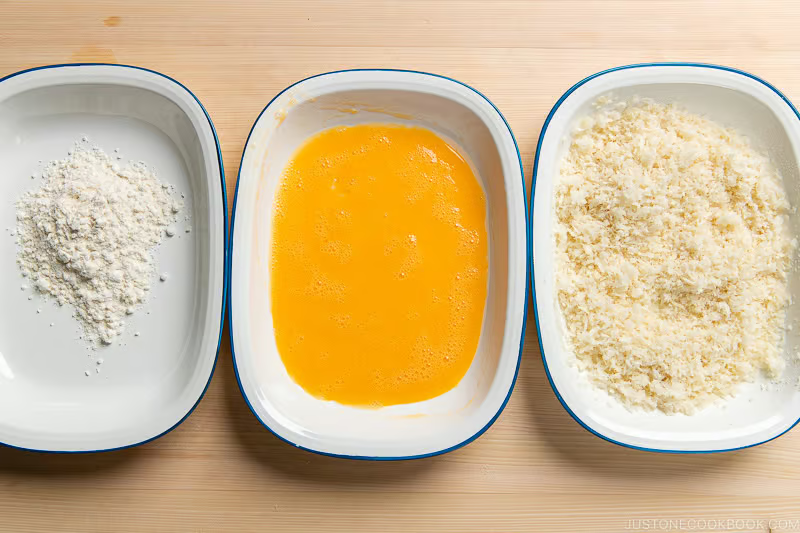
Meanwhile, prepare the other breading ingredients. Crack 1 large egg (50 g each w/o shell) into a deep dish or my favorite prep trays. Add ½ Tbsp neutral oil and whisk together until well combined. Then, prepare another dish or tray with 2 Tbsp all-purpose flour (plain flour). Tip: By adding oil, the breading won’t detach from the meat while deep-frying and this will help seal in the meat's juices and flavor.
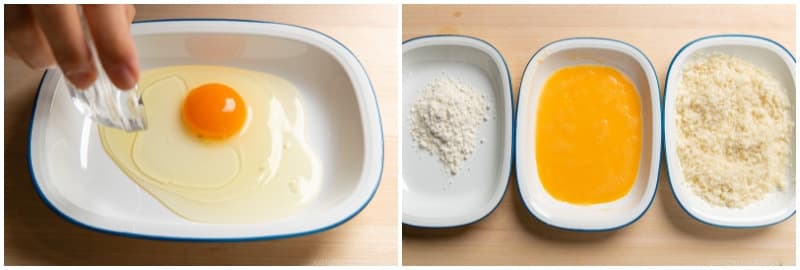
Image detailsMeanwhile, prepare the other breading ingredients. Crack 1 large egg (50 g each w/o shell) into a deep dish or my favorite prep trays. Add ½ Tbsp neutral oil and whisk together until well combined. Then, prepare another dish or tray with 2 Tbsp all-purpose flour (plain flour). Tip: By adding oil, the breading won’t detach from the meat while deep-frying and this will help seal in the meat's juices and flavor.Just One Cookbook · Tonkatsu (Japanese Pork Cutlet) (Video) とんかつDev reference Visual cue
until well combined.
Checks1
Visual cueInfoVisualuntil well combined.
Expected state: until well combined.
Inputs and tools4
Uses
- 1 large egg (50 g each w/o shell)
- ½ Tbsp neutral oil ((for the egg))
- 2 Tbsp all-purpose flour (plain flour)
- 3 cups neutral oil ((or enough for 1¾–2 inches (5 cm) of oil in the pot, for deep-frying))
Why and source
This step has reviewed source-backed guidance.
Step 8
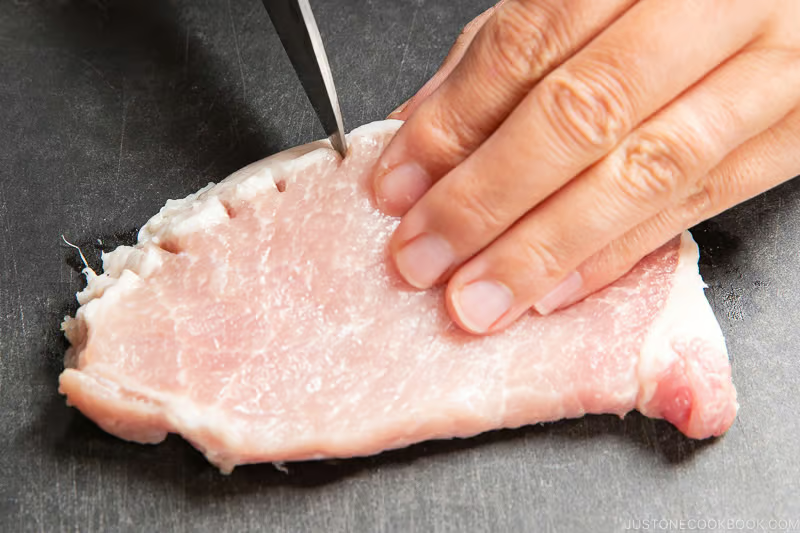
Use a sharp knife to remove the extra fat from 2 boneless pork loin chops (½ inch thick). Then, make several small slits on the connective tissue (the white area) between the meat and fat. Tip: Red meat and fat have different elasticities, and they shrink and expand at different rates while cooking. These slits will allow the tonkatsu to stay flat during cooking instead of curling up.
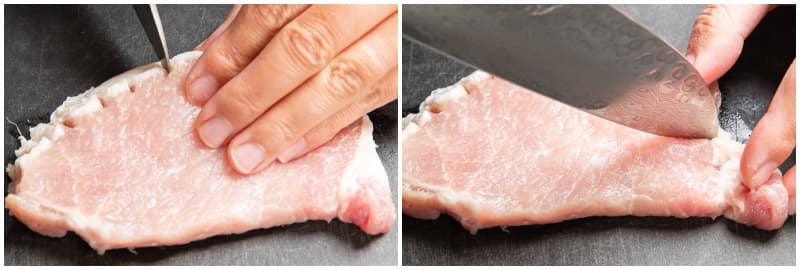
Image detailsUse a sharp knife to remove the extra fat from 2 boneless pork loin chops (½ inch thick). Then, make several small slits on the connective tissue (the white area) between the meat and fat. Tip: Red meat and fat have different elasticities, and they shrink and expand at different rates while cooking. These slits will allow the tonkatsu to stay flat during cooking instead of curling up.Just One Cookbook · Tonkatsu (Japanese Pork Cutlet) (Video) とんかつDev reference Inputs and tools1
Uses
- 2 boneless pork loin chops (½ inch thick) ((100 g, 3.5 oz per piece; ½ inch, 1–1.3 cm thick))
Step 9
Flip the meat and make several slits on the other side of the connective tissue.
Step 10
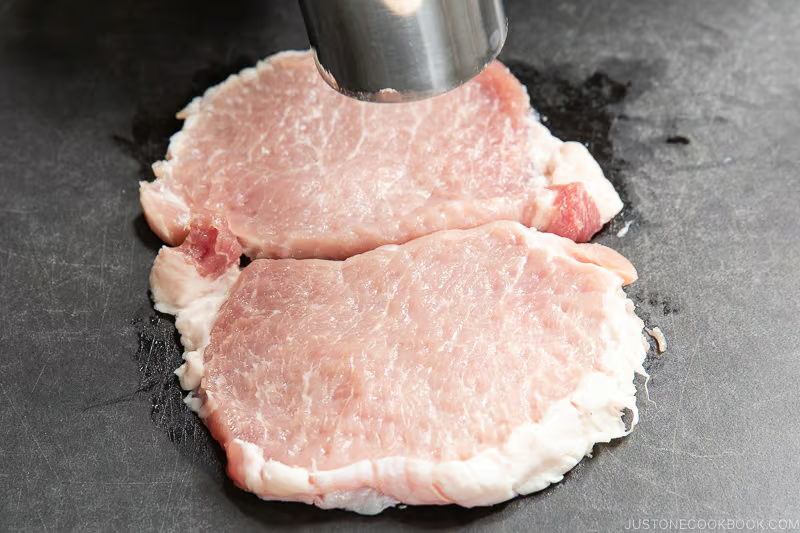
Pound both sides of the meat with the back of a knife or a meat tenderizer/mallet.
Step 11
Mold the cutlet back into its original shape with your hands.
Step 12
Season both sides with ½ tsp Diamond Crystal kosher salt and ⅛ tsp freshly ground black pepper.
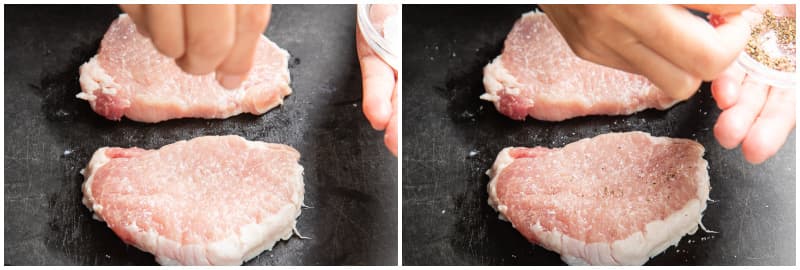
Image detailsSeason both sides with ½ tsp Diamond Crystal kosher salt and ⅛ tsp freshly ground black pepper.Just One Cookbook · Tonkatsu (Japanese Pork Cutlet) (Video) とんかつDev reference Inputs and tools2
Uses
- ½ tsp Diamond Crystal kosher salt
- ⅛ tsp freshly ground black pepper
Step 13
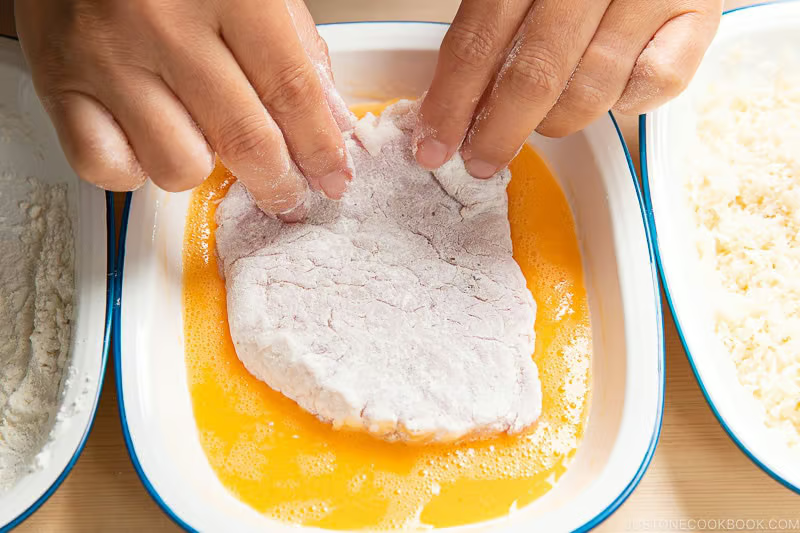
First, dredge the pork in the flour and dust off any excess. Next, dip the pork into the egg mixture and coat well. Tip: Excess flour will prevent the egg mixture from adhering to the pork.
Step 14
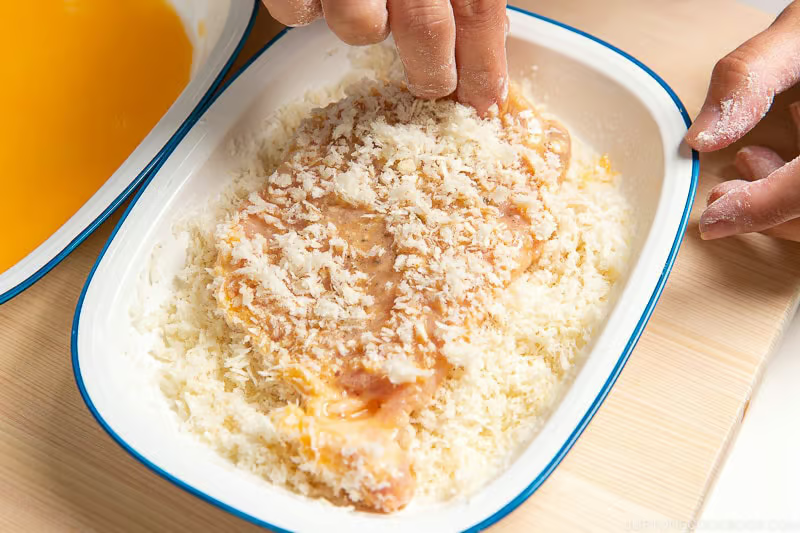
Lastly, dredge the pork in the fresh panko and gently press it to adhere to the cutlet. Gently shake off any excess, then place the breaded cutlets onto a tray or plate. Set them aside for 5–10 minutes to set the breading. Tip: The panko will “puff up” while deep-frying, so it doesn't have to be fluffy at this stage.
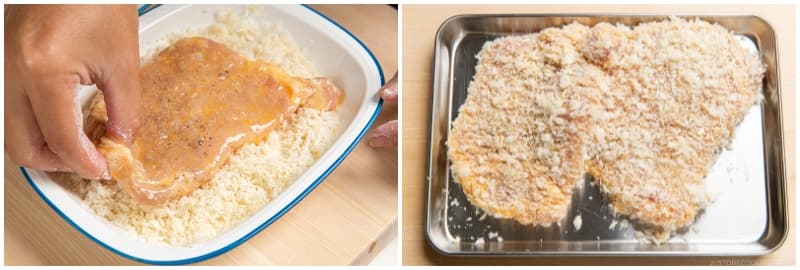
Image detailsLastly, dredge the pork in the fresh panko and gently press it to adhere to the cutlet. Gently shake off any excess, then place the breaded cutlets onto a tray or plate. Set them aside for 5–10 minutes to set the breading. Tip: The panko will “puff up” while deep-frying, so it doesn't have to be fluffy at this stage.Just One Cookbook · Tonkatsu (Japanese Pork Cutlet) (Video) とんかつDev reference Checks1
TimingInfoTimingfor 5–10 minutes
Target: 5-10 minute
Expected state: Set them aside for 5–10 minutes to set the breading.
Why and source
This step has reviewed source-backed guidance.
Step 15
Add 3 cups neutral oil to a pot. Make sure your oil is 1¾–2 inches (5 cm) deep. I use the tip of a chopstick to measure. Preheat on medium heat and bring the oil to 340ºF (170ºC). Tip: If you don’t have a thermometer, stick a chopstick in the oil; if you see tiny bubbles appear around the tip, it is hot enough. Alternatively, you can drop in a piece of panko; if it sinks down and immediately pops up to the surface, then the oil is ready.
medium heatStep 16
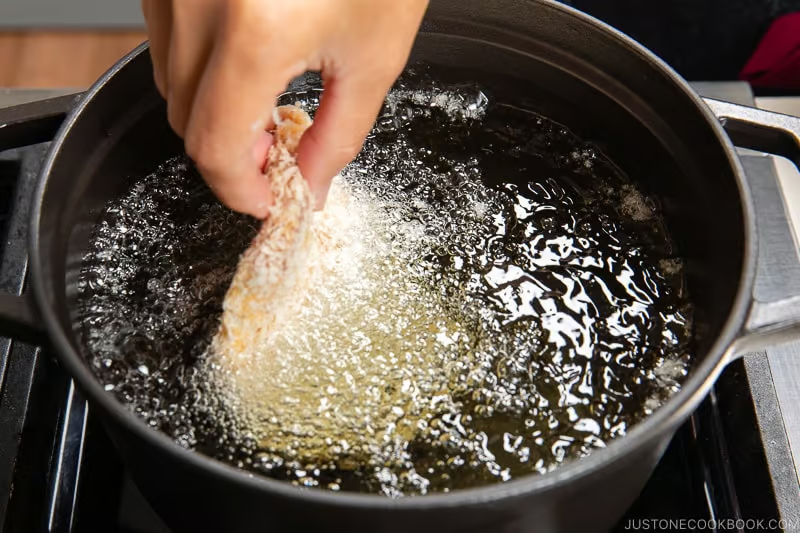
Gently put one pork cutlet into the oil and let it cook for 1 minute. Don‘t flip it or touch it for 30 seconds. Tip: Why one piece at a time? Too much food at once will drastically reduce the oil temperature, and the tonkatsu will absorb too much oil. You should see big oil bubbles when you add the pork. Also, monitor the oil temperature so it doesn't rise above 340ºF (170ºC). If it does, the breading will get dark before the pork is cooked and you meat will be undercooked.
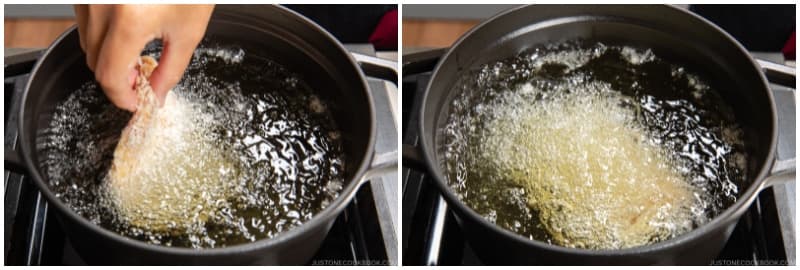
Image detailsGently put one pork cutlet into the oil and let it cook for 1 minute. Don‘t flip it or touch it for 30 seconds. Tip: Why one piece at a time? Too much food at once will drastically reduce the oil temperature, and the tonkatsu will absorb too much oil. You should see big oil bubbles when you add the pork. Also, monitor the oil temperature so it doesn't rise above 340ºF (170ºC). If it does, the breading will get dark before the pork is cooked and you meat will be undercooked.Just One Cookbook · Tonkatsu (Japanese Pork Cutlet) (Video) とんかつDev reference Visual cue
once will drastically reduce the oil temperature, and the tonkatsu will absorb too much oil.
Checks2
Visual cueInfoVisualonce will drastically reduce the oil temperature, and the tonkatsu will absorb too much oil.
Expected state: once will drastically reduce the oil temperature, and the tonkatsu will absorb too much oil.
TimingInfoTimingfor 1 minute
Target: 1 minute
Expected state: Gently put one pork cutlet into the oil and let it cook for 1 minute.
Why and source
This step has reviewed source-backed guidance.
Step 17
After a minute, flip the pork and cook the other side for 1 minute.
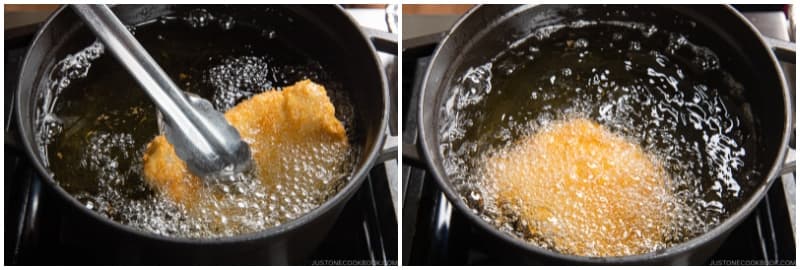
Image detailsAfter a minute, flip the pork and cook the other side for 1 minute.Just One Cookbook · Tonkatsu (Japanese Pork Cutlet) (Video) とんかつDev reference Checks1
TimingInfoTimingfor 1 minute
Target: 1 minute
Expected state: After a minute, flip the pork and cook the other side for 1 minute.
Why and source
This step has reviewed source-backed guidance.
Step 18
Remove the pork and let the excess oil drip off by holding the cutlet vertically over the pot for a few seconds. Place it on a wire rack or paper towel and prop it on its side, if possible, to drain excess oil. Let it sit for 4 minutes. The residual heat will continue to cook the meat as it rests.
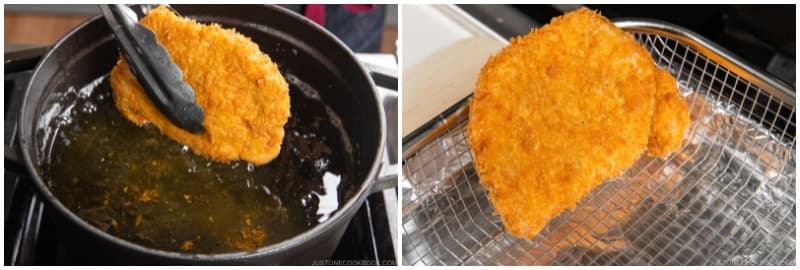
Image detailsRemove the pork and let the excess oil drip off by holding the cutlet vertically over the pot for a few seconds. Place it on a wire rack or paper towel and prop it on its side, if possible, to drain excess oil. Let it sit for 4 minutes. The residual heat will continue to cook the meat as it rests.Just One Cookbook · Tonkatsu (Japanese Pork Cutlet) (Video) とんかつDev reference Checks1
TimingInfoTimingfor 4 minutes
Target: 4 minute
Expected state: Let it sit for 4 minutes.
Why and source
This step has reviewed source-backed guidance.
Step 19
Turn off the heat temporarily. Scoop up and discard any fried crumbs in the oil with a fine-mesh strainer. Keep the oil clean of fried crumbs, which can burn and make the oil dark and dirty. Then, turn on the heat again to medium and bring the oil back to 340ºF (170ºC).
Step 20
While the first cutlet is resting on the wire rack, deep-fry the second cutlet for 1 minute without flipping. Do not touch it for 30 seconds.
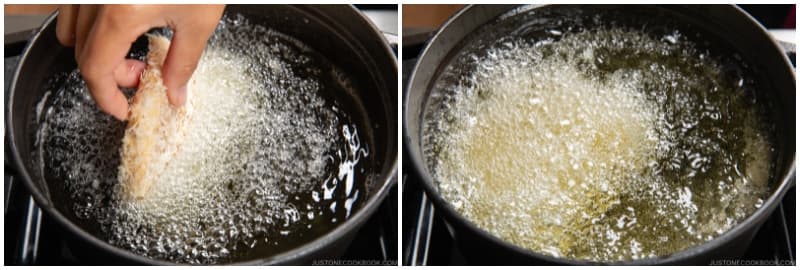
Image detailsWhile the first cutlet is resting on the wire rack, deep-fry the second cutlet for 1 minute without flipping. Do not touch it for 30 seconds.Just One Cookbook · Tonkatsu (Japanese Pork Cutlet) (Video) とんかつDev reference Checks1
TimingInfoTimingfor 1 minute
Target: 1 minute
Expected state: While the first cutlet is resting on the wire rack, deep-fry the second cutlet for 1 minute without flipping.
Why and source
This step has reviewed source-backed guidance.
Step 21
Flip and cook the other side for 1 minute.
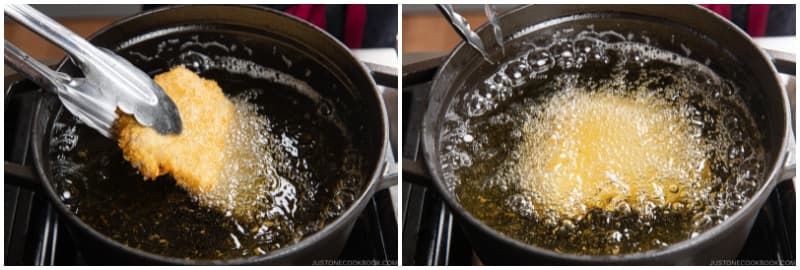
Image detailsFlip and cook the other side for 1 minute.Just One Cookbook · Tonkatsu (Japanese Pork Cutlet) (Video) とんかつDev reference Checks1
TimingInfoTimingfor 1 minute
Target: 1 minute
Expected state: Flip and cook the other side for 1 minute.
Why and source
This step has reviewed source-backed guidance.
Step 22
Take out the pork and drain the excess oil as before. Place it on the wire rack and let it rest for 4 minutes. Clean the oil of fried crumbs.
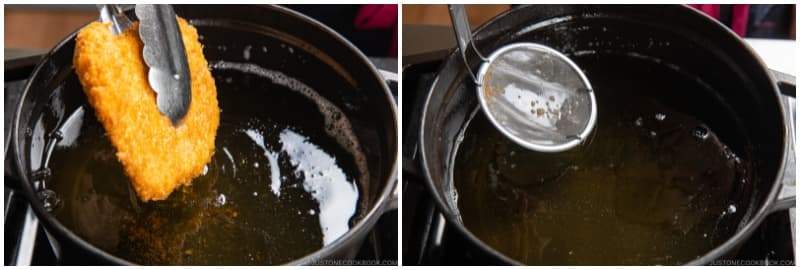
Image detailsTake out the pork and drain the excess oil as before. Place it on the wire rack and let it rest for 4 minutes. Clean the oil of fried crumbs.Just One Cookbook · Tonkatsu (Japanese Pork Cutlet) (Video) とんかつDev reference Checks2
TimingInfoTimingfor 4 minutes
Target: 4 minute
Expected state: Place it on the wire rack and let it rest for 4 minutes.
HoldingMain recipeSource holding instruction
Take out the pork and drain the excess oil as before. Place it on the wire rack and let it rest for 4 minutes. Clean the oil of fried crumbs.
Why and source
This step has reviewed source-backed guidance.
Step 23
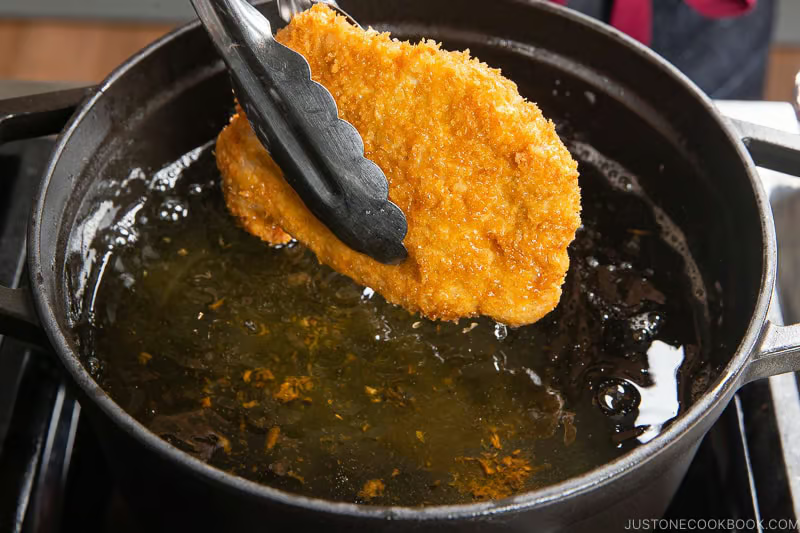
Raise the oil temperature to 355ºF (180ºC). After 4 minutes, the first piece of pork is ready for its second frying. Fry the cutlet again for 30 seconds on one side, then 30 seconds on the other side. Remove from the oil, let the oil drip off, and drain on the wire rack for 2 minutes. This prevents the breading from getting soggy on one side.
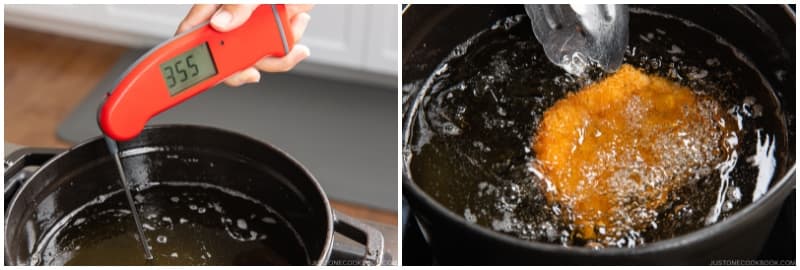
Image detailsRaise the oil temperature to 355ºF (180ºC). After 4 minutes, the first piece of pork is ready for its second frying. Fry the cutlet again for 30 seconds on one side, then 30 seconds on the other side. Remove from the oil, let the oil drip off, and drain on the wire rack for 2 minutes. This prevents the breading from getting soggy on one side.Just One Cookbook · Tonkatsu (Japanese Pork Cutlet) (Video) とんかつDev reference Checks1
TimingInfoTiming4 minutes
Target: 4 minute
Expected state: After 4 minutes, the first piece of pork is ready for its second frying.
Why and source
This step has reviewed source-backed guidance.
Step 24
Clean the fried crumbs in the oil, then fry the second cutlet again. Remove from the pot and drain the excess oil as before.
Step 25
Cut the tonkatsu crosswise into slices about ¾ inch (2 cm) wide.
Step 26
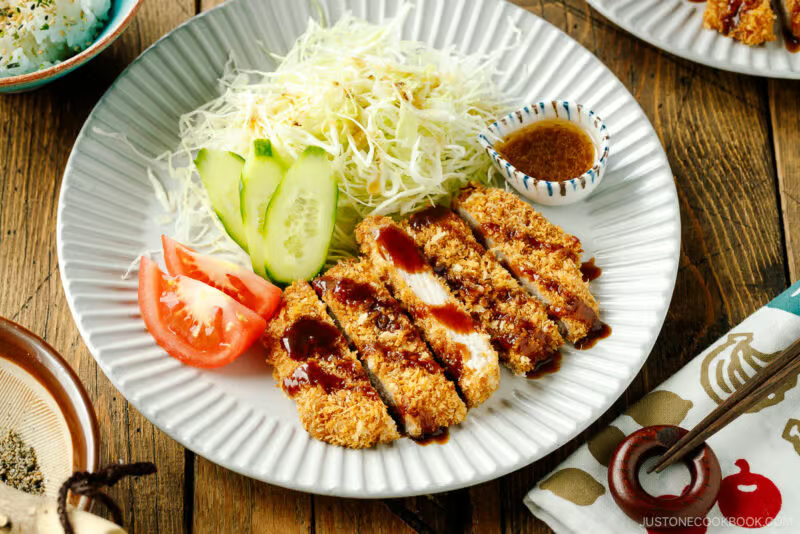
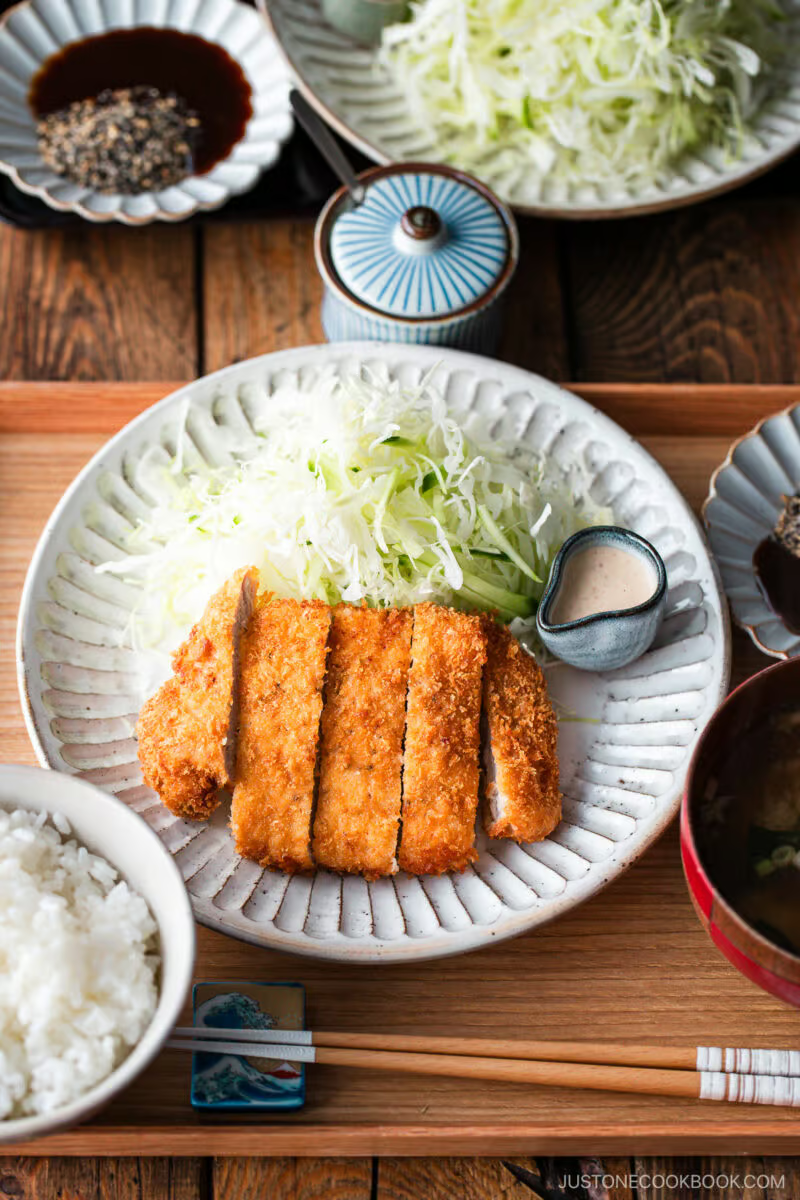
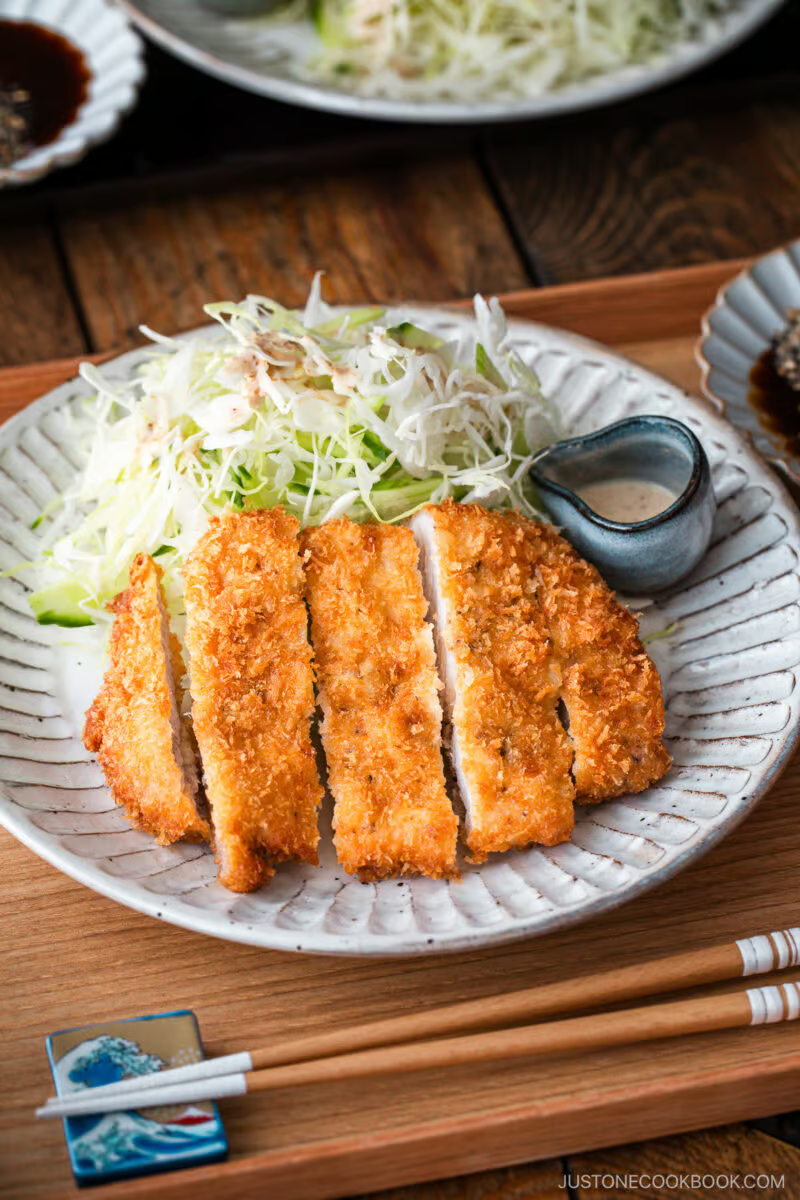
Transfer to a plate and serve it with the shredded cabbage and cucumber, the sesame dressing in small individual cups, and the sesame tonkatsu dipping sauce on the side.
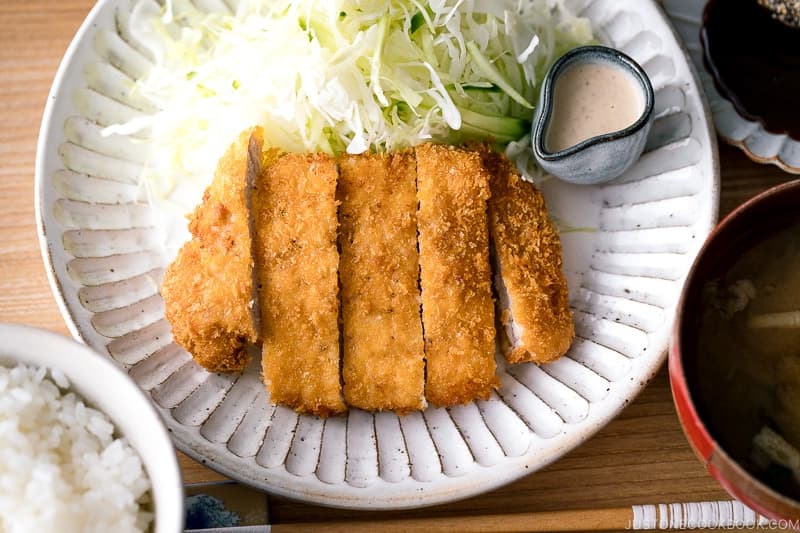
Image detailsTransfer to a plate and serve it with the shredded cabbage and cucumber, the sesame dressing in small individual cups, and the sesame tonkatsu dipping sauce on the side.Just One Cookbook · Tonkatsu (Japanese Pork Cutlet) (Video) とんかつDev reference Checks1
ServiceMain recipeSource service instruction
Transfer to a plate and serve it with the shredded cabbage and cucumber, the sesame dressing in small individual cups, and the sesame tonkatsu dipping sauce on the side.
Why and source
This step has reviewed source-backed guidance.
Step 27
You can store leftovers in an airtight container and freeze for up to a month. To reheat, put the defrosted or frozen tonkatsu on a baking sheet lined with aluminum foil or parchment paper. Bake at 350ºF (180ºC) for 15–20 minutes if defrosted or 30–40 minutes if frozen. Check if the inside is warm before serving.
Step 28
Please follow your local guidelines for disposing of cooking oil. In my neighborhood, we can take it to the recycling center and dump it into a designated container, so it’s very easy.
Step 29
If you are using a Japanese oil solidifier, add the powder into the hot oil right after deep-frying and mix well.
Step 30
Set it aside and let the oil completely solidify as it cools, which may take overnight.
Step 31
Cut into small pieces and discard them in the trash.
Handling and Storage
Reviewed hold, storage, make-ahead, and service-timing guidance.
Assemble
Step 7 – Cut and serve.
Slice the cutlets into ¾-inch-thick pieces, then serve with the dipping sauce. I shred cabbage and serve it on the side.
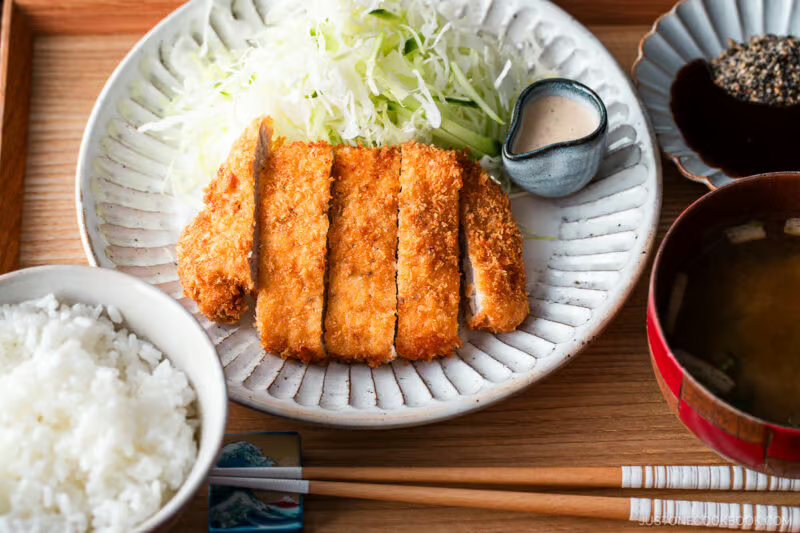
Variations and Customizations
Tonkatsu is a simple dish that you can easily modify or enhance.
Here are some of my suggestions. Add spices to the breading.
What to Serve with Tonkatsu
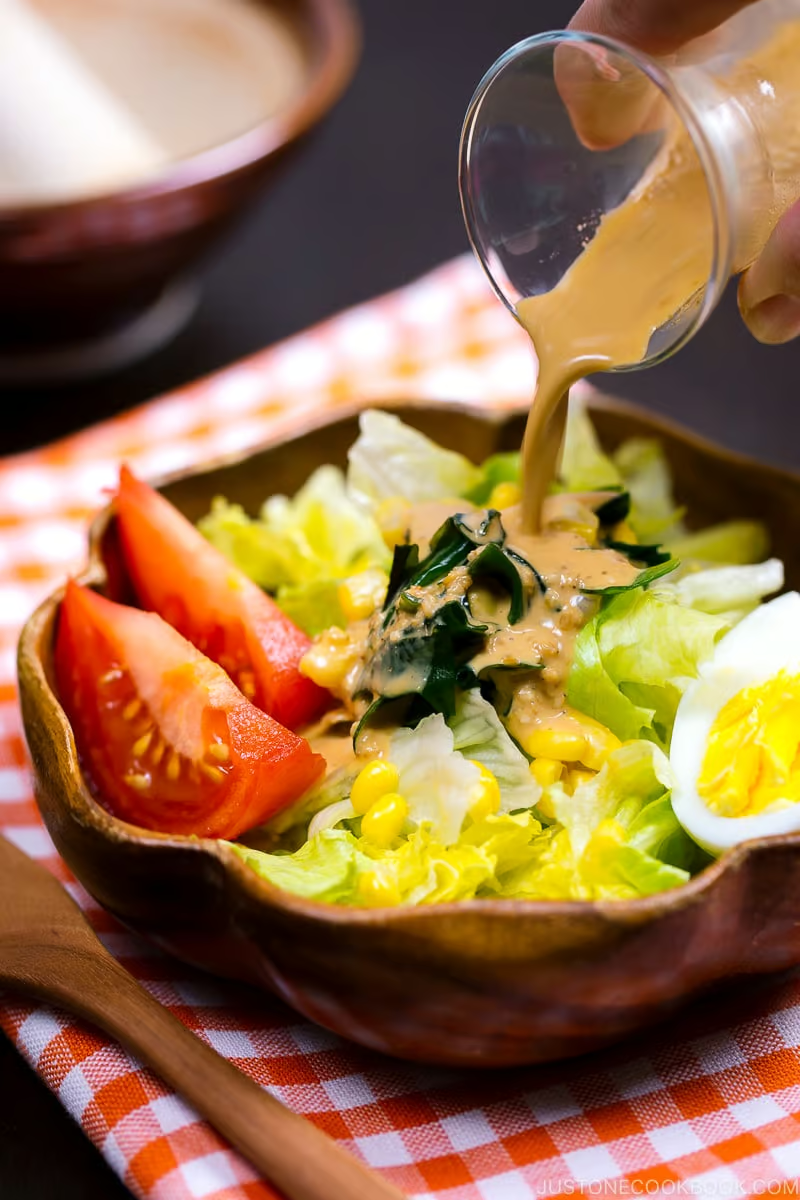
Cabbage slaw – Toss a shredded cabbage and cucumber slaw in Japanese Sesame Dressing or your favorite Asian dressing.
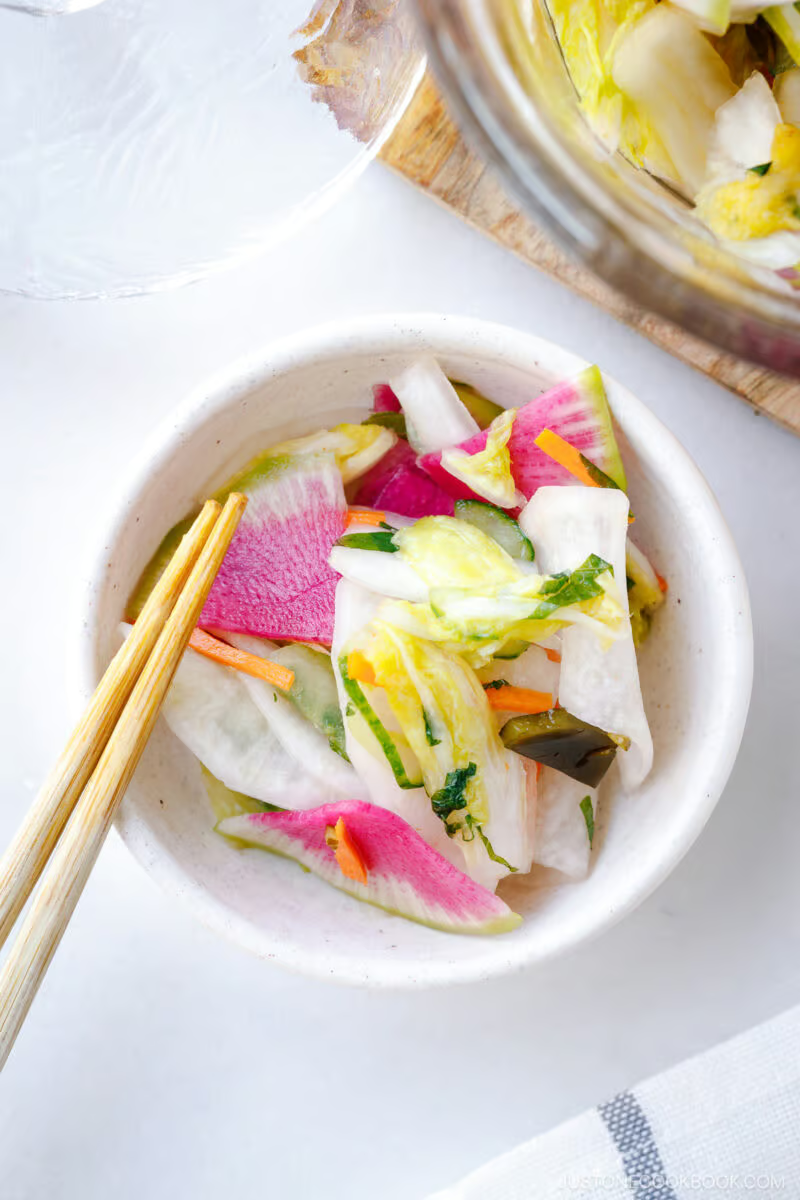
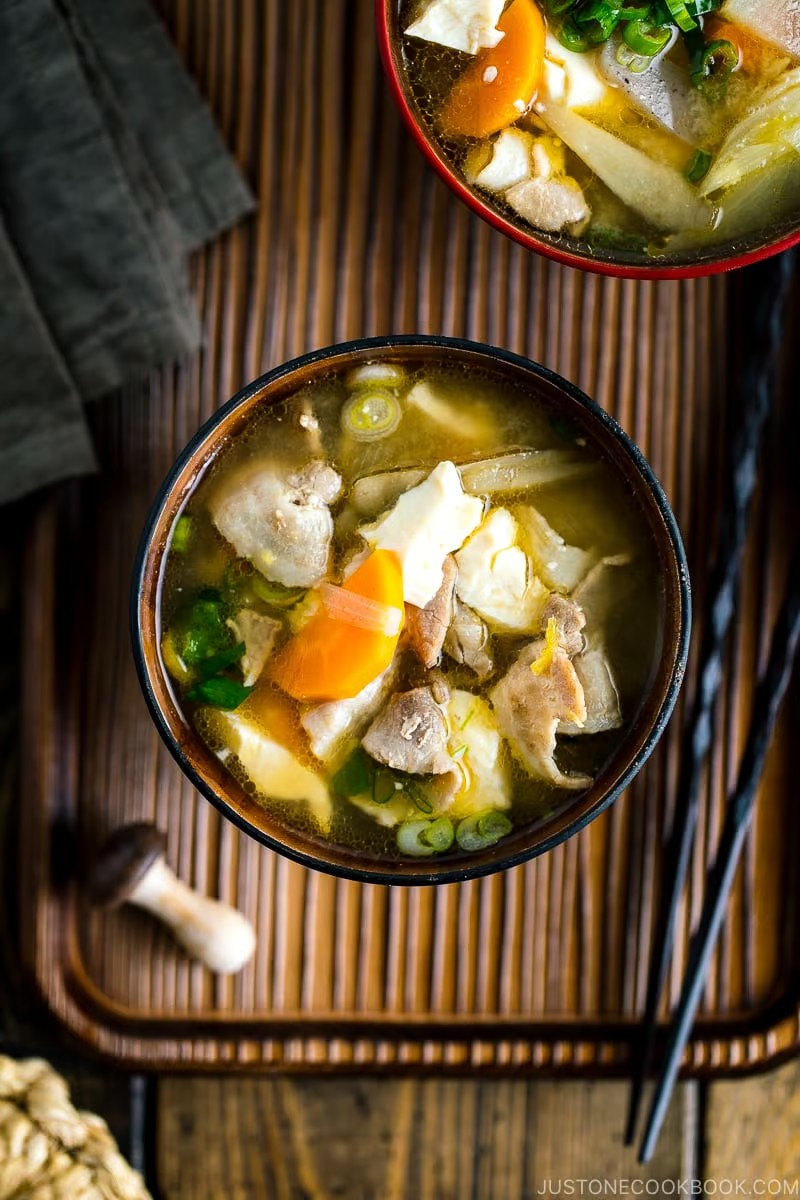
Pickles – chop up some veggies to make crunchy Asazuke for a slightly sweet and salty flavor and a lovely textural contrast with the tonkatsu. Hearty soup – Tonjiru or Clam Miso Soup is commonly served at Tonkatsu restaurants, making them the perfect companion.
Show 1 more media item
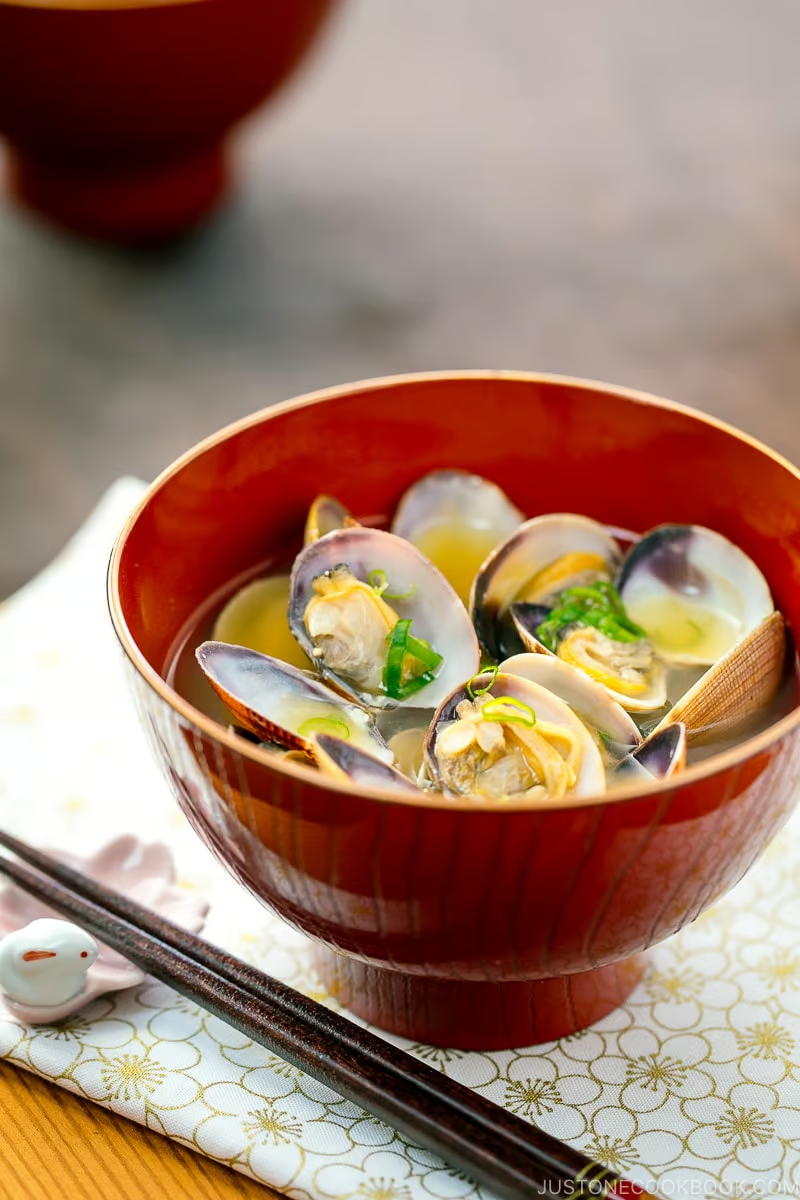
Storage and Reheating Tips
To store: Once the tonkatsu has cooled completely, store in an airtight container in the fridge for 3–4 days or in the freezer for up to 3–4 months.
To reheat: Reheat leftover cutlets in the oven and bake at 350ºF (180ºC) for 15–20 minutes if defrosted or 30–40 minutes if frozen.
Learn More
Extra cooking notes, tests, and source details kept out of the step-by-step method.
Why this works
Quick kitchen reasons behind the main choices.
Why I Love This Recipe
The light and crispy breading – I use flaky panko breadcrumbs for their light, fine, and supercrisp crunch.
A versatile recipe – We typically serve it with a heaping pile of cabbage and a side of pickles, but you could cook it over tender onions and serve it on rice to make my favorite donburi, Katsudon. Simple, yet irresistible – The ingredient list is short and the cook time is minimal, yet you’ll make a richly flavored and textured dish that everyone will love.
How do I dispose of cooking oil?
Since you do not want to pour oil down the drain, I suggest buying an oil-solidifying powder for easier removal (see the brand I use in my recipe card).
Alternatively, let the oil cool completely, then pour it into an empty container and place it in the garbage.
Article photos
Photos used with the article notes.
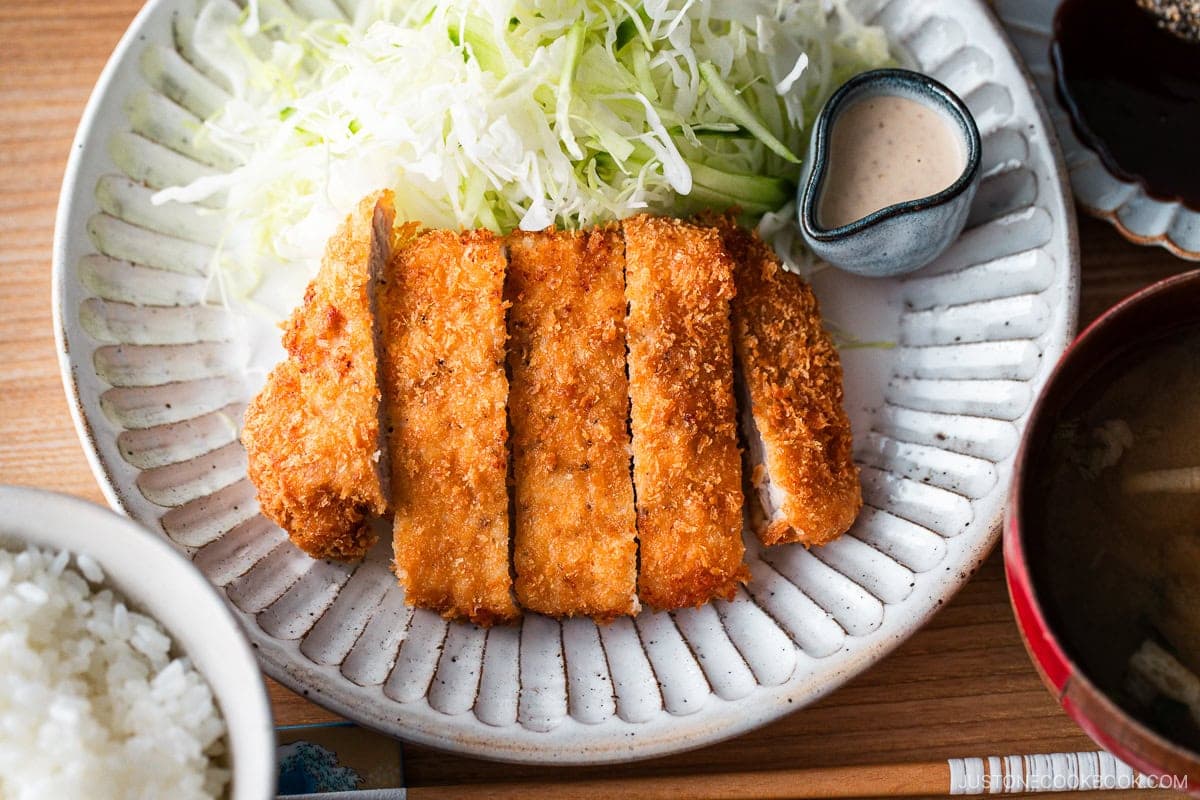
Source: Tonkatsu (Japanese Pork Cutlet) (Video) とんかつ
Testing notes
Useful tests and side-by-side notes after the method is clear.
What’s Japanese Panko?
These Japanese-style breadcrumbs are made from soft, crustless Japanese milk bread.
Their large, flaky texture absorbs less oil than finely ground breadcrumbs, creating a light, crisp coating. You can get Japanese panko from Amazon or at Japanese/Asian grocery stores.
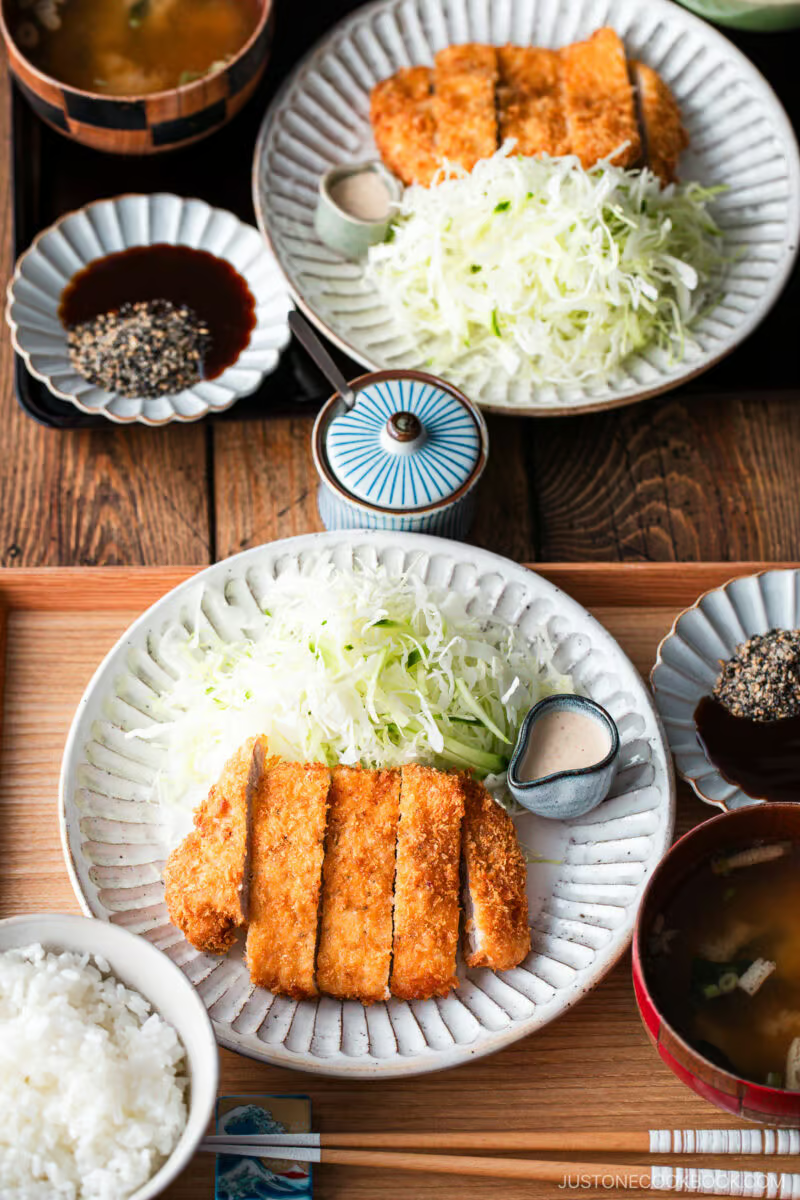
Recipe structure
Components and intermediate outputs created by the method.
Main recipe
Recipe card ingredients and steps.
2
Dressing
Source step 3 creates or uses dressing.
Mixture
Source step 13 creates or uses mixture.
Sauce
Source step 5 creates or uses sauce.
Recipe Utilities
Account actions, source details, export, and reporting stay available without interrupting the cooking flow.
Source and Origin
Origin declaration
Adapted from source
Imported from the just-one-cookbook page for dev review.
Copy risk: Unchecked
Tonkatsu (Japanese Pork Cutlet) (Video) とんかつ
Article
View source
My Kitchen Actions
Login is required.
My Kitchen keeps saved recipes, private notes, adaptations, cooking logs, imports, and exports tied to your account.
Export
Public recipe exports include only approved public content. Personal backup exports require login.
Export history
No exports yet.