Poke Bowl
Make a restaurant-quality poke bowl at home in 15 minutes. Fresh sashimi-grade fish, a simple sesame-soy marinade, and your favourite toppings. No cooking required!
- Total time
- 15 min
- Active time
- 15 min
- Yield
- 3
- Difficulty
- Medium

Ingredients and Constraints
Ingredients
Ingredient watchpoints3 watchpoints
Short requirements and tradeoffs to check while gathering ingredients; detailed source notes stay expandable.
Japanese Cucumber
Japanese or Persian cucumber ((cubed or sliced))
The source ingredient row lists alternatives.
Details and source
Acceptable alternatives: Persian Cucumber
Source: Poke Bowl Recipe
Japanese Cucumber
Japanese or Persian cucumber ((cubed or sliced))
The source row includes a form, size, temperature, preparation, or handling detail.
Details and source
Source: Poke Bowl Recipe
Red Radish
red radish ((thinly sliced))
The source row includes a form, size, temperature, preparation, or handling detail.
Details and source
Source: Poke Bowl Recipe
Additional ingredient notes
Ingredients for Poke Bowl
Sushi-grade tuna and salmon – Ahi tuna is the classic choice, and I add salmon for its flavor and bright color.
Different types of sashimi-grade seafood are used in traditional poke. Hawaiian ogo seaweed (dried) – A type of red seaweed common in poke bowls. Green onion/scallion Maui or sweet onion Marinade – I developed this marinade using Japanese pantry staples I always have at home. The rice vinegar brightens the sesame-soy base in a way that balances the richness of the fish. Soy sauce Toasted sesame oil Rice vinegar Kosher salt or Hawaiian sea salt White sesame seeds Cooked rice – Poke in Hawaii is often served without rice, but for a one-dish meal, we like to serve it over Japanese short-grain white rice or brown rice. Toppings of your choice – I like avocado, edamame, cucumber, radish, sushi ginger (gari), shiso leaves, and furikake (Japanese rice seasoning). Find the printable recipe with measurements below. JUMP TO RECIPE Substitutions Ogo seaweed: If you can’t find it, you can skip it. Soy sauce: Use tamari soy sauce for gluten free.
Substitutions
Ogo seaweed: If you can’t find it, you can skip it.
Soy sauce: Use tamari soy sauce for gluten free. Rice: A base of salad greens makes a refreshing low-carb option. Toppings: I love the flavor and color of the toppings in my recipe, but again, you are welcome to experiment with different toppings like carrots, red bell peppers, or microgreens. Masago (fish roe) and nori seaweed are wonderful additions, too.

Notes: Creamy texture
Macadamia nuts (roasted and chopped) – mild and creamy, they taste somewhat similar to roasted kukui nuts (candlenuts).
Spicy Mayo – a creamy and spicy sauce of Japanese mayo and sriracha sauce.
Notes: Heat level
Spicy Mayo – a creamy and spicy sauce of Japanese mayo and sriracha sauce.
Before You Cook
Constraints, controls, and warnings to review before starting.
Decisions before cookingDetails1
Reviewed comparisons and tradeoffs that affect the path before the first active step.
Variations and Customizations
The beauty of poke bowls is in how customizable they are with your favorite toppings.
Here are a few other suggestions that I think you’ll love. Try my Vegan Poke Bowl and use pan–fried tofu for a meatless option. Drizzle sriracha over the tuna poke bowls, or add a dash of red pepper flakes for heat. Try my Homemade Ponzu Sauce for a more citrus-forward marinade.

Method Overview
Structured method notes that are separate from the step timeline.
Preparation
Step 1 – Rehydrate the seaweed and cut the ingredients.
Place the seaweed in a small bowl with water to cover and set aside briefly to rehydrate. Then, squeeze out the water and slice it into smaller pieces.


Show 4 more media items


Nami’s Recipe Tips
Buy your fish from a reliable source – It is important to source raw fish from a reputable source.
Terms like “sashimi-grade” and “sushi-grade” are not strictly regulated, so it’s best to go with a fishmonger you trust. Do not use just any fresh fish – What makes fish “sashimi-grade” is that it has been flash-frozen before being packaged, as this is required to kill any potential parasites.

Method Timeline
Prep
ActivePrep
15 min
Prep time from the source recipe card.
Total
PassiveTotal
15 min
Total time from the source recipe card.
Step 1
I recommend a marination time of 1 hour for the poke to develop the best flavor. If you‘re short on time, you can always shorten or skip it.
Step 2
For 3 donburi servings of steamed rice, I recommend cooking 2¼ cups (3 rice cooker cups, 450 g) of uncooked Japanese short-grain rice. This yields 6⅔ cups (990 g) cooked rice. See how to cook short-grain rice with a rice cooker, pot over the stove, Instant Pot, or donabe.
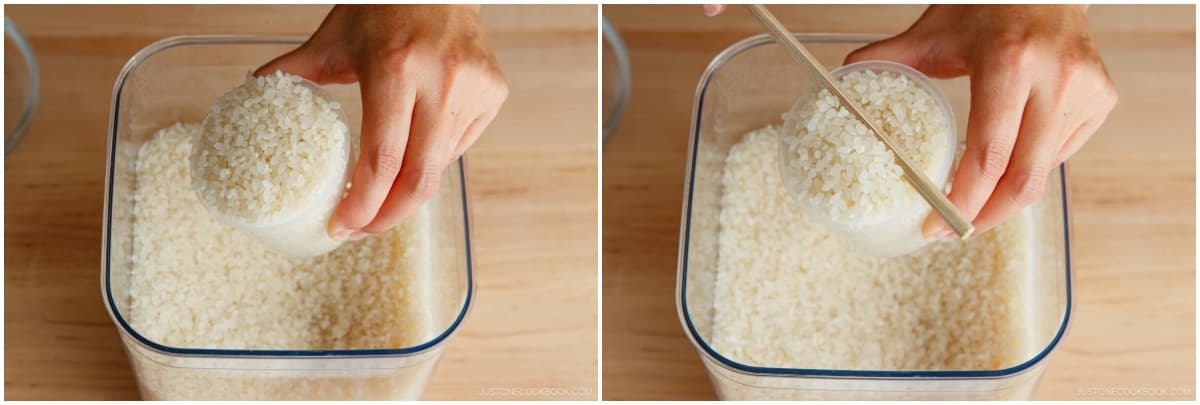
Image detailsFor 3 donburi servings of steamed rice, I recommend cooking 2¼ cups (3 rice cooker cups, 450 g) of uncooked Japanese short-grain rice. This yields 6⅔ cups (990 g) cooked rice. See how to cook short-grain rice with a rice cooker, pot over the stove, Instant Pot, or donabe.Just One Cookbook · Poke Bowl RecipeDev reference Inputs and tools1
Uses
- 3 servings cooked Japanese short-grain rice ((about 1⅔ cups, 250 g per donburi serving))
Step 3
Now, gather all the ingredients.
Step 4
Put 1 small clump Hawaiian ogo seaweed (dried) in a small bowl and add enough water to cover. Soak for 5 minutes to rehydrate.
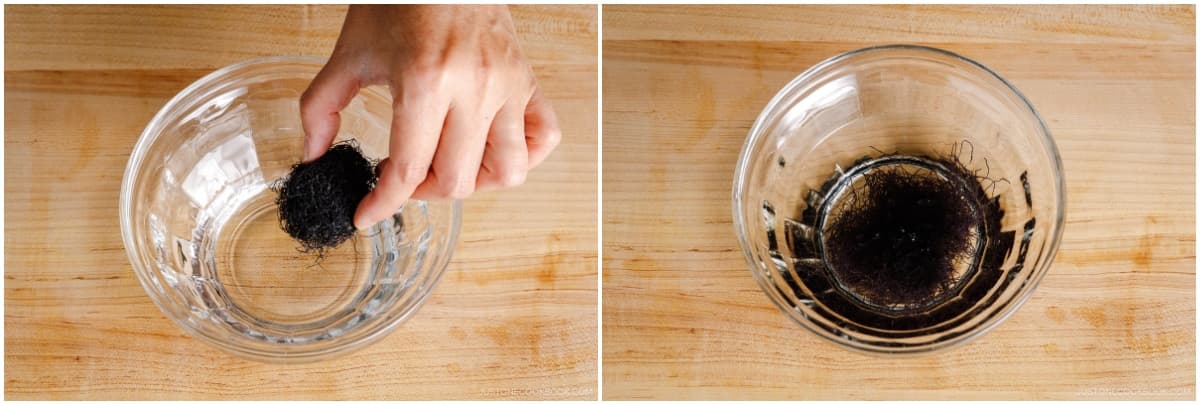
Image detailsPut 1 small clump Hawaiian ogo seaweed (dried) in a small bowl and add enough water to cover. Soak for 5 minutes to rehydrate.Just One Cookbook · Poke Bowl RecipeDev reference Checks1
TimingInfoTimingfor 5 minutes
Target: 5 minute
Expected state: Soak for 5 minutes to rehydrate.
Inputs and tools1
Uses
- 1 small clump Hawaiian ogo seaweed
Why and source
This step has reviewed source-backed guidance.
- Source: Poke Bowl Recipe
Step 5
Squeeze out the water and cut the ogo into smaller pieces, about 1 inch (2.5 cm) long.
Step 6
Thinly slice ¼ sweet onion lengthwise.
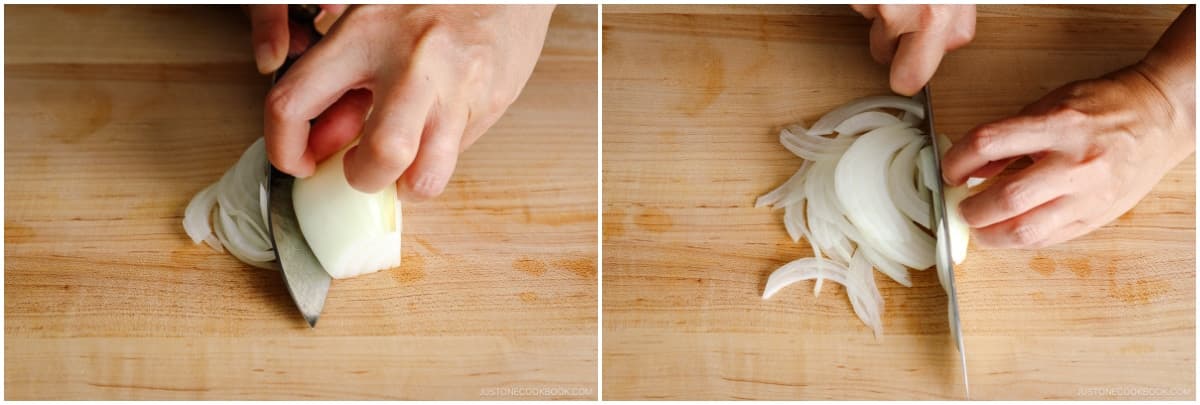
Image detailsThinly slice ¼ sweet onion lengthwise.Just One Cookbook · Poke Bowl RecipeDev reference Inputs and tools1
Uses
- ¼ sweet onion ((use Maui onion for the best flavor))
Step 7
Thinly slice 1 green onion/scallion.
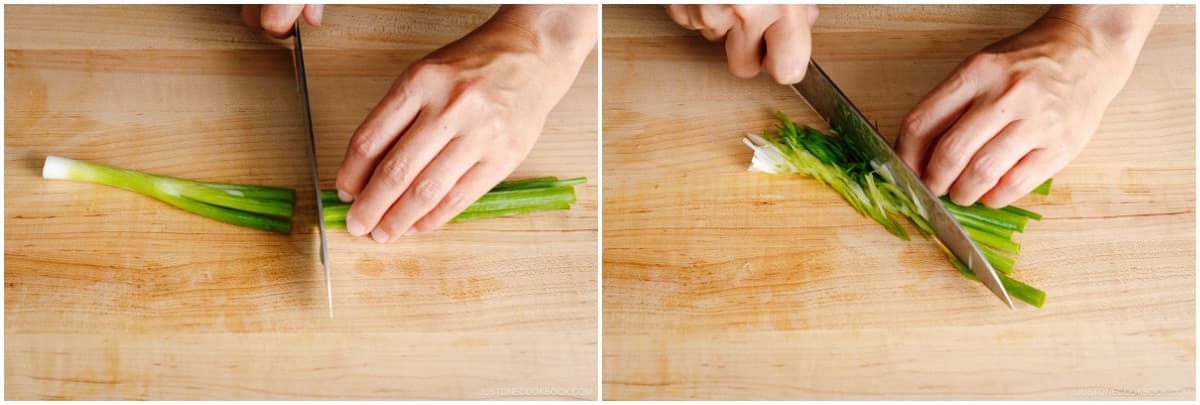
Image detailsThinly slice 1 green onion/scallion.Just One Cookbook · Poke Bowl RecipeDev reference Inputs and tools1
Uses
- 1 green onion/scallion
Step 8
Cut ½ lb sashimi-grade tuna into bite-sized cubes about ¾ inch (2 cm).
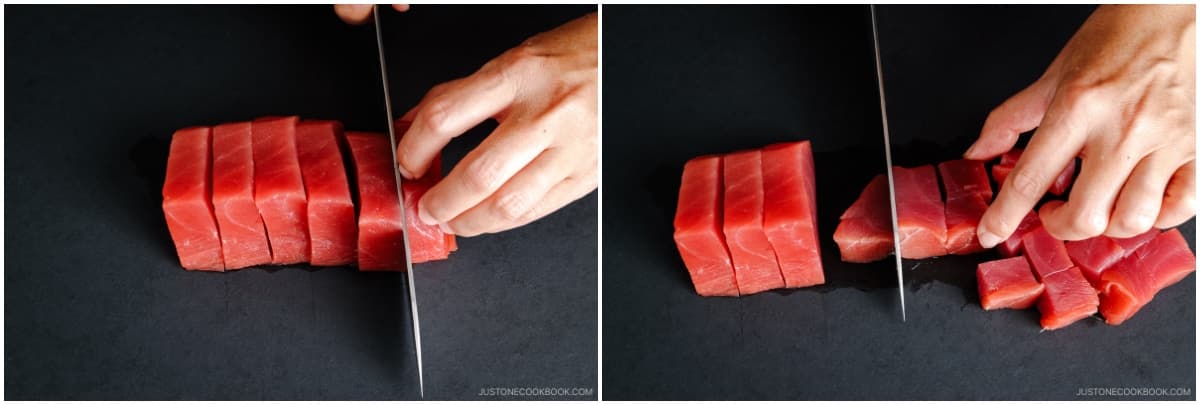
Image detailsCut ½ lb sashimi-grade tuna into bite-sized cubes about ¾ inch (2 cm).Just One Cookbook · Poke Bowl RecipeDev reference Inputs and tools1
Uses
- ½ lb sashimi-grade tuna ((try ahi or skipjack for an authentic flavor))
Step 9
Cut ½ lb sashimi-grade salmon into bite-sized cubes about ¾ inch (2 cm).
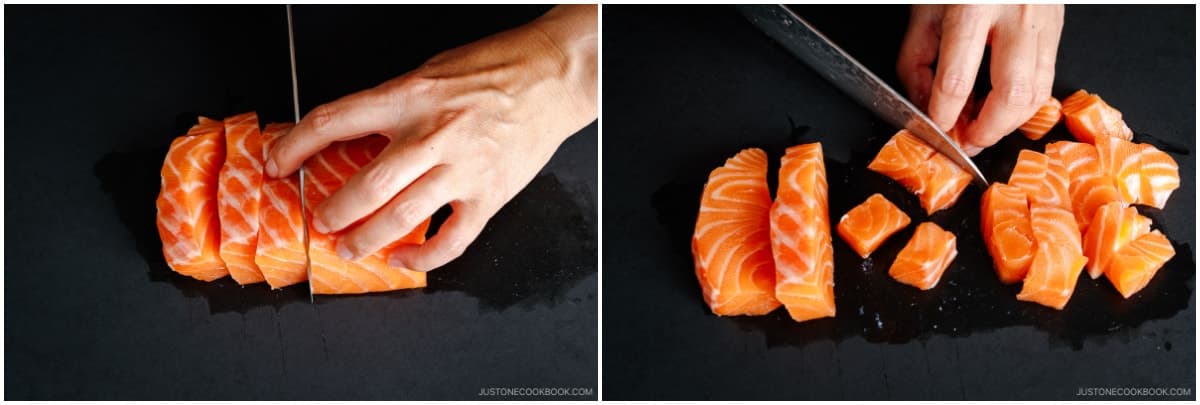
Image detailsCut ½ lb sashimi-grade salmon into bite-sized cubes about ¾ inch (2 cm).Just One Cookbook · Poke Bowl RecipeDev reference Inputs and tools1
Uses
- ½ lb sashimi-grade salmon ((though not traditional, it adds a beautiful color))
Step 10
Put the tuna and salmon in a large bowl. Add the onion, green onion, and ogo.
Step 11
Add the seasonings: 3 Tbsp soy sauce, 1 Tbsp toasted sesame oil, 2 tsp rice vinegar (unseasoned), and ⅛ tsp Diamond Crystal kosher salt⅛ tsp Diamond Crystal kosher salt (or Hawaiian sea salt).
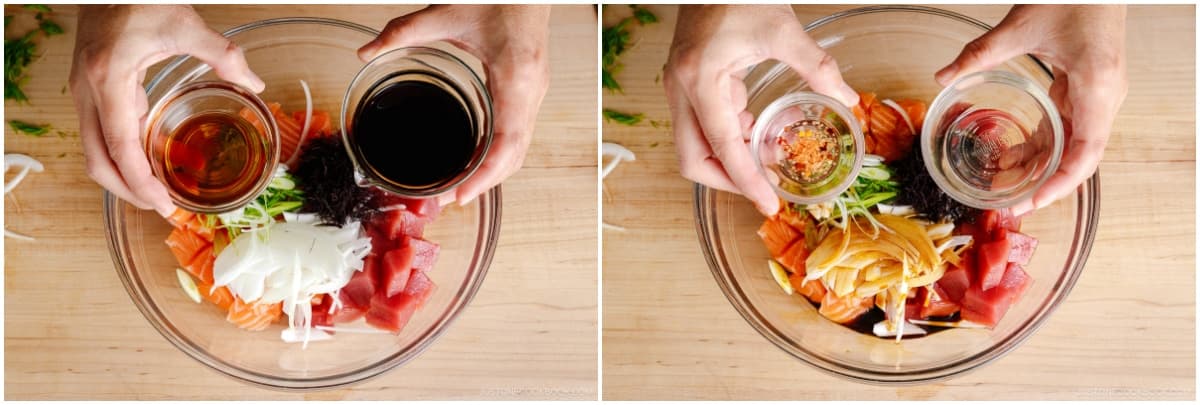
Image detailsAdd the seasonings: 3 Tbsp soy sauce, 1 Tbsp toasted sesame oil, 2 tsp rice vinegar (unseasoned), and ⅛ tsp Diamond Crystal kosher salt⅛ tsp Diamond Crystal kosher salt (or Hawaiian sea salt).Just One Cookbook · Poke Bowl RecipeDev reference Inputs and tools4
Uses
- 3 Tbsp soy sauce ((GF soy sauce for gluten free))
- 1 Tbsp toasted sesame oil
- 2 tsp rice vinegar (unseasoned)
- ⅛ tsp Diamond Crystal kosher salt
Step 12
Sprinkle in ½ Tbsp toasted white sesame seeds and gently mix it all together. Cover and marinate it in the refrigerator for at least 1 hour (or up to 12 hours) to develop the flavors. During this time, prepare your optional toppings.
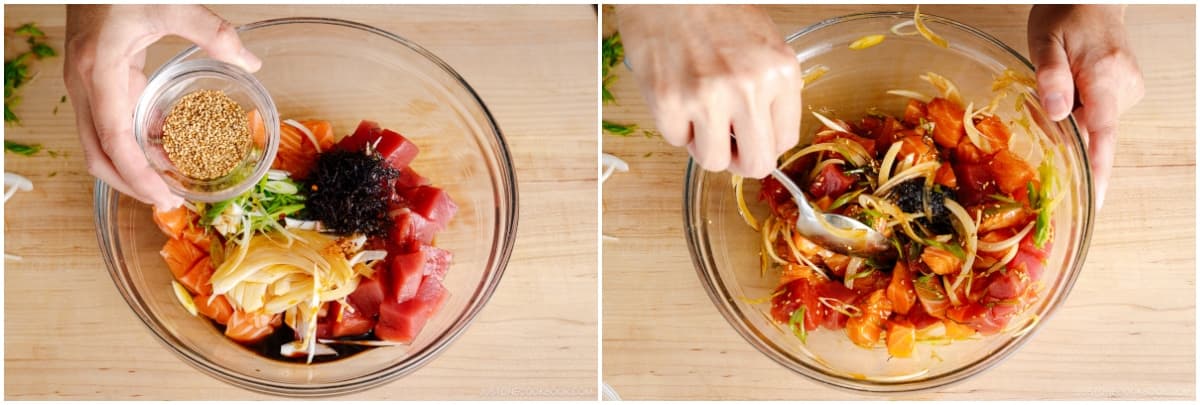
Image detailsSprinkle in ½ Tbsp toasted white sesame seeds and gently mix it all together. Cover and marinate it in the refrigerator for at least 1 hour (or up to 12 hours) to develop the flavors. During this time, prepare your optional toppings.Just One Cookbook · Poke Bowl RecipeDev reference Checks1
TimingInfoTiming1 hour
Target: 60 minute
Expected state: Cover and marinate it in the refrigerator for at least 1 hour (or up to 12 hours) to develop the flavors.
Inputs and tools1
Uses
- ½ Tbsp toasted white sesame seeds
Why and source
This step has reviewed source-backed guidance.
- Source: Poke Bowl Recipe
Step 13
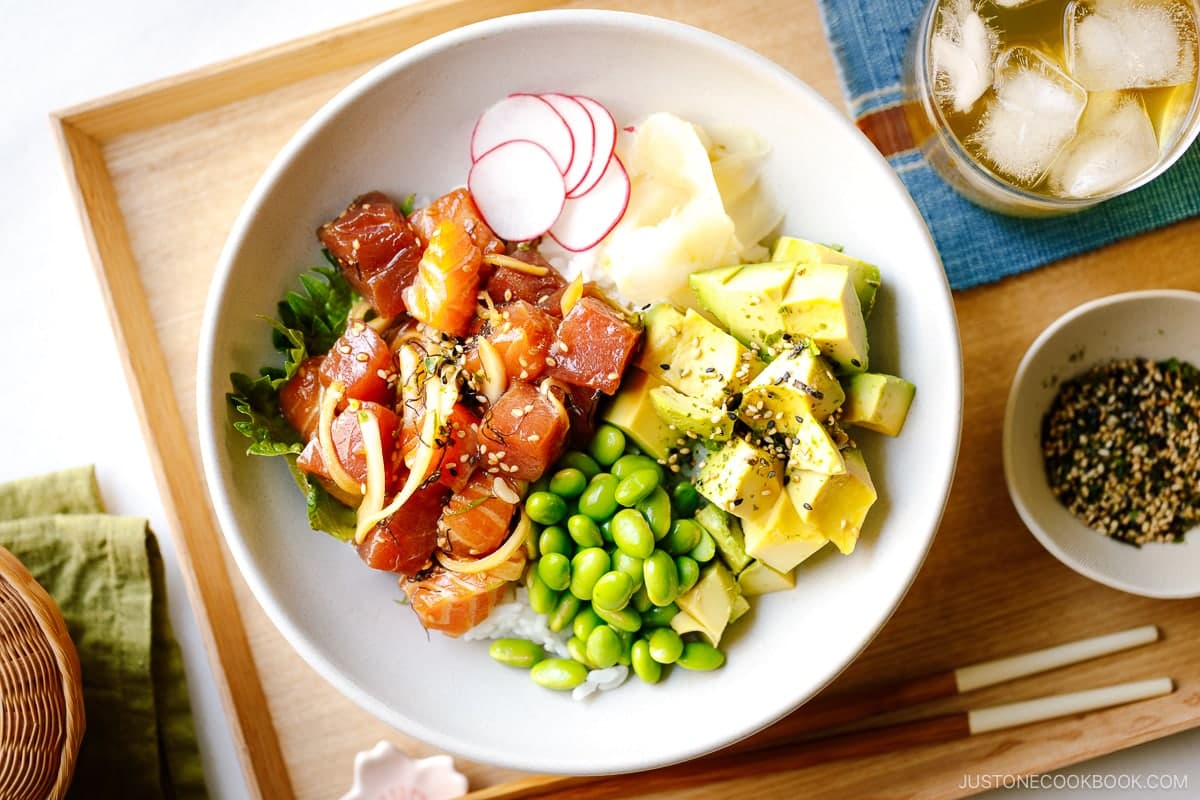
Divide 3 servings cooked Japanese short-grain rice into individual large (donburi) bowls. Cool the hot rice for 3–5 minutes (you don‘t want to warm up the raw fish). Then, pile the poke on top. You can add the toppings of your choice now. I recommend sliced or cubed avocado shelled edamame, thinly sliced Japanese or Persian cucumber, thinly sliced red radish, sushi ginger (gari), shiso leaves (perilla/ooba), and furikake (rice seasoning). See my Notes below for more suggestions. Serve immediately and enjoy!
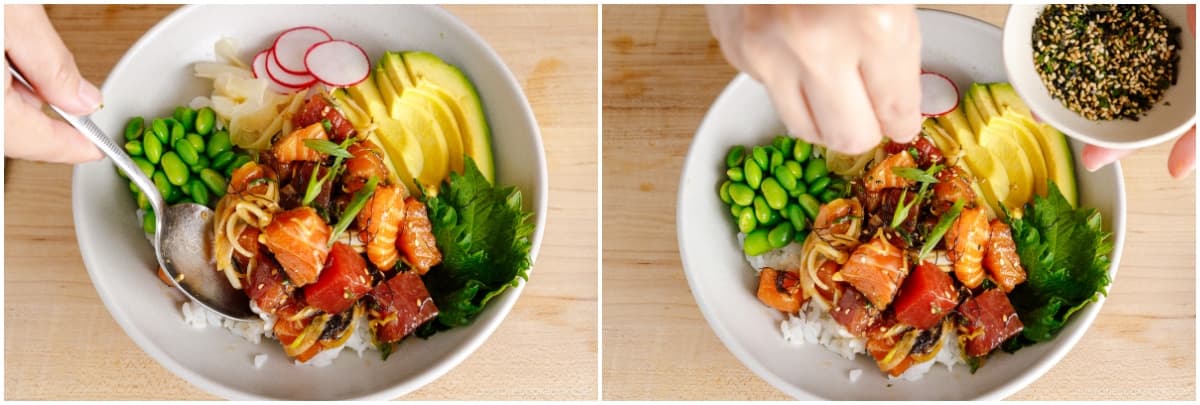
Image detailsDivide 3 servings cooked Japanese short-grain rice into individual large (donburi) bowls. Cool the hot rice for 3–5 minutes (you don‘t want to warm up the raw fish). Then, pile the poke on top. You can add the toppings of your choice now. I recommend sliced or cubed avocado shelled edamame, thinly sliced Japanese or Persian cucumber, thinly sliced red radish, sushi ginger (gari), shiso leaves (perilla/ooba), and furikake (rice seasoning). See my Notes below for more suggestions. Serve immediately and enjoy!Just One Cookbook · Poke Bowl RecipeDev reference Checks2
TimingInfoTimingfor 3–5 minutes
Target: 3-5 minute
Expected state: Cool the hot rice for 3–5 minutes (you don‘t want to warm up the raw fish).
HoldingMain recipeSource holding instruction
Divide 3 servings cooked Japanese short-grain rice into individual large (donburi) bowls. Cool the hot rice for 3–5 minutes (you don‘t want to warm up the raw fish). Then, pile the poke on top. You can add the toppings of your choice now. I recommend sliced or cubed avocado shelled edamame, thinly sliced Japanese or Persian cucumber, thinly sliced red radish, sushi ginger (gari), shiso leaves (perilla/ooba), and furikake (rice seasoning). See my Notes below for more suggestions. Serve immediately and enjoy!
Inputs and tools7
Uses
- furikake (rice seasoning)
- shiso leaves (perilla/ooba)
- sushi ginger (gari)
- red radish ((thinly sliced))
- Japanese or Persian cucumber ((cubed or sliced))
- shelled edamame ((boiled))
- avocado
Why and source
This step has reviewed source-backed guidance.
- Source: Poke Bowl Recipe
Step 14
It‘s best to enjoy the poke bowl on the day you prepare it. You can keep the poke ingredients in the refrigerator for up to 24 hours. I recommend cooking the rice just before serving.
Handling and Storage
Reviewed hold, storage, make-ahead, and service-timing guidance.
Where to Get Sashimi-Grade Tuna and Salmon
If you live near a Japanese grocery store, I recommend checking out their sashimi selection.
Here in the Bay Area, I always buy sashimi at Suruki Market in San Mateo. Other Japanese grocery stores that sell sashimi include Nijiya Market, Marukai (Tokyo Central), and Mitsuwa Market Place.
What is sashimi-grade and sushi-grade fish?
The terms “sashimi-grade” and “sushi-grade” aren’t officially regulated in the US, so they come down to trust in your supplier.
Generally, the label means the fish has been commercially flash-frozen at a temperature low enough to kill any parasites, making it safe to eat raw. Your safest bet is to buy from a reputable grocery store or specialist fishmonger, ask directly whether the fish is intended for raw consumption, and use it within two days.

Assemble
Step 4 – Portion the rice and poke.
Divide the cooked rice into large bowls and let it cool briefly. Then, place your toppings and pile the poke on top.


What to Serve with a Poke Bowl
Poke bowls make an excellent one-bowl dish that you can serve on its own.
To add extra variety, I suggest pairing it with one of these dishes. With pickles – I find Pickled Napa Cabbage adds a pleasant crunch and satisfying acidity.


Storage Tips
To store: Poke bowls are best enjoyed the same day, but you can store the poke ingredients in separate airtight containers for up to 24 hours.
I suggest cooking the rice fresh before serving.
Can I make poke bowls ahead of time?
The poke marinade can be made up to 12 hours ahead and kept covered in the refrigerator.
However, I recommend cooking the rice fresh just before serving for the best texture. Don’t assemble the bowls in advance; keep the poke and toppings separate until you’re ready to eat.
Learn More
Extra cooking notes, tests, and source details kept out of the step-by-step method.
Why this works
Quick kitchen reasons behind the main choices.
Why I Love This Recipe
No cooking needed – I enjoy any dish that doesn’t require turning on the oven, especially in the summertime!
Endlessly customizable – You can add any of your favorite toppings and go crazy with colorful veggies. It’s completely up to you.

Complete Your Meal
Japanese Clam Miso Soup あさりの味噌汁 14 10 minutes minutes Simmered Bamboo Shoots (Tosani)たけのこの土佐煮 12 30 minutes minutes Spinach Ohitashi (Japanese Spinach Salad) ほうれん草のお浸し 66 20 minutes minutes Namasu (Daikon and Carrot Salad) 紅白なます 50 15 minut
Are poke bowls healthy?
Yes, poke bowls can be a very healthy dish, as it’s composed of fish that’s high in Omega 3 fatty acids.
Combined with colorful vegetables, it’s a dish that is rich in protein, fiber, and healthy fats.
How do I make sure the raw fish in poke is safe to eat?
It’s important to make sure the fish you are using is free from harmful parasites.
While there is no regulation around the labels of “sashimi-grade” and “sushi-grade” in the US, you should use your best judgment when it comes to using a reliable fishmonger.
Article photos
Photos used with the article notes.


Source: Poke Bowl Recipe
Recipe structure
Components and intermediate outputs created by the method.
Main recipe
Recipe card ingredients and steps.
3
Sauce
Source step 11 creates or uses sauce.
Extra useful notes
Short source-backed recommendations and facts that do not need a step.
More Ideas for Creative Toppings:
More Ideas for Creative Toppings:
Cucumbers and carrots – thinly sliced or diced, they add color and crunch.
Cucumbers and carrots – thinly sliced or diced, they add color and crunch.
Microgreens – daikon sprouts, broccoli sprouts, or kale sprouts pack a nutritious punch.
Microgreens – daikon sprouts, broccoli sprouts, or kale sprouts pack a nutritious punch.
Cherry tomatoes (quartered) – adds a sweet, flavorful, and lightly acidic element.
Cherry tomatoes (quartered) – adds a sweet, flavorful, and lightly acidic element.
Masago – this salty, delicate fish roe adds color and an interesting bite.
Masago – this salty, delicate fish roe adds color and an interesting bite.
Dried seaweed (nori) – shredded or julienned for a crispy texture.
Dried seaweed (nori) – shredded or julienned for a crispy texture.
Macadamia nuts (roasted and chopped) – mild and creamy, they taste somewhat similar to roasted kukui nuts (candlenuts).
Macadamia nuts (roasted and chopped) – mild and creamy, they taste somewhat similar to roasted kukui nuts (candlenuts).
Wasabi – so good with fresh sashimi.
Wasabi – so good with fresh sashimi.
Recipe Utilities
Account actions, source details, export, and reporting stay available without interrupting the cooking flow.
Source and Origin
Origin declaration
Adapted from source
Imported from the just-one-cookbook page for dev review.
Copy risk: Unchecked
Poke Bowl Recipe
Article
View source
My Kitchen Actions
Login is required.
My Kitchen keeps saved recipes, private notes, adaptations, cooking logs, imports, and exports tied to your account.
Export
Public recipe exports include only approved public content. Personal backup exports require login.
Export history
No exports yet.