Miso Salmon
This Miso Salmon is a magical weeknight meal! Marinated in a sweet and savory miso sauce, the fillets are broiled to perfection.
- Total time
- 20 min
- Active time
- 5 min
- Yield
- 2
- Difficulty
- Medium

Ingredients and Constraints
Ingredients
Ingredient watchpoints1 watchpoint
Short requirements and tradeoffs to check while gathering ingredients; detailed source notes stay expandable.
Green Onion/Scallion
1 green onion/scallion ((chopped))
The source row includes a form, size, temperature, preparation, or handling detail.
Details and source
Source: Miso Salmon (Video) 味噌サーモン
Additional ingredient notes
Ingredients for Miso Salmon
Salmon: I recommend using salmon that is less than 1 inch (2.5 cm) thick for broiling.
If you don’t have a broiler, wild King/Chinook salmon, which is thick and has a high-fat content, is ideal for baking. You don’t have to worry about the fish drying out quickly. Farmed Atlantic salmon, while very rare to find in the wild, is a more affordable and accessible option. Miso: I use white miso (shiro miso) in this recipe for two reasons. First, it is widely available in Japanese and Asian markets, as well as mainstream grocery stores. Second, the flavor profile complements this recipe well. If you have other types of miso, you can certainly use them (I use various miso for this recipe as well). Just remember that each brand and type of miso has a different level of saltiness, so adjust the amount accordingly. If you’ve had a tub of miso in the fridge for a while, Does Miso Go Bad? covers when it’s still good to use.

Nami’s Recipe Tips: Creamy texture
Choose center-cut fillets about 1 inch (2.5 cm) thick, with each piece roughly the same size (around 6 oz / 170 g).
Marinate 1–2 hours for fillets under 1 inch (2.5 cm) thick and up to 3 hours for thicker cuts.
Nami’s Recipe Tips: Heat level
Control broiling by adjusting the rack distance between the food and the heat source.
Ingredients 1X 2X 3X
2 skin-on salmon fillets (¾ lb, 340 g; ideally, less than 1 inch or 2.5 cm thick; 4–6 oz or 113–170 g per fillet) For the Marinade 2 Tbsp miso (use any type of miso; I used Hikari Miso Organic White Miso) 1 Tbsp sake 1 Tbsp mirin 1 Tbsp soy
Before You Cook
Constraints, controls, and warnings to review before starting.
Decisions before cookingDetails1
Reviewed comparisons and tradeoffs that affect the path before the first active step.
Broiling vs. Baking Fish
In case you’re curious, I summarized the differences between broiling and baking fish, and which types of fish are suitable for broiling versus baking.
Method Overview
Structured method notes that are separate from the step timeline.
How to Make Miso Salmon
Make the miso marinade and marinate the salmon for 1-2 hours.
Remove the marinade from the salmon and broil it.

Why Broil the Salmon?
If you usually bake salmon, try broiling instead!
Broiling cooks the salmon quickly with high heat from above, caramelizing the surface for a golden finish while keeping the inside juicy and tender. Baking uses gentler, all-around heat, which takes longer to cook, dries out the fish, and doesn’t give you that same lightly charred look and flavor.
Broiling Method
Broiling cooks the food from the direct radiant heat (infrared energy) coming from the oven’s top element.
You control the cooking by adjusting the rack distance (how close the food is to the broiler) rather than the oven temperature. Pros and cons: Delivers quick, high heat directly to the food’s surface Great for browning and caramelization Ideal for thin cuts of fish; thicker cuts won’t cook evenly Best fish for broiling: Fatty fish: Salmon (thin cuts; under 1 inch or 2.5 cm), mackerel, swordfish Moderately lean fish: Cod, haddock (brushed with oil first) Thin fillets: Common in Japanese markets, where fish is often cut very thin.


Wait, you said to cook the salmon until an internal temperature of 125-130°F (52-54ºC). Don’t we need to cook it to 145°F (63ºC)?
The USDA recommends cooking fish to an internal temperature of 145°F (63ºC); however, the remaining heat will continue to cook the salmon, resulting in well-overcooked fish.
There are many discussions online on this topic, and many reputable cooking websites do recommend cooking the salmon to 120-130ºF (49-54ºC).
Source video
Source video
Method Timeline
Prep
ActivePrep
5 min
Prep time from the source recipe card.
Cook
ActiveCook
15 min
Cook time from the source recipe card.
Total
PassiveTotal
20 min
Total time from the source recipe card.
Step 1
Please note that this recipe requires a marination time of 1–2 hours.
Step 2
Gather all the ingredients. To check 2 skin-on salmon fillets for bones, run your fingers along the flesh and sides, then pull them out with fish boning tweezers. To check for scales, run your fingers over the fish skin and scrape them off with the flat edge of a knife.
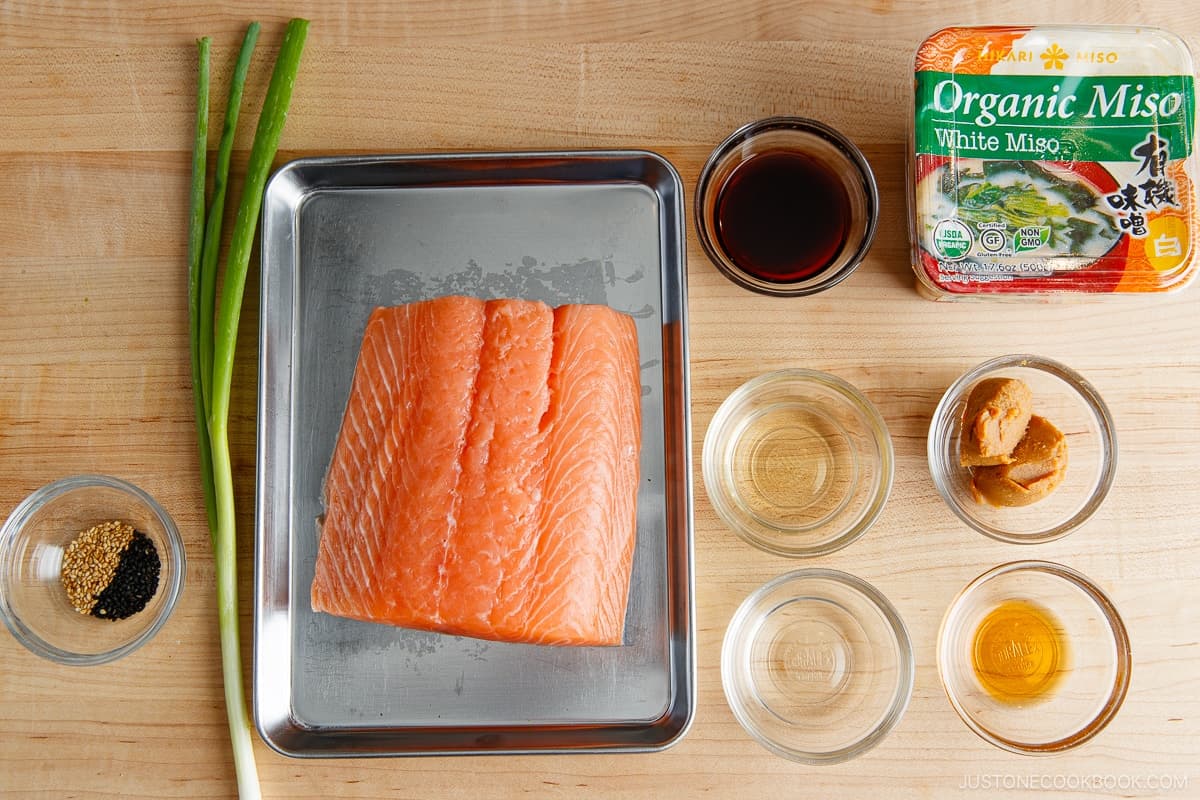
Image detailsGather all the ingredients.To check 2 skin-on salmon fillets for bones, run your fingers along the flesh and sides, then pull them out with fish boning tweezers. To check for scales, run your fingers over the fish skin and scrape them off with the flat edge of a knife.Just One Cookbook · Miso Salmon (Video) 味噌サーモンDev reference Inputs and tools1
Uses
- 2 skin-on salmon fillets
Step 3
Mix 2 Tbsp miso, 1 Tbsp sake, 1 Tbsp mirin, 1 Tbsp soy sauce, and ¼ tsp toasted sesame oil in a large bowl or flat tray.
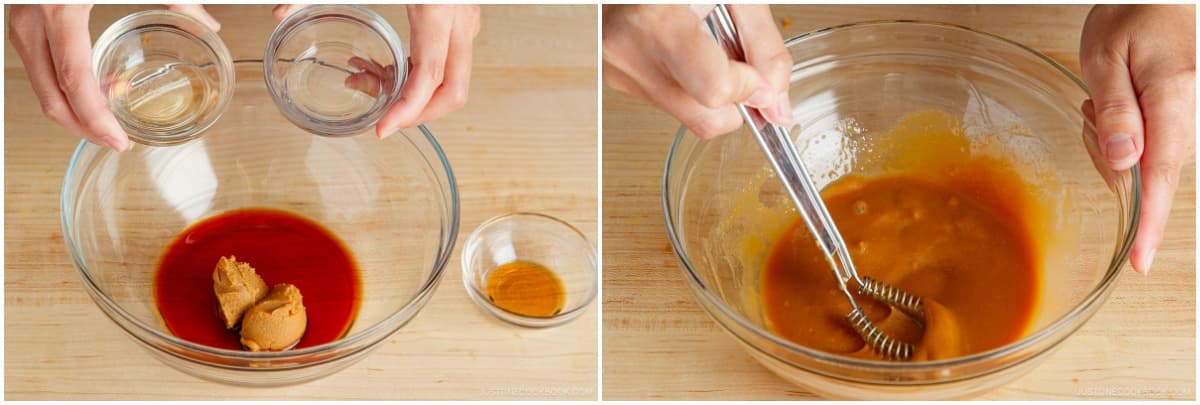
Image detailsMix 2 Tbsp miso, 1 Tbsp sake, 1 Tbsp mirin, 1 Tbsp soy sauce, and ¼ tsp toasted sesame oil in a large bowl or flat tray.Just One Cookbook · Miso Salmon (Video) 味噌サーモンDev reference Inputs and tools5
Uses
- 2 Tbsp miso ((use any type of miso; I used Hikari Miso Organic White Miso))
- 1 Tbsp sake
- 1 Tbsp mirin
- 1 Tbsp soy sauce
- ¼ tsp toasted sesame oil
Step 4
If your salmon isn’t cut into fillets, slice it into individual portions about 6 oz / 170 g each. Place the pieces in the marinade, skin side up. Nami's Tip: Slicing into individual fillets makes for quicker, more even cooking.
Step 5
Spoon the marinade over the salmon, coating the flesh, sides, and skin. Cover and refrigerate for 1–2 hours for fillets up to 1 inch (2.5 cm) thick, or up to 3 hours for thicker cuts. Nami's Tip: Avoid marinating overnight, as the miso marinade is very salty.
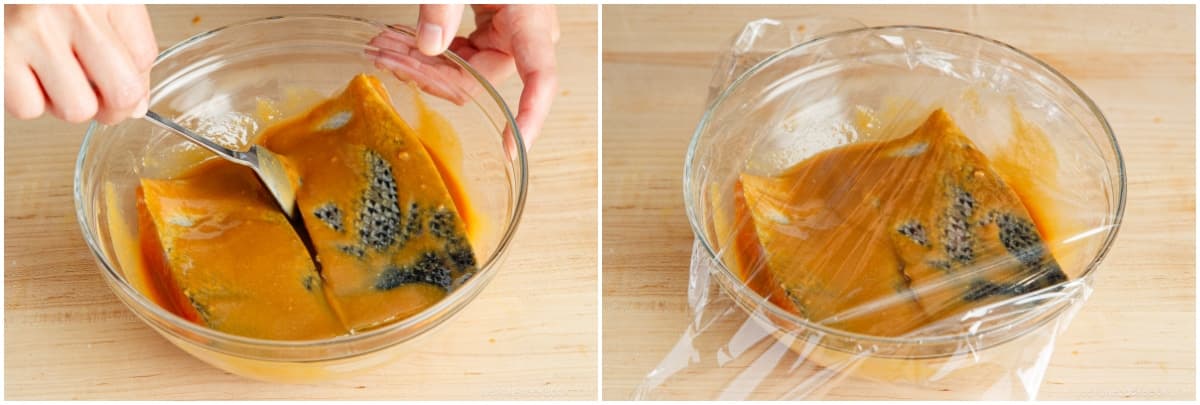
Image detailsSpoon the marinade over the salmon, coating the flesh, sides, and skin. Cover and refrigerate for 1–2 hours for fillets up to 1 inch (2.5 cm) thick, or up to 3 hours for thicker cuts.Nami's Tip: Avoid marinating overnight, as the miso marinade is very salty.Just One Cookbook · Miso Salmon (Video) 味噌サーモンDev reference Checks1
TimingInfoTimingfor 1–2 hours
Target: 60-120 minute
Expected state: The broiling time depends entirely on your broiler’s settings, the distance of the rack from the heating element, and the thickness of the salmon fillets.When I buy salmon fillets, I always opt for skin-on, center-cut fillets that are less than 1 inch (2.5 cm) thick. And make sure all the fillets are of the same thickness, each weighing roughly 6 ounces (170 g). After marinating the salmon in the refrigerator, it takes 10-13 minutes to broil.
Why and source
This step has reviewed source-backed guidance.
- Source: Miso Salmon (Video) 味噌サーモン
Step 6
I recommend broiling the miso salmon. If you don't have a broiler, you can bake it instead (see the next section). Preheat: Turn the broiler to High (550ºF/290ºC) and place a rack in the center, about 9 inches (23 cm) from the top heating element. Preheat for 5 minutes. Nami's Tip: When broiling, you don‘t adjust the oven temperature; instead, you control the cooking by adjusting the rack distance (how close the food is to the broiler). Think of it like using hotter and cooler zones on a grill.
Step 7
Cut the green onions diagonally into thin slices. Line a baking sheet with aluminum foil (since parchment paper will burn) and spray or brush the oil so the salmon skin won‘t stick.
Step 8
Remove all excess marinade before broiling, as miso burns easily.
Step 9
Place the salmon skin side down on the prepared baking sheet. Nami's Tip: I like to scrape off the excess marinade from all sides with an offset spatula or butter knife.
Step 10
Broil the salmon for about 10–13 minutes or until the thickest part of the fillet reaches 125–130°F (52–54ºC). No need to flip the salmon. For medium-rare, stop cooking at 120ºF (49ºC). Note: The USDA recommends cooking fish to 145°F (63ºC). Keep in mind that the salmon continues to cook with residual heat, which may cause it to overcook. I highly recommend a Thermapen instant-read thermometer to check the temperature.
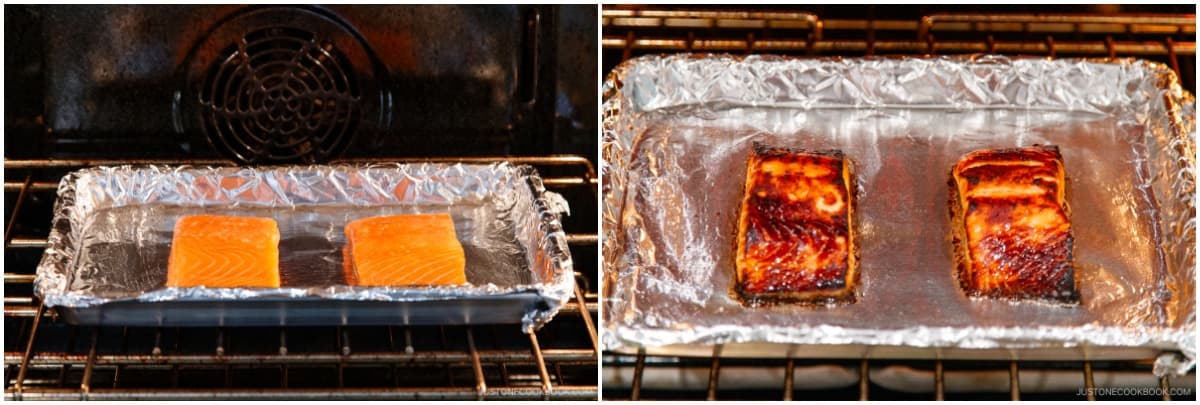
Image detailsBroil the salmon for about 10–13 minutes or until the thickest part of the fillet reaches 125–130°F (52–54ºC). No need to flip the salmon. For medium-rare, stop cooking at 120ºF (49ºC). Note: The USDA recommends cooking fish to 145°F (63ºC). Keep in mind that the salmon continues to cook with residual heat, which may cause it to overcook. I highly recommend a Thermapen instant-read thermometer to check the temperature.Just One Cookbook · Miso Salmon (Video) 味噌サーモンDev reference Visual cue
until the thickest part of the fillet reaches 125–130°F (52–54ºC).
Checks3
TemperatureInfoTemperature130°F
Target: 130 degree-fahrenheit
Expected state: Broil the salmon for about 10–13 minutes or until the thickest part of the fillet reaches 125–130°F (52–54ºC).
TemperatureInfoTemperature145°F
Target: 145 degree-fahrenheit
Expected state: Note: The USDA recommends cooking fish to 145°F (63ºC).
Visual cueInfoVisualuntil the thickest part of the fillet reaches 125–130°F (52–54ºC).
Expected state: until the thickest part of the fillet reaches 125–130°F (52–54ºC).
Why and source
This step has reviewed source-backed guidance.
- Source: Miso Salmon (Video) 味噌サーモン
Step 11
Alternatively, you can bake the salmon instead of broiling it. Here's how: Preheat the oven to 425°F (220ºC) with a rack placed in the center position. For a convection oven, reduce the cooking temperature by 25ºF (15ºC). Line a baking sheet with parchment paper.
Step 12
Remove all excess marinade before broiling, as miso burns easily. Nami's Tip: I like to scrape off the excess marinade from all sides with an offset spatula or butter knife.
Step 13
Place the salmon skin side down on the prepared baking sheet. If using an oven probe, insert it into the thickest part of the fillet. Nami's Tip: If you don‘t have a probe, I highly recommend a Thermapen instant-read thermometer.
Step 14
Bake the salmon for about 18–20 minutes, or until the thickest part of the fillet reaches 125–130°F (52–54ºC). No need to flip the salmon. For medium-rare, stop cooking at 120ºF (49ºC). Nami's Tip: Bake about 5 minutes per ½-inch (1.3-cm) of thickness, measured at the thickest part. Note: The USDA recommends cooking fish to 145°F (63ºC). Keep in mind that the salmon continues to cook with residual heat, which may cause it to overcook.
5 min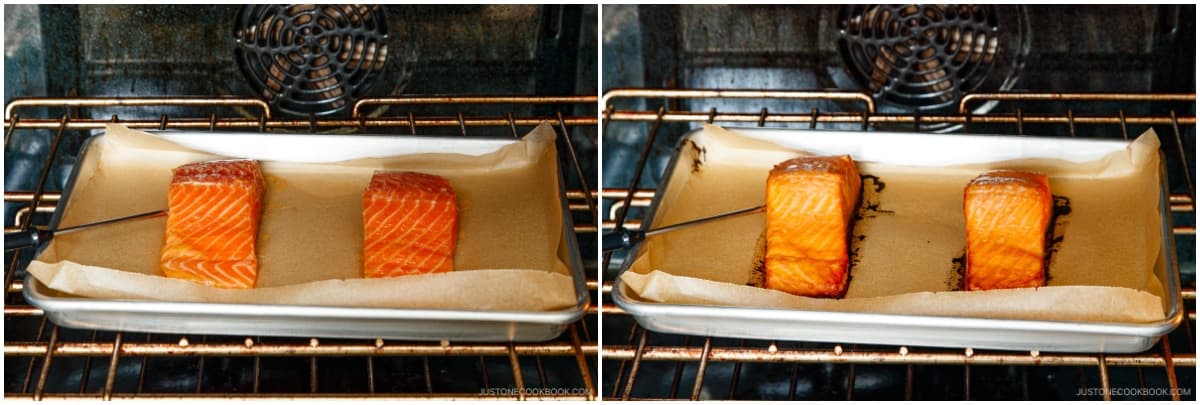
Image detailsBake the salmon for about 18–20 minutes, or until the thickest part of the fillet reaches 125–130°F (52–54ºC). No need to flip the salmon. For medium-rare, stop cooking at 120ºF (49ºC). Nami's Tip: Bake about 5 minutes per ½-inch (1.3-cm) of thickness, measured at the thickest part. Note: The USDA recommends cooking fish to 145°F (63ºC). Keep in mind that the salmon continues to cook with residual heat, which may cause it to overcook.Just One Cookbook · Miso Salmon (Video) 味噌サーモンDev reference Visual cue
until the thickest part of the fillet reaches 125–130°F (52–54ºC).
Checks3
TemperatureInfoTemperature130°F
Target: 130 degree-fahrenheit
Expected state: Bake the salmon for about 18–20 minutes, or until the thickest part of the fillet reaches 125–130°F (52–54ºC).
TemperatureInfoTemperature145°F
Target: 145 degree-fahrenheit
Expected state: Note: The USDA recommends cooking fish to 145°F (63ºC).
Visual cueInfoVisualuntil the thickest part of the fillet reaches 125–130°F (52–54ºC).
Expected state: until the thickest part of the fillet reaches 125–130°F (52–54ºC).
Why and source
This step has reviewed source-backed guidance.
- Source: Miso Salmon (Video) 味噌サーモン
Step 15
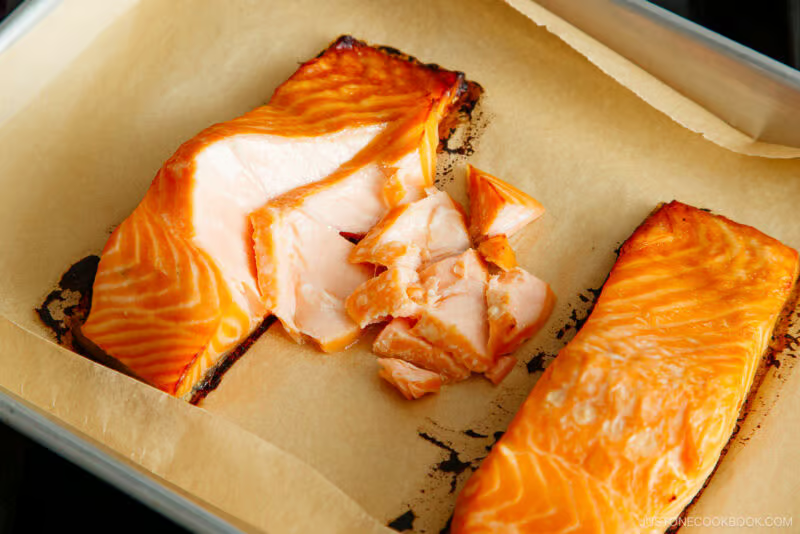
Remove the salmon from the oven and check doneness by flaking the flesh—it’s ready if it flakes easily. Optional char: For a golden, slightly blistered finish, underbake the salmon a little, then remove the probe and switch to broil on High (550ºF/290ºC). Keep the rack in the center and broil for about 3 minutes, until the surface is browned. Remember, the salmon will continue to cook while broiling, so switch early to avoid overcooking.
3 min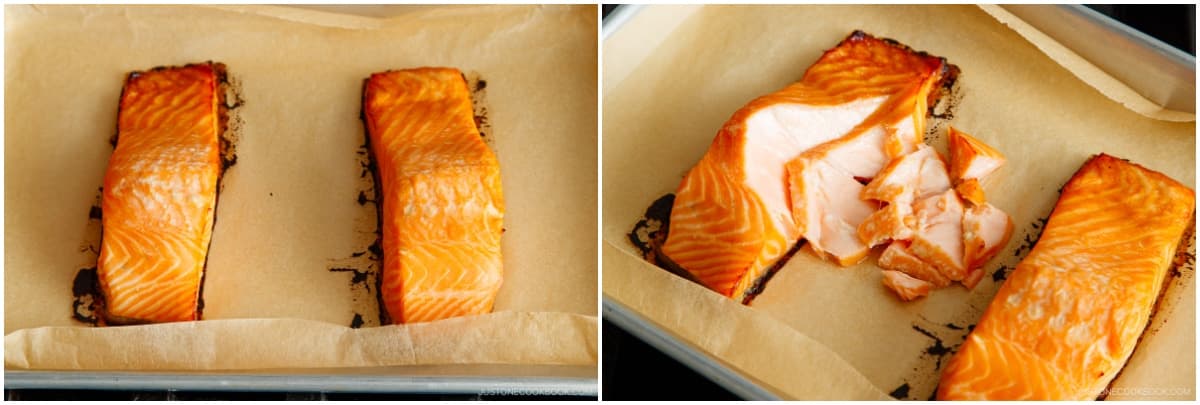
Image detailsRemove the salmon from the oven and check doneness by flaking the flesh—it’s ready if it flakes easily.Optional char: For a golden, slightly blistered finish, underbake the salmon a little, then remove the probe and switch to broil on High (550ºF/290ºC). Keep the rack in the center and broil for about 3 minutes, until the surface is browned. Remember, the salmon will continue to cook while broiling, so switch early to avoid overcooking.Just One Cookbook · Miso Salmon (Video) 味噌サーモンDev reference Visual cue
until the surface is browned.
Checks2
Visual cueInfoVisualuntil the surface is browned.
Expected state: until the surface is browned.
TimingInfoTimingabout 3 minutes
Target: 3 minute
Expected state: Keep the rack in the center and broil for about 3 minutes, until the surface is browned.
Why and source
This step has reviewed source-backed guidance.
- Source: Miso Salmon (Video) 味噌サーモン
Step 16
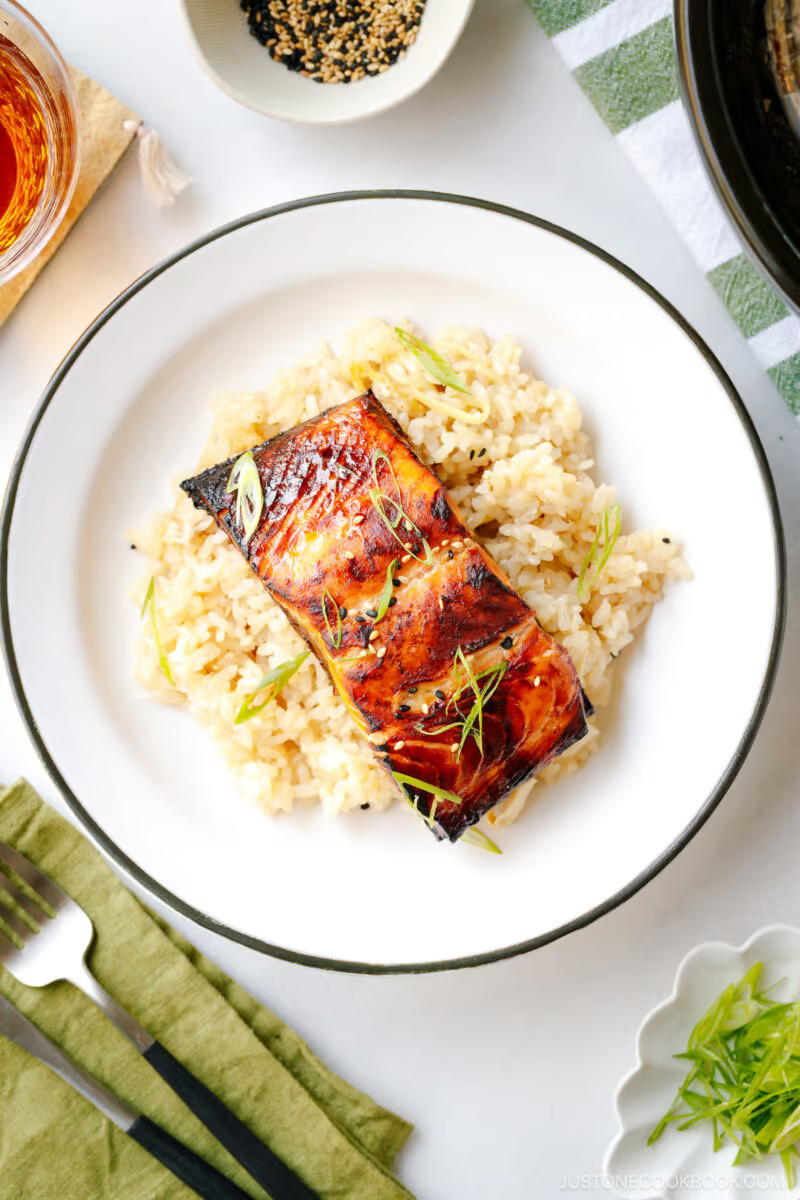
Top the salmon with ½ tsp toasted white and black sesame seeds and 1 green onion/scallion thinly sliced (both optional). I like to serve this salmon with Ginger Rice. Enjoy!
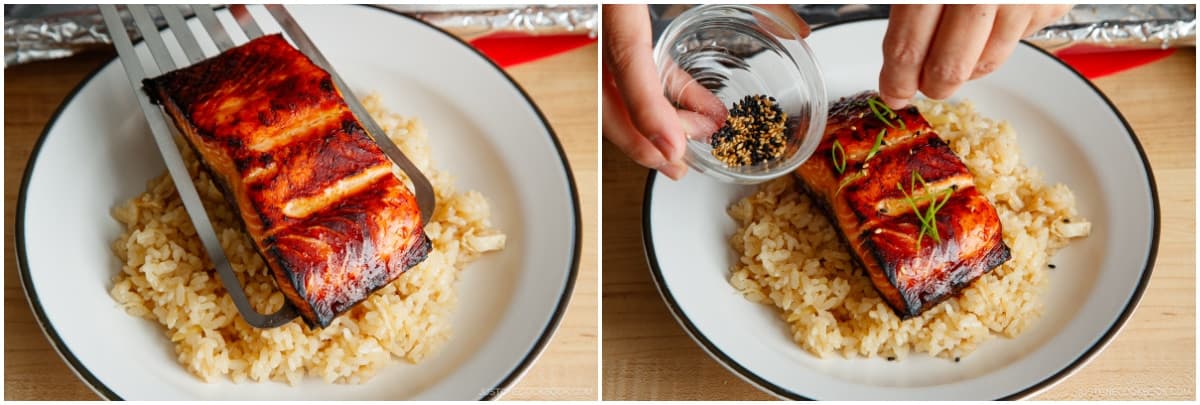
Image detailsTop the salmon with ½ tsp toasted white and black sesame seeds and 1 green onion/scallion thinly sliced (both optional). I like to serve this salmon with Ginger Rice. Enjoy!Just One Cookbook · Miso Salmon (Video) 味噌サーモンDev reference Checks1
ServiceMain recipeSource service instruction
Top the salmon with ½ tsp toasted white and black sesame seeds and 1 green onion/scallion thinly sliced (both optional). I like to serve this salmon with Ginger Rice. Enjoy!
Inputs and tools2
Uses
- ½ tsp toasted white and black sesame seeds
- 1 green onion/scallion ((chopped))
Why and source
This step has reviewed source-backed guidance.
- Source: Miso Salmon (Video) 味噌サーモン
Step 17
Optional glaze: I usually discard the marinade (which is why I keep it to a minimal amount). But if you’d like a glaze, dilute the marinade with a little water and simmer for a few minutes. Drizzle it over the salmon or save it for another dish.
Step 18
You can store the leftovers in an airtight container and store in the refrigerator for up to 3 days and in the freezer for a month.
Step 19
Got leftover miso salmon? Flake it into rice for Salmon Onigiri — a classic filling for Japanese rice balls and a great way to use up the rest of the fillet.
Handling and Storage
Reviewed hold, storage, make-ahead, and service-timing guidance.
Baking Method
Baking cooks food by circulating hot air evenly throughout the oven, usually generated from the bottom heating element.
You control the cooking by setting the oven temperature and placing the rack where you want the heat to reach most evenly. Pros and cons: Steady, gentler heat cooks food more slowly and thoroughly Ideal for even heating and cooking of thick cuts of fish Dry heat means the food’s surface can become a bit dry Best fish for baking: Fatty fish: Salmon (thick, fatty cuts), mackerel, swordfish Whole fish Thick and large fillets Lean, delicate fish like sole Useful Kitchen Tools The best method is to use a meat probe thermometer (that comes with your oven) or an instant-read thermometer, especially when the salmon fillets are very thick. With the right tool, you don’t need to guess if the salmon is cooked to the right temperature: It’s perfect every single time. A probe thermometer allows you to track the temperature of your chicken, turkey, salmon, etc., in the oven as they cook, so you don’t have to repeatedly open the oven door to test. An instant-read thermometer is a lot more versatile.

Useful Kitchen Tools
The best method is to use a meat probe thermometer (that comes with your oven) or an instant-read thermometer, especially when the salmon fillets are very thick.
With the right tool, you don’t need to guess if the salmon is cooked to the right temperature: It’s perfect every single time. A probe thermometer allows you to track the temperature of your chicken, turkey, salmon, etc., in the oven as they cook, so you don’t have to repeatedly open the oven door to test.

What to Serve with Miso Salmon
The rich flavor of miso-marinated salmon is lovely when matched with the aromatic ginger-infused rice.
Rice: Ginger Rice Soup: Kakitamajiru (Japanese Egg Drop Soup) Sides: Kinpira Gobo Salads: Spinach Gomaae (Japanese Spinach Salad) If you love the depth miso brings to this salmon, try it on chicken too — Spicy Miso Chicken uses a similar marinade with a spicy kick.

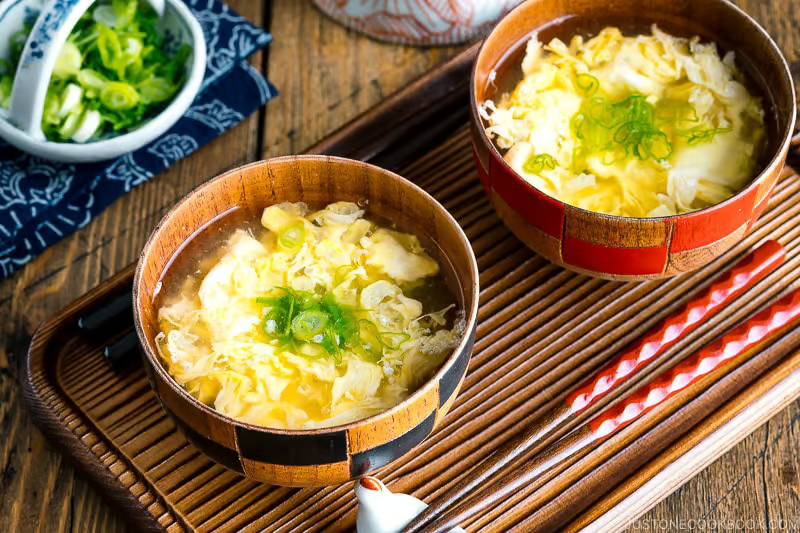
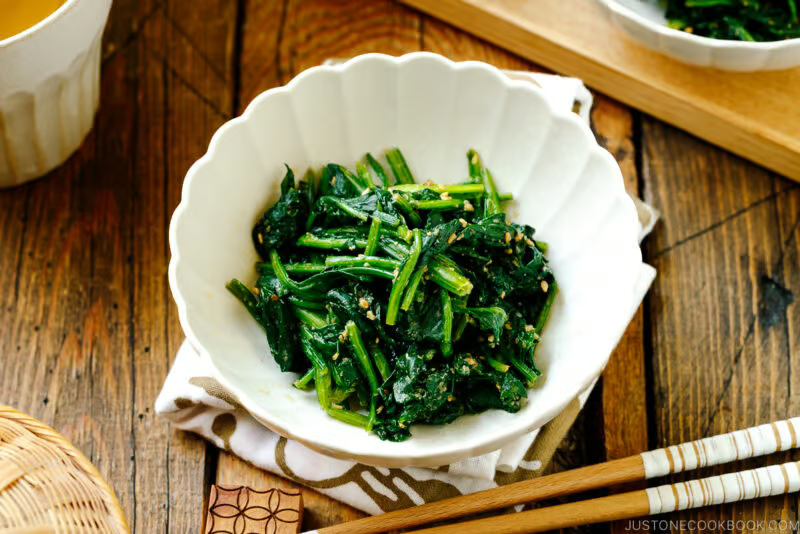
Show 1 more media item

Storage and Reheating Tips
To Store: Keep leftover miso salmon in an airtight container in the refrigerator for up to 3 days.
To Freeze: Place in an airtight container and freeze up to 1 month. Thaw overnight in the fridge before reheating. To Reheat: Cover with a moist paper towel and warm gently in the oven at 300ºF (150ºC) until heated through. Avoid the microwave—it can dry out the fish and make the texture rubbery.
Learn More
Extra cooking notes, tests, and source details kept out of the step-by-step method.
Why this works
Quick kitchen reasons behind the main choices.
Why I Love This Recipe
Simple and no fuss – Lightly marinate it and broil until tender and golden—it couldn’t be easier.
Quick – It takes just 1 hour to marinate the salmon fillet in a savory blend of five Japanese pantry staples that I always have on hand. Satisfying and nutritious – Salmon is full of protein and healthy fats that I like to serve my family.
Can I marinate the salmon overnight?
Miso is quite salty, so I don’t recommend marinating the salmon overnight, especially if the fillet is thin.
Also, to marinate the salmon evenly, I recommend cutting a one-pound salmon fillet into two to four pieces. I recommend at least one to two hours.
How do you know when salmon is done?
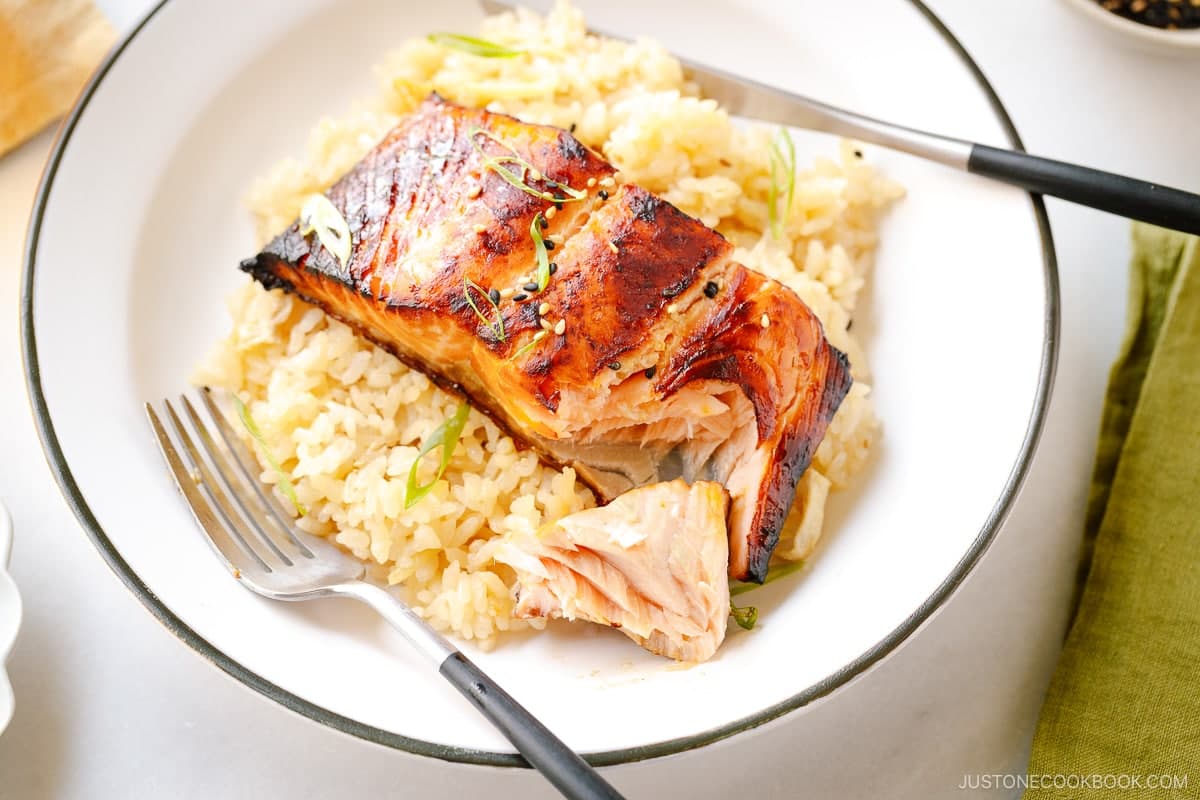
You can tell when salmon is cooked when its flesh turns translucent to opaque and flakes easily with a fork, chopsticks, or by pressing on the fish.If the fish looks dry, you’ve probably cooked it too long.
When salmon is overcooked, you may notice white protein (known as albumin) coming from the fish. While you can’t undo it, the salmon is still edible, albeit a little dry.
Is miso salmon gluten-free?
Yes, miso salmon is naturally gluten-free when made with gluten-free soy sauce or tamari (regular soy sauces contain wheat).
Double-check your miso paste label too, as some brands include barley. For more naturally GF dishes, see our 15 Gluten-Free Japanese Recipes collection.
Article photos
Photos used with the article notes.


Source: Miso Salmon (Video) 味噌サーモン
Recipe structure
Components and intermediate outputs created by the method.
Main recipe
Recipe card ingredients and steps.
2
Filling
Source step 19 creates or uses filling.
Marinade
Source step 4 creates or uses marinade.
Sauce
Source step 3 creates or uses sauce.
Recipe Utilities
Account actions, source details, export, and reporting stay available without interrupting the cooking flow.
Source and Origin
Origin declaration
Adapted from source
Imported from the just-one-cookbook page for dev review.
Copy risk: Unchecked
Miso Salmon (Video) 味噌サーモン
Article
View source
My Kitchen Actions
Login is required.
My Kitchen keeps saved recipes, private notes, adaptations, cooking logs, imports, and exports tied to your account.
Export
Public recipe exports include only approved public content. Personal backup exports require login.
Export history
No exports yet.