Homemade Miso Soup with Tofu
Stop making watery soup. Master authentic Miso Soup with my step-by-step video, 3 dashi methods, and tips on choosing the perfect miso paste.
Dish: Miso Soup With Tofu
Variant: Homemade Miso Soup with Tofu
Source: Homemade Miso Soup (Video) 味噌汁
- Total time
- 20 min
- Active time
- 5 min
- Yield
- 4
- Difficulty
- Medium
- Equipment
- 1 required

Ingredients and Constraints
Ingredients
Ingredient watchpoints1 watchpoint
Short requirements and tradeoffs to check while gathering ingredients; detailed source notes stay expandable.
Katsuobushi
1 cup katsuobushi (dried bonito flakes) ((packed; I used a loosely packed 3 cups in the video for stronger flavor))
The source row includes a form, size, temperature, preparation, or handling detail.
Details and source
Source: Homemade Miso Soup (Video) 味噌汁
Additional ingredient notes
Ingredients for Homemade Miso Soup
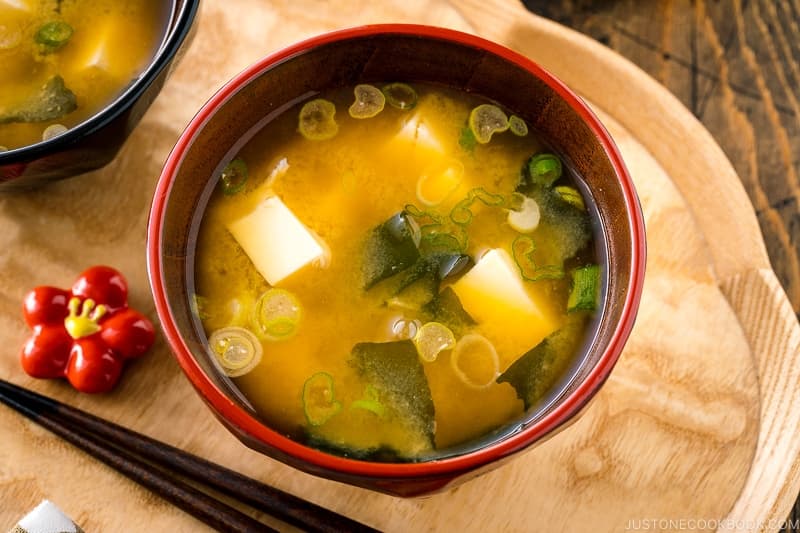
Let’s master the classic version with tofu and wakame seaweed.
The ingredients include: Dashi (Japanese soup stock) — The heart of authentic miso soup. We’ll dive into it below!


Required setup
Equipment
pot
Method Overview
Structured method notes that are separate from the step timeline.
5 Key Tips for Making the Best Miso Soup
You can make a big batch of dashi and store it in the refrigerator for 3–5 days for convenience.
Add miso right before serving for the best fragrance and taste! Bring dashi to a slow boil, then turn off the heat when adding miso.
How to Make Homemade Miso Soup
Making miso soup is easy when you break it down into three simple steps: Make dashi (Japanese soup stock) – 5 minutes (quick) or 20 minutes (homemade) Add miso – 2 minutes Add tofu and wakame, then serve – 3 minutes Once you’ve mastered thi
Types of Miso
There are many types of miso available, each with its own unique flavor.
In the U.S., grocery stores typically categorize miso by color: white miso (shiro miso) for a mild, slightly sweet taste, red miso (aka miso) for a deeper, bolder flavor, and yellow miso (awase miso or mixed miso) as a balanced option. Check out our detailed guide on miso!


Show 1 more media item

Adding Root Vegetables
Place them in cold dashi and cook until they become tender, approximately 10-15 minutes, depending on the vegetable’s density and cut sizes.


Source video
Source video
Method Timeline
Prep
ActivePrep
5 min
Prep time from the source recipe card.
Cook
ActiveCook
15 min
Cook time from the source recipe card.
Total
PassiveTotal
20 min
Total time from the source recipe card.
Step 1
Before we start... If you want to make miso soup in less than 10 minutes, follow my Easy Miso Soup recipe, using a dashi packet or powder. In this recipe, I make Awase Dashi from scratch with kombu and katsuobushi. For vegan/vegetarian, make the Kombu Dashi I showed below, or make Vegan Dashi with kombu and dried shiitake mushrooms.
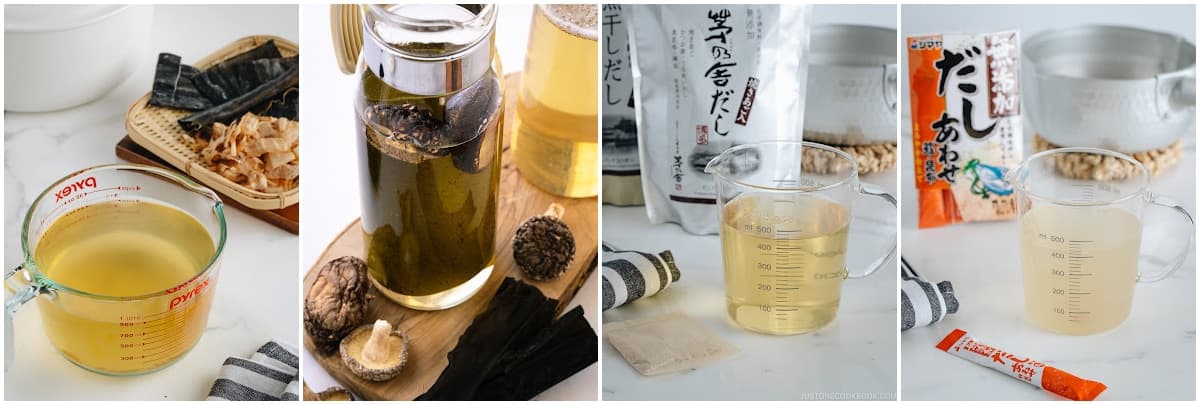
Image detailsBefore we start... If you want to make miso soup in less than 10 minutes, follow my Easy Miso Soup recipe, using a dashi packet or powder.In this recipe, I make Awase Dashi from scratch with kombu and katsuobushi.For vegan/vegetarian, make the Kombu Dashi I showed below, or make Vegan Dashi with kombu and dried shiitake mushrooms.Just One Cookbook · Homemade Miso Soup (Video) 味噌汁Dev reference Checks1
TimingInfoTiming10 minutes
Target: 10 minute
Expected state: If you want to make miso soup in less than 10 minutes, follow my Easy Miso Soup recipe, using a dashi packet or powder.
Inputs and tools3
Uses
- 1 piece kombu (dried kelp) ((⅓ oz, 10 g per piece; 4 x 4 inches or 10 x 10 cm))
- 1 cup katsuobushi (dried bonito flakes) ((packed; I used a loosely packed 3 cups in the video for stronger flavor))
- 4 Tbsp miso ((use 1 Tbsp, 18 g for every 1 cup, 240 ml of dashi))
Why and source
This step has reviewed source-backed guidance.
- Source: Homemade Miso Soup (Video) 味噌汁
Step 2
Gather all the ingredients.
Step 3
Cut 1 green onion/scallion into thin rounds.
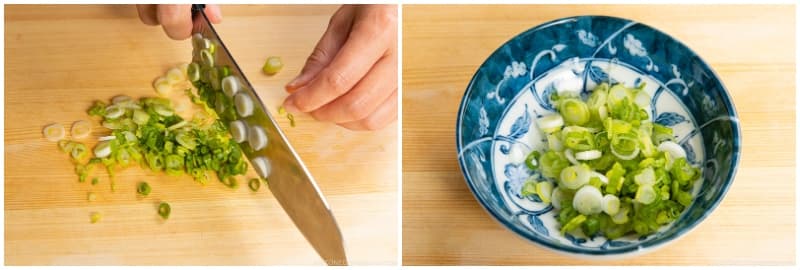
Image detailsCut 1 green onion/scallion into thin rounds.Just One Cookbook · Homemade Miso Soup (Video) 味噌汁Dev reference Inputs and tools1
Uses
- 1 green onion/scallion
Step 4
Add 4 cups water and 1 piece kombu (dried kelp) to a medium saucepan. If you have time, soak the kombu in water for 30 minutes. NEVER wash kombu and do not remove the white substance—that’s umami! These days, it‘s pretty clean, so just make sure there are no dirt particles.
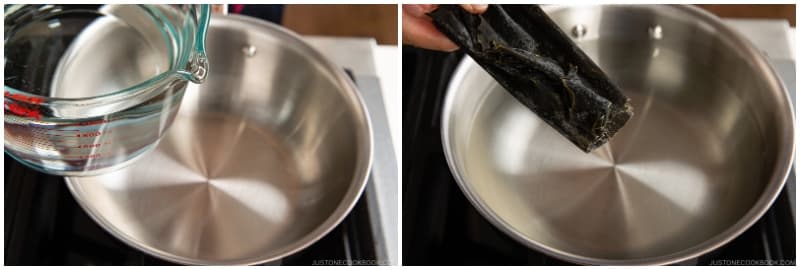
Image detailsAdd 4 cups water and 1 piece kombu (dried kelp) to a medium saucepan. If you have time, soak the kombu in water for 30 minutes. NEVER wash kombu and do not remove the white substance—that’s umami! These days, it‘s pretty clean, so just make sure there are no dirt particles.Just One Cookbook · Homemade Miso Soup (Video) 味噌汁Dev reference Checks1
TimingInfoTimingfor 30 minutes
Target: 30 minute
Expected state: If you have time, soak the kombu in water for 30 minutes.
Inputs and tools1
Uses
- 4 cups water
Why and source
This step has reviewed source-backed guidance.
- Source: Homemade Miso Soup (Video) 味噌汁
Step 5
SLOWLY bring it to a boil (about 10 minutes) on medium-low heat so you can extract as much umami from the kombu as possible. Right before the stock boils, remove the kombu and set it aside for another use. (If you leave the kombu, it gets slimy and yields a bitter taste.) Now, what you have is Kombu Dashi. If you’re vegetarian/vegan, use this kombu dashi for your miso soup.
low heat10 min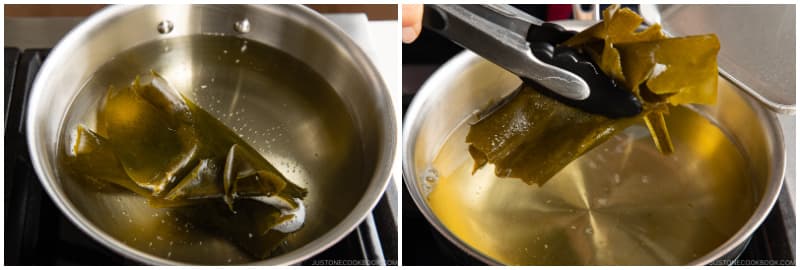
Image detailsSLOWLY bring it to a boil (about 10 minutes) on medium-low heat so you can extract as much umami from the kombu as possible. Right before the stock boils, remove the kombu and set it aside for another use. (If you leave the kombu, it gets slimy and yields a bitter taste.) Now, what you have is Kombu Dashi. If you’re vegetarian/vegan, use this kombu dashi for your miso soup.Just One Cookbook · Homemade Miso Soup (Video) 味噌汁Dev reference Checks1
TimingInfoTimingabout 10 minutes
Target: 10 minute
Expected state: SLOWLY bring it to a boil (about 10 minutes) on medium-low heat so you can extract as much umami from the kombu as possible.
Why and source
This step has reviewed source-backed guidance.
- Source: Homemade Miso Soup (Video) 味噌汁
Step 6
If you‘re not vegetarian/vegan, add 1 cup katsuobushi (dried bonito flakes) to the kombu dashi and bring it back to a boil again. Once the dashi is boiling, reduce the heat, simmer for just 30 seconds.
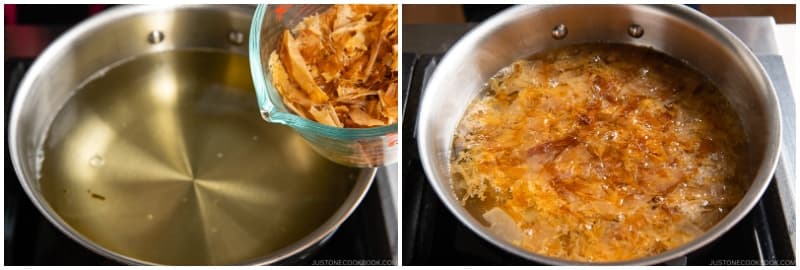
Image detailsIf you‘re not vegetarian/vegan, add 1 cup katsuobushi (dried bonito flakes) to the kombu dashi and bring it back to a boil again. Once the dashi is boiling, reduce the heat, simmer for just 30 seconds.Just One Cookbook · Homemade Miso Soup (Video) 味噌汁Dev reference Visual cue
Once the dashi is boiling, reduce the heat, simmer for just 30 seconds.
Checks2
Visual cueInfoVisualOnce the dashi is boiling, reduce the heat, simmer for just 30 seconds.
Expected state: Once the dashi is boiling, reduce the heat, simmer for just 30 seconds.
TimingInfoTiming30 seconds
Target: 1 minute
Expected state: Once the dashi is boiling, reduce the heat, simmer for just 30 seconds.
Why and source
This step has reviewed source-backed guidance.
- Source: Homemade Miso Soup (Video) 味噌汁
Step 7
Turn off the heat and let the katsuobushi sink to the bottom, about 10 minutes. Then, strain through a fine-mesh sieve.
10 min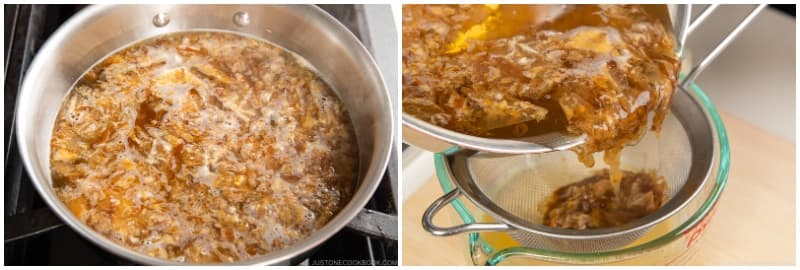
Image detailsTurn off the heat and let the katsuobushi sink to the bottom, about 10 minutes. Then, strain through a fine-mesh sieve.Just One Cookbook · Homemade Miso Soup (Video) 味噌汁Dev reference Checks1
TimingInfoTimingabout 10 minutes
Target: 10 minute
Expected state: Turn off the heat and let the katsuobushi sink to the bottom, about 10 minutes.
Why and source
This step has reviewed source-backed guidance.
- Source: Homemade Miso Soup (Video) 味噌汁
Step 8
Now you have roughly 4 cups of Awase Dashi. You can store the dashi in the refrigerator for up to 3–5 days and in the freezer for up to 2 weeks. Reserve the spent katsuobushi and repurpose it; see the suggested recipes that follow at the end of the instructions.
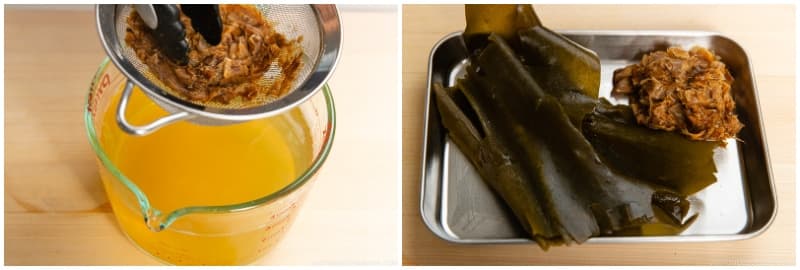
Image detailsNow you have roughly 4 cups of Awase Dashi. You can store the dashi in the refrigerator for up to 3–5 days and in the freezer for up to 2 weeks. Reserve the spent katsuobushi and repurpose it; see the suggested recipes that follow at the end of the instructions.Just One Cookbook · Homemade Miso Soup (Video) 味噌汁Dev reference Checks1
HoldingMain recipeSource holding instruction
Now you have roughly 4 cups of Awase Dashi. You can store the dashi in the refrigerator for up to 3–5 days and in the freezer for up to 2 weeks. Reserve the spent katsuobushi and repurpose it; see the suggested recipes that follow at the end of the instructions.
Why and source
This step has reviewed source-backed guidance.
- Source: Homemade Miso Soup (Video) 味噌汁
Step 9
Add the dashi to the saucepan. If you are using dashi from the refrigerator, bring it to a slow boil (205°F/96°C) over medium heat and turn off the heat.
medium heat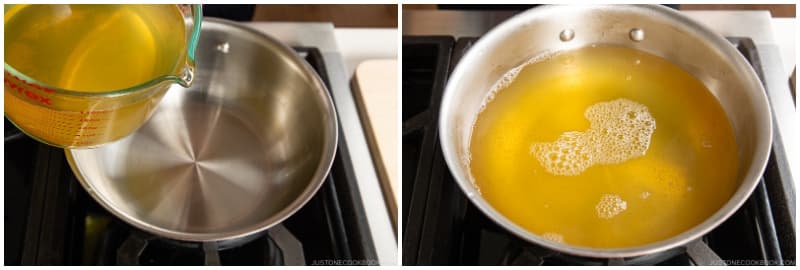
Image detailsAdd the dashi to the saucepan. If you are using dashi from the refrigerator, bring it to a slow boil (205°F/96°C) over medium heat and turn off the heat.Just One Cookbook · Homemade Miso Soup (Video) 味噌汁Dev reference Checks1
TemperatureInfoTemperature205°F
Target: 205 degree-fahrenheit
Expected state: If you are using dashi from the refrigerator, bring it to a slow boil (205°F/96°C) over medium heat and turn off the heat.
Why and source
This step has reviewed source-backed guidance.
- Source: Homemade Miso Soup (Video) 味噌汁
Step 10
Add 4 Tbsp miso. Put the miso in a ladle, slowly add the dashi into the ladle, and stir with chopsticks to dissolve completely. Here, I‘m using a miso muddler. If you accidentally add too much miso, dilute the miso soup with dashi (or water).
Step 11
Here, I‘m using a fine-mesh miso strainer, which helps you dissolve the miso faster. After dissolving the miso in the strainer, you may see rice koji (especially when it‘s koji miso). It‘s up to you if you want to include it in the miso soup or discard it (personal preference).
Step 12
Cut 7 oz soft/silken tofu (kinugoshi dofu) into ½-inch (1.3 cm) cubes and add to the miso soup. Tip: Add the tofu after the miso is completely dissolved; otherwise, you might break the tofu when stirring in the miso. Note: It is very common to cut tofu on your palm in Japan. However, I recommend using a cutting board if you have never done this.
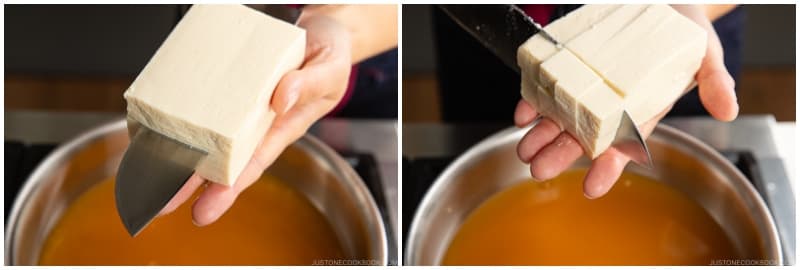
Image detailsCut 7 oz soft/silken tofu (kinugoshi dofu) into ½-inch (1.3 cm) cubes and add to the miso soup. Tip: Add the tofu after the miso is completely dissolved; otherwise, you might break the tofu when stirring in the miso. Note: It is very common to cut tofu on your palm in Japan. However, I recommend using a cutting board if you have never done this.Just One Cookbook · Homemade Miso Soup (Video) 味噌汁Dev reference Inputs and tools1
Uses
- 7 oz soft/silken tofu (kinugoshi dofu)
Step 13
Add 1 Tbsp dried wakame seaweed and the chopped green onions to the pot right before serving to keep their fresh fragrance and color. Tip: If you worry about salt intake, I recommend rehydrating the dried wakame in a separate bowl of water to get rid of the saltiness, instead of rehydrating it in the soup itself. If reheating, warm up the miso soup until it is just hot. NEVER BOIL miso soup because it loses flavor and aroma.
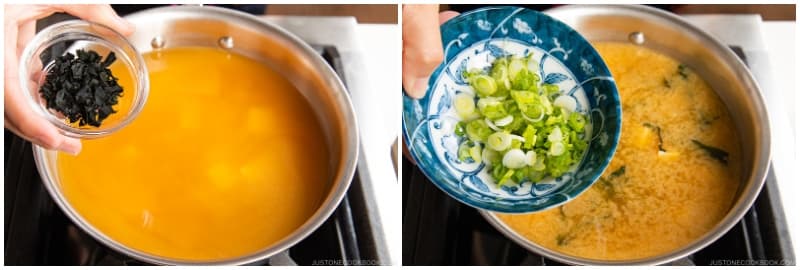
Image detailsAdd 1 Tbsp dried wakame seaweed and the chopped green onions to the pot right before serving to keep their fresh fragrance and color. Tip: If you worry about salt intake, I recommend rehydrating the dried wakame in a separate bowl of water to get rid of the saltiness, instead of rehydrating it in the soup itself. If reheating, warm up the miso soup until it is just hot. NEVER BOIL miso soup because it loses flavor and aroma.Just One Cookbook · Homemade Miso Soup (Video) 味噌汁Dev reference Visual cue
until it is just hot.
Checks2
Visual cueInfoVisualuntil it is just hot.
Expected state: until it is just hot.
ServiceMain recipeSource service instruction
Add 1 Tbsp dried wakame seaweed and the chopped green onions to the pot right before serving to keep their fresh fragrance and color. Tip: If you worry about salt intake, I recommend rehydrating the dried wakame in a separate bowl of water to get rid of the saltiness, instead of rehydrating it in the soup itself. If reheating, warm up the miso soup until it is just hot. NEVER BOIL miso soup because it loses flavor and aroma.
Inputs and tools1
Uses
- 1 Tbsp dried wakame seaweed
Why and source
This step has reviewed source-backed guidance.
- Source: Homemade Miso Soup (Video) 味噌汁
Step 14
Serve immediately. Place on the right side of the table setting; you can read about this in my post Ichiju Sansai (One Soup Three Dishes).

Image detailsServe immediately. Place on the right side of the table setting; you can read about this in my post Ichiju Sansai (One Soup Three Dishes).Just One Cookbook · Homemade Miso Soup (Video) 味噌汁Dev reference Checks1
ServiceMain recipeSource service instruction
Serve immediately. Place on the right side of the table setting; you can read about this in my post Ichiju Sansai (One Soup Three Dishes).
Why and source
This step has reviewed source-backed guidance.
- Source: Homemade Miso Soup (Video) 味噌汁
Step 15
In general, it‘s best to consume all the miso soup right away because it will lose its aroma and taste as time passes. Let your miso soup cool to room temperature (up to 4 hours; any longer and it will spoil) and then refrigerate. Keep for up to 2 days in the refrigerator. If you want to make a big batch to store for later, it‘s best to refrigerate the soup without adding the miso. When ready to use, add the miso only for the portion you need. You can freeze miso soup for up to 2 weeks. However, you have to remove the tofu before freezing as the texture will change.
Step 16
Heat the miso soup in a pot over medium heat, but do not boil. Miso loses its nutrients, flavor, and aroma at high temperatures.
medium heatPotStep 17
Save the spent kombu and katsuobushi in an airtight container and store it in the refrigerator for a week or in the freezer for up to a month.
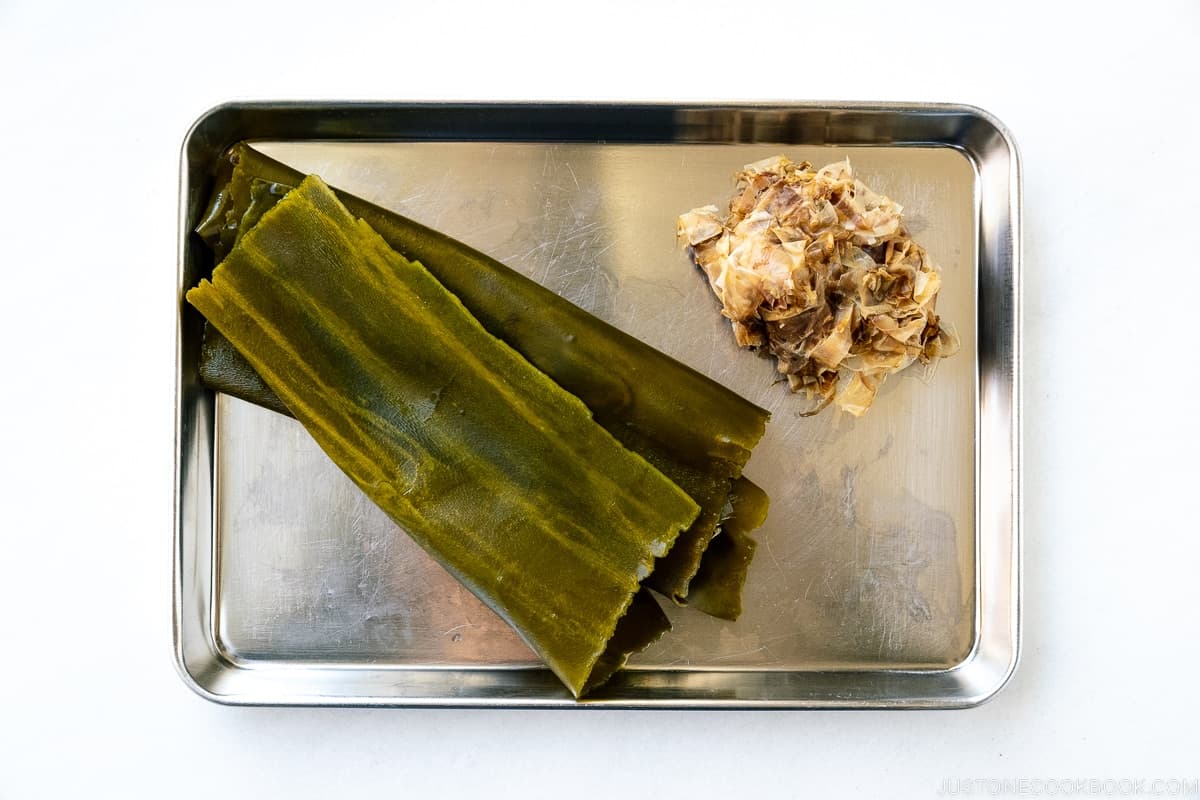
Image detailsSave the spent kombu and katsuobushi in an airtight container and store it in the refrigerator for a week or in the freezer for up to a month.Just One Cookbook · Homemade Miso Soup (Video) 味噌汁Dev reference Checks1
HoldingMain recipeSource holding instruction
Save the spent kombu and katsuobushi in an airtight container and store it in the refrigerator for a week or in the freezer for up to a month.
Why and source
This step has reviewed source-backed guidance.
- Source: Homemade Miso Soup (Video) 味噌汁
Step 18
With the spent kombu, you can make Simmered Kombu (Kombu Tsukudani).
Step 19
You can also make Homemade Furikake (Rice Seasoning).
Handling and Storage
Reviewed hold, storage, make-ahead, and service-timing guidance.
What is Miso Soup?
Miso soup (味噌汁, miso shiru) is a traditional Japanese soup made from a miso paste mixed into dashi (Japanese soup stock).
It often includes ingredients like tofu, seaweed, green onions, and vegetables, with variations depending on the region and season. A staple in Japanese cuisine, miso soup is enjoyed as a side dish with meals, offering a comforting umami flavor and numerous health benefits.
3 Ways to Make Dashi
Each method has its balance of flavor and convenience.
Homemade dashi (20 mins | best flavor & quality) — To make Awase Dashi, soak kombu in cold water, heat it just below boiling, then add bonito flakes and let it steep briefly before straining. For Kombu Dashi or Vegan Dashi, a cold brew method works best—soak the kombu in the water ahead of time for a naturally deep flavor before steeping briefly.

Step 3: Add Tofu to the Soup
To avoid breaking the tofu, always add it after dissolving the miso paste.
This helps keep the tofu intact and ensures a smoother texture in your soup. Since tofu doesn’t require cooking, you just need to warm it up.


Reheating Tips
If your miso soup cools down, gently reheat it to a simmer (around 190°F/88°C), but never let it boil.
Boiling diminishes its delicate flavor and aroma. When reheating leftover miso soup, stir in about 1 tablespoon (18 g) of miso to refresh its aroma.


Storage Tips
While it’s best to enjoy miso soup right away for the freshest taste and aroma, leftovers can be stored with a few precautions: Let miso soup cool to room temperature (within 4 hours; longer could cause spoilage) before refrigerating.
You can store it in the refrigerator for up to 3–4 days. Miso soup can also be frozen for up to 2 weeks, but remove tofu before freezing, as its texture will change upon reheating.
Adding Leafy Vegetables or Mushrooms
Add them to simmering dashi (with or without other cooked ingredients) and cook for a few minutes.
For miso soup with seasonal ingredients, check out my Just One Cookbook Miso Soup Recipes. Curious about how to store miso?


Learn More
Extra cooking notes, tests, and source details kept out of the step-by-step method.
Why this works
Quick kitchen reasons behind the main choices.
5 Types of Dashi
I recommend starting with the most common dashi, Awase Dashi (#1) or Vegan Dashi (#6)!
Awase Dashi — Made with kombu (dried kelp) and katsuobushi (dried bonito flakes) Kombu Dashi — Made with kombu; plant-based, subtle flavor Katsuo Dashi — Made with katsuobushi; strong flavor Iriko Dashi — Made with dried anchovies; strong flavor Shiitake Dashi — Made with dried shiitake mushrooms; plant-based; strong flavor Vegan Dashi — Made with kombu and dried shiitake mushrooms; plant-based.
Article photos
Photos used with the article notes.



Source: Homemade Miso Soup (Video) 味噌汁
Recipe structure
Components and intermediate outputs created by the method.
Main recipe
Recipe card ingredients and steps.
4
Recipe Utilities
Account actions, source details, export, and reporting stay available without interrupting the cooking flow.
Source and Origin
Origin declaration
Adapted from source
Imported from the just-one-cookbook page for dev review.
Copy risk: Unchecked
Homemade Miso Soup (Video) 味噌汁
Article
View source
My Kitchen Actions
Login is required.
My Kitchen keeps saved recipes, private notes, adaptations, cooking logs, imports, and exports tied to your account.
Export
Public recipe exports include only approved public content. Personal backup exports require login.
Export history
No exports yet.